Artemis II Astronauts Splash Down Safely After Moon Mission
Artemis II Astronauts Are Home Safe
 Why You Can Trust CNET
Our expert, award-winning staff selects the products we cover and rigorously researches and tests our top picks. If you buy through our links, we may get a commission. Reviews ethics statement
Artemis II Astronauts Splash Down Safely After Moon Mission
Astronauts Reid Wiseman, Victor Glover, Christina Koch and Jeremy Hansen returned to Earth on Friday. Here's everything that happened.


Katelyn Chedraoui


David Lumb


Jon Reed


Jon Skillings


Gael Cooper


Lori Grunin


Patrick Holland


Corinne Reichert


Jeff Carlson
The Artemis II crew – (from left) mission specialists Christina Koch and Jeremy Hansen, pilot Victor Glover and commander Reid Wiseman – pause for a group photo inside the Orion spacecraft on their way home.
NASAThe Artemis II crew is back home on Earth. They've accomplished incredible feats since leaving Earth on April 1. They beat Apollo 13's record for the farthest ever space travel; they took some gorgeous photography during their lunar flyby; and they proposed two new crater names, one of which honors commander Reid Wiseman's late wife, Carroll.
Artemis II is a historic mission for NASA. The team of American and Canadian astronauts departed Earth in a 332-foot-tall rocket to do something that humanity hasn't done in more than 50 years: travel to the moon.
The crew is Wiseman, pilot Victor Glover, and mission specialists Jeremy Hansen and Christina Koch. It's also a team of many lunar firsts: Glover is the first Black person to be sent to the moon, Hansen is the first Canadian and Koch is the first woman. In a press conference, the crew got personal about what the mission has meant to them, their families and the international community.
"Part of our ethos as a crew and our values from the very beginning were that this is a relay race," said Koch. "In fact, we have batons that we bought to symbolize, physically, that. We plan to hand them to the next crew. And every single thing we do is with them in mind."
Artemis II helps set the stage for future missions to the moon, deep space and Mars. Here's everything you need to know about the mission back to the moon.
When did Artemis II return to Earth?
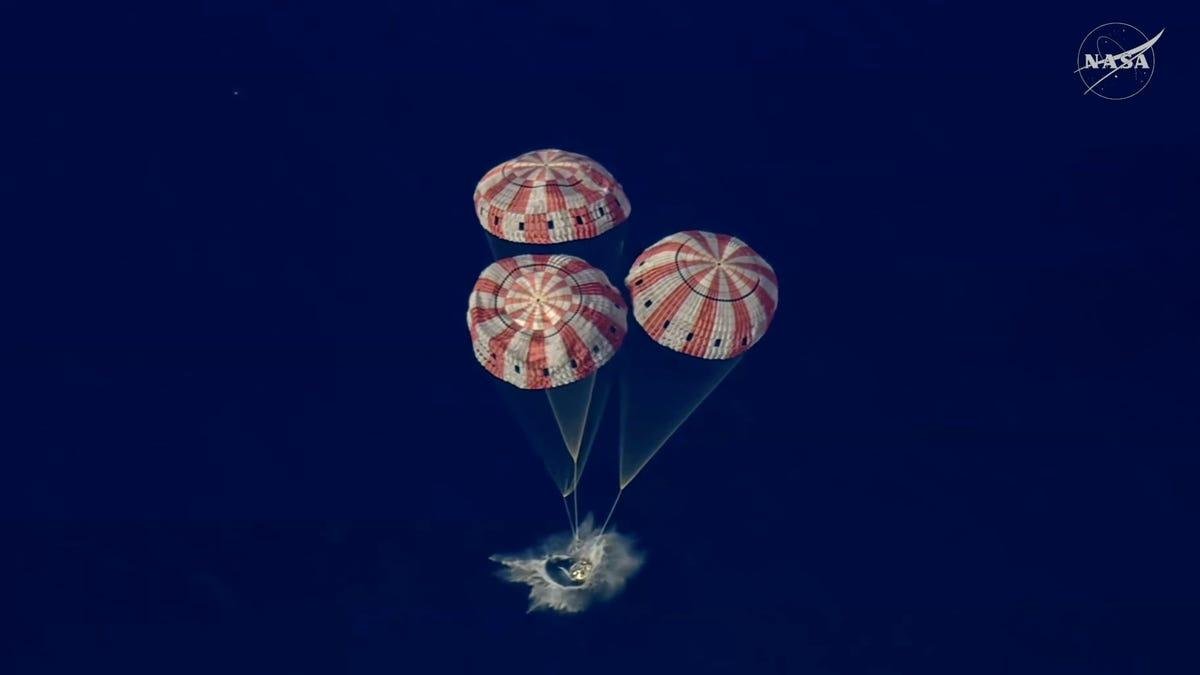
The Orion and its crew splashed down in the Pacific Ocean west of San Diego, California, right on time on Friday, April 10, at 5:07 p.m. PT (8:07 p.m. ET, 1:07 a.m. BST, 10 a.m. AEST).
Watch Artemis II's splashdown on Earth
If you missed it, go to NASA's YouTube channel to watch archived coverage of Orion's splashdown.
What happened on the Artemis II moon mission?
The Artemis II astronauts didn't touch down on the moon's surface this trip, but they tested the system's life support systems for the first time. Artemis II could be considered this generation's version of Apollo 8. The mission sets the stage for future Artemis missions, including Artemis IV, scheduled for 2028, which is planned to put humans back on the moon.
The Integrity crew exit their helicopters
By Patrick Holland
Mission Specialist Christina Koch (center) walks across the flight deck.
NASA/Screenshot by CNETThe Integrity astronauts walked across the flight deck of the USS John P. Murtha after exiting the helicopters that had airlifted them from the Pacific Ocean. Their next stop is the ship's medical bay for a checkup after their 10 days in space.
Artemis II astronauts are on the USS John P. Murtha
By Patrick Holland
Pilot Victor Glover and Mission Specialist Christina Koch (obscured) sitting in the door of a helicopter.
NASA/Screenshot by CNETAll four Artmeis II astronauts are safe and sound after a splashdown landing in the Pacific Ocean. The crew was airlifted from a raft to the USS John P. Murtha.
Earthlings welcome Artemis crew home with social media posts
By Gael Cooper
The four Artemis II astronauts are back on Earth, and if social media is any indication, their fellow planet dwellers are thrilled.
"Watched splashdown with my son and for a very brief moment had hope for humanity," wrote Jer Thorp on BlueSky.
An X user shared the classic shot of Finding Nemo's escaped Tank Gang bobbing in little plastic bags, labeling it, "Our good friends in space waiting to be picked up after splashdown."
For some reason, many Earth cats seemed to enjoy watching the watery splashdown.
"Nicky watched the Artemis II #splashdown," wrote Mary Jo Richards on Bluesky, including a photo of her cat intently following the TV coverage. "She watched it so closely, in fact, that I didn't get to see the actual contact with water. Thanks, Nicky."
Welcome home, Artemis II!@NASA | #LGM pic.twitter.com/vrpGWj6GHH
— New York Mets (@Mets) April 11, 2026
Famous folks watched as well. The New York Mets shared a video of fans applauding the splashdown airing on the giant video display at Citi Field.
And Apple CEO Tim Cook congratulated the crew on X -- noting that an Apple product was along for the ride, and neatly shoehorning a company slogan, "think different," into his post.
"Congratulations to Artemis II on a successful mission!" Cook wrote. "You captured the wonders of space and our planet beautifully, taking iPhone photography to new heights, and we're grateful you shared it with the world. Your work continues to inspire us all to think different. Welcome home!"
Artemis II astronauts airlifted out of Pacific
By Patrick Holland
The Artemis II astronauts are being airlifted one at a time from a raft called the front porch.
All four astronauts are on the 'front porch' raft
By Patrick Holland
The four people in the image above wearing orange flight suits in the raft, are the Artemis II astronauts. The entire crew is officially out of the Integrity for the first time since Wednesday, April. 1.
The astronauts exiting the Integrity
By Patrick Holland
Two of the four Artemis II astronauts on the front porch raft.
NASA/Screenshot by CNETThe Artemis II astronauts are exiting the Integrity capsule. The US Navy and a recovery team are extracting the crew from the vehicle and helping them onto a special raft called the front porch. From here, each astronaut will be airlifted to a helicopter.
Integrity's 'front porch' inflated for the astronauts
By Patrick Holland
A raft connected to the Integrity, called the front porch, has been inflated. US Navy divers erected the front porch, which allows the Artemis II astronauts to acclimate to Earth's gravity and the open ocean.
Integrity's side hatch is open
By Patrick Holland
For the first time in over nine days, the Integrity capsule's side hatch is open. US Navy divers are entering the cabin to access each Artemis II astronaut before having them exit the capsule.
Back on Earth...phone troubles
By Jeff Carlson
Integrity bobs in the water while the crew attempts to communicate with the recovery teams.
Screenshot by Jeff Carlson/CNETAfter traveling beyond the far side of the moon, sharing live video over direct laser communications to Earth, one of the first things the crew of Integrity experienced after splashdown was... phone troubles. "No joy on SAR radio or Sat phone," said one of the crew members when coordinating with the recovery teams.
"For SAT phone, we are going to attempt to call you," said Mission Control while the crew explained they were rebooting comms by holding down a sequence of buttons.
Welcome back to the Earth that most of us deal with every day!
Integrity has been powered down for its recovery
By Patrick Holland
Integrity is powered down to prepare for recovery in the Pacific Ocean.
Artemis II splashdown confirmed at 8:07 p.m. EDT
By Patrick Holland
The Integrity capsule has splashed down in the Pacific Ocean.
Integrity's parachutes are open
By Patrick Holland
The Integrity capsule's parachutes are open, and will slow the craft to around 19 mph and eventually to zero as it lands in the Pacific Ocean.
Integrity and Mission Control are back in contact
By Patrick Holland
Cheers erupt in the Mission Control room as communications resume with Integrity.
NASA visualization of Integrity during blackout
By Patrick Holland
Here is a visualization NASA shared of the Integrity capsule reentering the Earth's atmosphere and the plasma forming around the capsule.
Integrity enters a 6-minute communications blackout
By Patrick Holland
Integrity entering the Earth's atmosphere.
NASA/Screenshot by CNETAs planned, the Integrity capsule has entered its 6-minute communications blackout after entering the Earth's atmosphere. During this time, there is no communication or data coming from the capsule.
The Integrity capsule separates from the service module
By Patrick Holland
The Integrity capsule has separated from the European Service Module.
NASA/Screenshot by CNETIn another significant step toward splashdown, the Orion capsule has separated from the service module.
Listen for the sonic boom
By Gael Cooper
If you're in Southern California and close enough to the splashdown, you might actually hear a sonic boom as the spacecraft re-enters Earth's atmosphere.
"The sonic boom is expected at ~5-5:15 pm Pacific time today, April 10," the U.S. Geological Survey said on social media.
If you do hear it, the USGS wants to know.
"Share your experience using our Did You Feel It survey so we can understand the spatial extent of the boom," the agency said on X.
Astronauts will take anti-nausea medication
By Corinne Reichert
The astronauts on the Artemis II mission will be taking anti-nausea medication to cope with the speeds of their rapid descent back to Earth, which should hit a peak of around 24,661.21 miles per hour at 7:53 p.m. ET / 4:54 p.m. PT.
For their transition back to 1G -- the gravity on Earth -- they're also taking anti-inflammatory medicine. This will be the first time since 1972 that astronauts are landing in water, and with a landing in the choppy Pacific Ocean (a few miles off the coast of San Diego), the anti-nausea medication will also help with the new surface.
The crew will all receive full medicals right after splashdown.
Integrity is 14,000 nautical miles away
By Corinne Reichert
The Integrity shuttle is now just 14,000 nautical miles from Earth, with splashdown happening in less than two hours. Earth appears as a half circle on the livestream and still looks very far away.
The next big event will be separation from the service module, which will be ejected at 7:30 p.m. ET (4:30 p.m. PT), ahead of reentry at 7:57 p.m. ET (4:57 p.m. PT).
Watch the Artemis II splashdown on Netflix, Apple TV, Amazon Prime and more
By Patrick Holland
Artemis II reentry speed could be the second fastest ever
By Patrick Holland
This image of NASA's Orion spacecraft was taken with a camera mounted on its solar array wings.
NASANASA's Flight Dynamics team anticipates that the Orion capsule will reach a peak speed of 24,661.21 mph (around Mach 33) at 7:54 p.m. ET. The actual speed will be confirmed after reentry, but if the estimate is correct, it would mean that Artemis II would fall 130 mph short of the record set in 1969 by the Apollo 10 crew's return.
The Orion looks stunning with Earth in the background
By Patrick Holland
This is a still grabbed from NASA's live feed of a camera on the Orion spacecraft at 12:45 p.m. PT.
NASA/Screenshot by CNETWe are getting to see some truly stunning views as the Orion spacecraft gets closer to Earth. The Artemis II's splashdown is expected to be at 5:07 p.m. PT (8:07 p.m. ET).
Artemis II astronauts are less than 35,000 miles from Earth
By Patrick Holland
NASA just posted on X that the Orion spacecraft is under 35,000 miles from Earth. The post notes that the weather looks good for splashdown.
— NASA (@NASA) April 10, 2026Fist bump! 👊
The Artemis II crew is now under 35,000 miles from Earth. The astronauts are preparing the spacecraft for reentry and the weather is looking good for splashdown. pic.twitter.com/jYNlo0xoNu
Orion takes a selfie with the Artemis II crew
By Patrick Holland
Enlarge Image
Mission Specialist Christina Koch (center) and Commander Reid Wiseman (top) are seen through windows of the Orion spacecraft while on their way to the moon.
NASAWhat do you do if you're in a spacecraft on a 10-day mission to the moon and back? You take a selfie (or it didn't happen). NASA shared several images from a camera on the Orion's solar array wing, showing the Artemis II crew through the capsule's windows. You gotta look closely, but they're there. And it's so delightful when you find them.
Mission Specialist Jeremy Hansen in a window of the Orion spacecraft.
NASAMission Specialist Christina Koch, holding "Rise," the zero gravity indicator, in one of the Orion's windows.
NASAThe many times Apple products left Earth
By Katelyn Chedraoui
We've talked a lot this week about the beautiful photos the Artemis II crew captured on the newest iPhones, but did you know this is not the first time Apple products have been used in outer space?
Apple products have long been relied on by astronauts and NASA -- the first email sent from space was sent on a Mac. Space technology isn't just rocket science; it's the devices, software and accessories that many of us use down here on Earth.
CNET's Apple expert Bridget Carey walks us through the long history of Apple products used in space flight. You can watch the video above and on CNET's YouTube channel.
It's splashdown day
By Jon Skillings
The Orion capsule will travel on a northeasterly route from its reentry point over the Pacific Ocean to a landing area in the water near San Diego, California.
NASAToday, the Artemis II astronauts come home. They will be splashing down just off the coast of California near San Diego at around 5:07 p.m. PT (8:07 p.m. ET) after reentering the atmosphere 2,000 miles out over the Pacific Ocean southeast of Hawaii. Here's the sequence of events that NASA has laid out:
At around 4:33 p.m. PT, the Orion capsule will separate from its service module, and 4 minutes later will make a final trajectory adjustment, followed by "a series of roll maneuvers" to get away from the jettisoned equipment. Just before reentering the atmosphere, it will reach its maximum velocity of approximately 23,864 mph.
Sponsorluk
Sponsorluk
Sponsorluk
Sponsorluk
Reklam
Kategoriler
Read More
Clive Davis, music mogul behind Whitney Houston and Bruce Springsteen, dies aged 9418 minutes agoMark SavageMusic correspondentPA MediaClive Davis is one of the few music industry executives who became a well-known figure outside the boardroomClive Davis, one of the most influential music executives in the history of rock and pop, has died at the age of 94.A former head of Colombia and Arista...

Thousands of U.S. troops deploy to Middle East. And, the latest on DHS funding talks 82nd Airborne Deployment, Israel Threatens Lebanon Invasion, DHS Funding Negotiations Good morning. You're reading the Up First newsletter. Subscribe here to get it delivered to your inbox, and listen to the Up First podcast for all the news you need to...

The global Engine Oil Filters Market is expected to witness stable growth over the next decade as increasing vehicle ownership, aging automotive fleets, and rising awareness regarding preventive engine maintenance continue to support replacement demand. According to FactMR, the market is projected to grow from USD 9.2 billion in 2026 to USD 12.6 billion by 2036,...

Gazan mother reunited with evacuated daughter after two yearsLucy WilliamsonBBC Middle East correspondent, JerusalemBBCSundus al-Kurd and her daughter Bisan had been separated for more than two yearsAt least eight children who were evacuated from Gaza as premature babies in the early weeks of the war, have returned from Egypt and been reunited with their relatives.The hospital complex had...

Say goodbye to renting software and take control of your productivity with a new offer on Microsoft Office. For just $90, you can purchase a lifetime license for Microsoft Office 2024 Home and Business, which is compatible with both Mac and PC. This mea
This Microsoft Office package includes powerful tools that can transform how you handle tasks, whether it's creating documents, managing spreadsheets, or setting up presentations. By investing in this one-time purchase, you ensure that you have access to these vital applications whenever you need them, without the hassle of ongoing costs. It's a smart choice for anyone looking to enhance their...