Inertia moves to commercialize one of the world’s most elaborate science experiments
Inertia moves to commercialize one of the world’s most elaborate science experiments
Fusion power startup Inertia Enterprises said on Tuesday that it has signed three agreements with the Lawrence Livermore National Laboratory (LLNL) to help bring the laser-based fusion reactor pioneered at the Californian lab to market.
The deals could give Inertia a boost over rival startups. The National Ignition Facility (NIF) at LLNL is so far the only experiment to prove that controlled fusion reactions could produce more power than they require to ignite. Inertia burst onto the scene in February with a $450 million Series A, making it one of the best capitalized startups in the industry.
Inertia and LLNL are working on a type of fusion called inertial confinement, which generates fusion conditions by compressing a fuel pellet using some external force, unlike other approaches that use powerful magnetic fields to confine plasmas until atoms fuse.
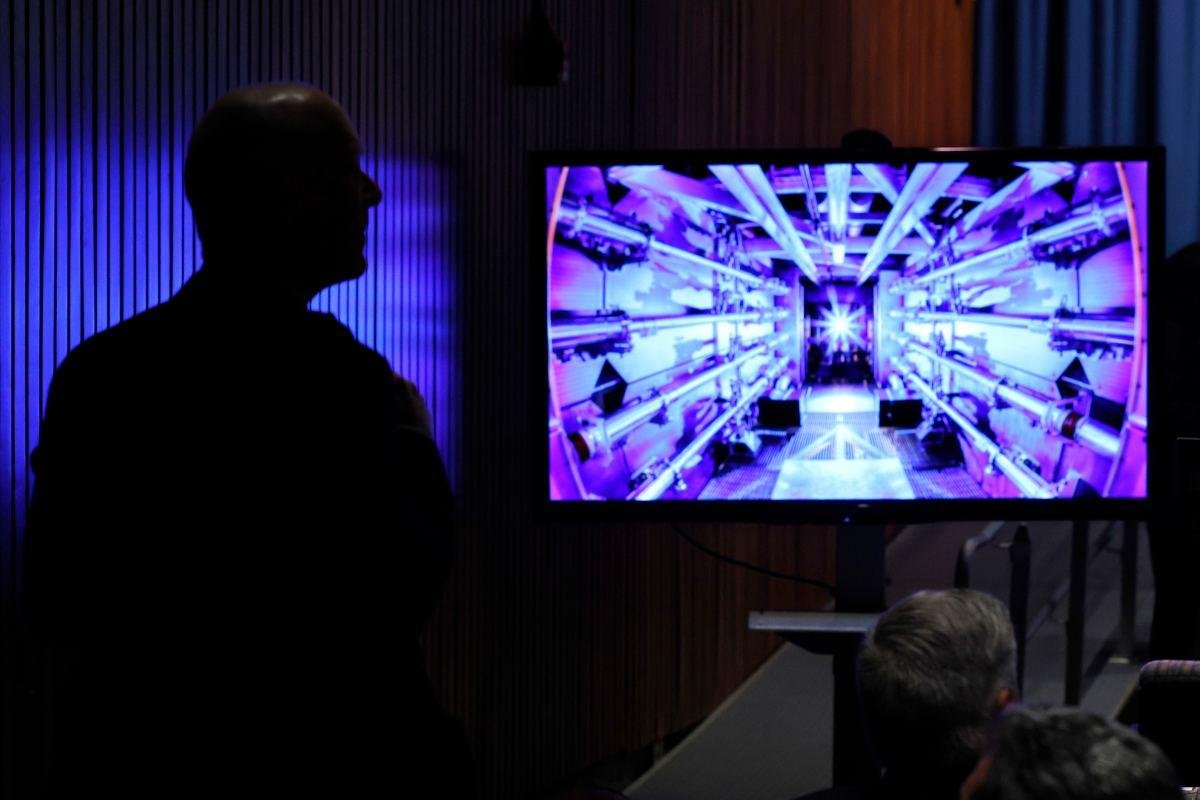
At the NIF, 192 laser beams are fired into a large vacuum chamber so that they converge on a small gold cylinder called a hohlraum, which contains a diamond-coated fuel pellet. When the lasers hit the hohlraum, it gets vaporized and emits X-Rays that blast the BB-sized fuel pellet inside. The diamond coating is transformed into a plasma, which expands to compress the deuterium-tritium fuel.
If that doesn’t sound exotic enough, keep in mind that all of this needs to happen several times per second if the technology is ever going to produce power for the grid.
The laser-driven reactor design was first theorized in the 1960s as a safer way to research thermonuclear weapons, though scientists also recognized its potential for power production. Construction on the NIF began in 1997, and it took 25 years to reach the breakeven point where a fusion reaction released more power than needed to kick it off.
Several startups, including Inertia, Xcimer, Focused Energy and First Light, are attempting to turn the concept into commercial-scale power plants. Because NIF’s lasers are based on old technology, the hope is that new lasers will be more efficient, lowering the energy required to ignite each fusion reaction and so make it easier for each reaction to release enough energy to make a commercial-scale power plant profitable.
Techcrunch event
San Francisco, CA | October 13-15, 2026
The agreements between Inertia and LLNL cover two strategic partnership projects, and one cooperative research and development agreement. The organizations say they will work together to develop more advanced lasers and improve the fuel targets with an eye toward better performance and manufacturing. Inertia is also licensing almost 200 patents from the lab.
It was perhaps inevitable that Inertia and LLNL would continue to work together. Annie Kritcher, the co-founder and chief scientist of Inertia, helped design the successful experiment at NIF that achieved scientific breakeven. The 2022 CHIPS and Science Act paved the way for her to found a company while retaining her position at LLNL.
Tim De Chant is a senior climate reporter at TechCrunch. He has written for a wide range of publications, including Wired magazine, the Chicago Tribune, Ars Technica, The Wire China, and NOVA Next, where he was founding editor.
De Chant is also a lecturer in MIT’s Graduate Program in Science Writing, and he was awarded a Knight Science Journalism Fellowship at MIT in 2018, during which time he studied climate technologies and explored new business models for journalism. He received his PhD in environmental science, policy, and management from the University of California, Berkeley, and his BA degree in environmental studies, English, and biology from St. Olaf College.
You can contact or verify outreach from Tim by emailing tim.dechant@techcrunch.com.
Sponsored
Sponsored
Sponsored
Sponsored
Ads
Categories
Read More
Today's NYT Connections Hints, Answers and Help for July 3, #1118 Why You Can Trust CNET Our expert, award-winning staff selects the products we cover and rigorously researches and tests our top picks. If you buy through our links, we may get a commission. Reviews ethics statement Here are some hints and the answers for the NYT Connections puzzle for July 3 No. 1,118. CNET...

Strait of Hormuz: What have US allies and China said about sending ships to key shipping route?Mallory MoenchandPatrick JacksonAFPOne of multiple carriers struck in Strait of Hormuz attacks in the past two weeksPresident Donald Trump has said the US does not need the help of other countries in its war against Iran - just days after calling on US allies to help secure the vital Strait of...
Selecting suitable materials is one of the most important decisions in hosiery manufacturing, and Newborn Socks demonstrate how fiber selection, fabric construction, and finishing techniques work together to create products that support comfort and everyday practicality. Since newborns spend much of their time resting, being carried, or gently moving, textile materials should contribute to a...

Mark Zuckerberg wants Meta to launch its own prediction market In Brief Posted: 12:19 PM PDT · June 23, 2026 Image Credits:David Paul Morris/Bloomberg / Getty Images Mark Zuckerberg is betting that prediction markets are the future. The New York Times reports that Zuck wants Meta to have its own Polymarket-like smartphone app and has...

The Lost 401(k) Database Can Help you Find Old Accounts — But You Still Need to Know What to Search We research all brands listed and may earn a fee from our partners. Research and financial considerations may influence how brands are displayed. Not all brands are included. Learn more. Workplace benefits are a major draw when people are...