Barbara Plett Usher,Africa correspondentand Mohamed Zakaria

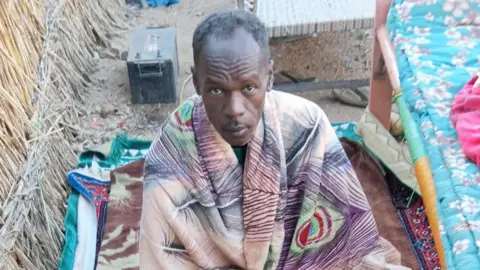 Mohamed Suleiman
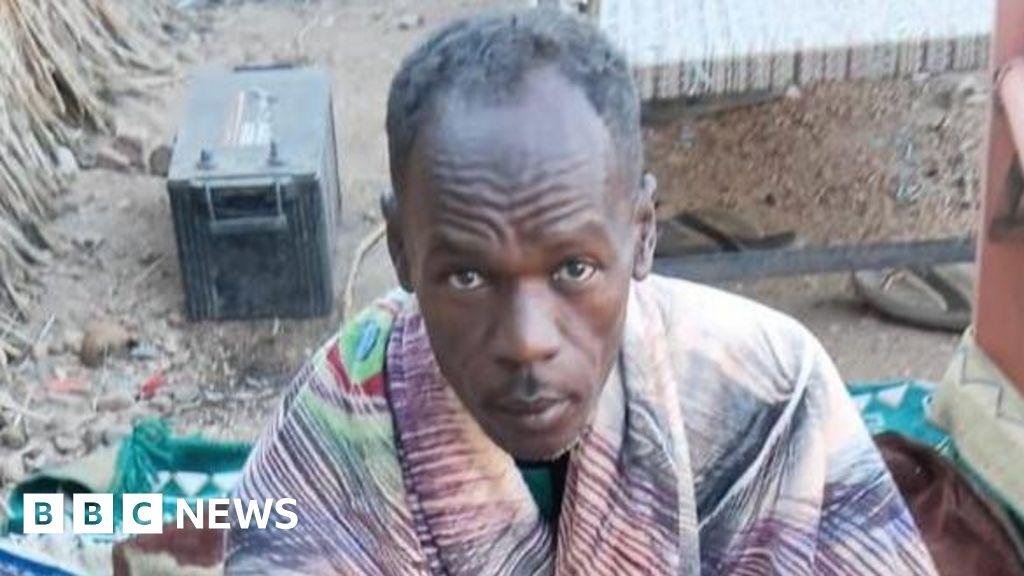
Soon after Mohamed Suleiman entered the telecoms office in the coastal city of Port Sudan on 13 January he started to cry.
He hadn't heard his phone ring for most of Sudan's civil war, which began exactly three years ago following a power struggle between the army and its then-ally, the Rapid Support Forces (RSF) paramilitary group.
The journalist and academic had made it to Port Sudan after being trapped in the western city of el-Fasher, largely cut off from the world by a communications blackout and unable to convey fully the horrors he was witnessing.
"I was flustered because people were talking on their phones (inside the office)," he tells the BBC.
"Throughout the past three years, my phone was silent. After I inserted the SIM card, my tears flowed."
When his phone finally sprang to life, it was pinging with three years' worth of messages, an inventory of loss: news of colleagues who had died, friends asking whether he was still alive.
"A few days ago, a person called me saying he thought I had died," he says. "Some people had told him that I was in Port Sudan, so he called me, but he didn't believe (it was me) until I called him back by video, then he broke down in tears."
In some ways the silence was almost as deadly as the violence, Suleiman says.
He describes it as "a suffocating feeling because I was watching systematic killings through drone strikes and bombs or deadly killing through the tight siege" imposed on el-Fasher by the RSF for 18 months.
And when the RSF finally took over the city in October last year, "It was like the Day of Judgment on Earth," he says.
"We witnessed the Day of Judgment on Earth."
The fall of el-Fasher was one of the most brutal chapters of the civil war, which began in the capital Khartoum on 15 April 2023.
It soon spread to other parts of the country and has been particularly vicious in the western region of Darfur, the RSF stronghold, where el-Fasher is located.
As the conflict enters its fourth year, the fighting has led to a de-facto partition between territory held by the army and the paramilitaries.
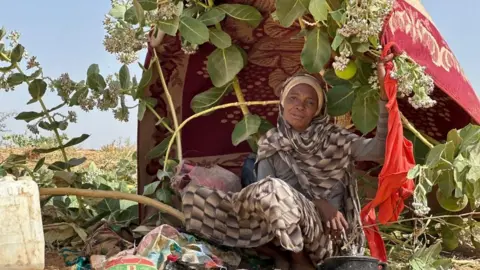
Millions of Sudanese citizens are scattered, some outside the country, forced from their homes in the midst of the world's worst humanitarian crisis.
 EPA
EPA
Diplomatic efforts to end the war led by the US have failed, with both sides given support by regional powers that enables them to keep fighting.
Mohamed Suleiman's account is a story about the worst of the war, and the way it can strip the innocent of food, shelter, life and even identity.
Civilians in el-Fasher were caught up in the fighting between the RSF and local armed groups which helped the army defend the city. And as the paramilitaries tightened their siege, a UN-backed food monitor declared famine conditions.
The relentless daily trauma of death and hunger exploded into apocalyptic scenes as people frantically tried to escape when the RSF closed in.
"We saw dead children in the streets," Suleiman says.
"We saw women crying from extreme hunger and thirst, too weak to carry their children, so they left them in the road."
There were "people we know by name and know their fathers, we cannot provide anything for them".
"There is no food, no water, no first aid to save them, or to carry them with you. You cannot do anything. So you step over them, jump over them, cry, and continue walking," Suleiman says.
 Reuters
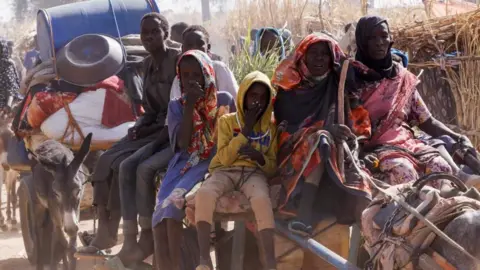
Many tried to flee to the nearest safe place, the town of Tawila. The road was littered with the dead and injured - "very, very large numbers, countless numbers".
If there had been a way to call for help, Suleiman says, they wouldn't have had to leave so many wounded behind.
"There are things I cannot describe because they are inhumane. I cannot talk about them. And the regrettable thing is that the audio-visual media did not convey the scene.
"Until now, the world does not know what happened in el-Fasher city, nor does the state know."
The RSF leadership has admitted "individual violations" were committed during the takeover of el-Fasher but says these are being investigated and the scale of atrocities was exaggerated by its enemies. Both sides are accused of war crimes, including mass civilian casualties from air and drone strikes.
Communications had become very unstable in the city right from the beginning of the war because of the fighting, and because of a fuel shortage that cut the power. That quickly evolved into a full blackout, Suleiman says, which was reinforced when the RSF laid siege in May 2024.
Some people smuggled in Starlink devices that enable a satellite connection to the internet. But they were very expensive and restricted by the army when it was in control of the city.
The RSF confiscated any they found. And if journalists did manage to access a Starlink device, they faced great risks from both sides, Suleiman points out.
"The Rapid Support Forces consider you affiliated with security agencies and accuse you of using it for espionage," he tells the BBC.
"As for the army, they consider that when shelling begins, you are accused of being a spotter," he says, referring to someone who can identify targets and communicate ground conditions to the enemy.
"The accusation of being a spotter harmed many journalists and harmed the transmission of truth from el-Fasher.
"And the military authorities did not give you a permit to convey the truth. So, you hide, and when you try to convey the news secretly, you expose yourself to risks."
 Reuters
Suleiman was also exposed to the same risks as everyone else.
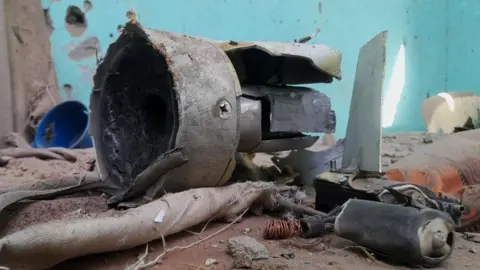
In July 2025 a shell fell less than two metres from him as he was on his way home.
He survived but lay on the ground for about half an hour, holding a phone that was unable to call for help.
"If I had been injured, I would have died," he says.
He could see drones flying into the city but had no way to call and warn people so they could take cover from the bombing. Even using his phone with no network connection put him at risk of being targeted because of the screen light.
You had to "go under the bed and cover yourself with a blanket", he says.
"When the shelling starts, you hide in rooms and under beds. Or in a trench under the earth, or take shelter in anything, sometimes for up to seven hours in very hot weather. You remain silent, unable to speak. And you cannot convey what you are seeing."
Suleiman witnessed the death of many children, "even if a donkey cart is moving, and a drone hits it, it contains children".
Under such circumstances, people clung to their faith in God.
"We remembered God Almighty night and day. Neighbours would come to the Quran circle in the house," Suleiman says.
"After Asr (afternoon) prayer, we would read a part of the Quran, while the shelling was ongoing. If the shelling came from the north, we would move south; if from the south, we would move north."
 Mohamed Eid
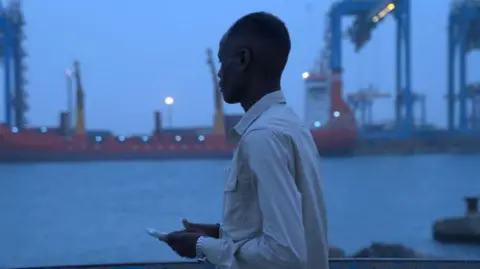
Suleiman prayed again when he finally reached Port Sudan, headquarters of the military-backed government for most of the war, in January this year after a journey of more than two months that took him through Chad.
"As soon as I arrived in Port Sudan, I prostrated in the airport and cried intensely because I never imagined I would reach a safe haven," he said.
Although Suleiman had reached safety, he had lost all his identification documents. Retrieving them made him feel like a person again, but that was another kind of fight, with bureaucracy.
"I spent 22 days going around offices," he says. "The last regrettable thing they said to me was to bring my mother. And to bring a number of witnesses. Thank God I have witnesses and I brought them, but what happens to the person who comes out of the war and has no one?"
Special procedures for exceptional cases announced by officials were just talk, Suleiman says, calling on the state to provide identification documents to people coming out of war zones without charge.
Suleiman is reconnected to the world, but, he says, after what he has witnessed and experienced, it feels like the world has not returned to him.
"There is no international law in the world," he says bitterly.
"There is no such thing as the United Nations. If there were human rights international organisations, no day would pass in el-Fasher with people dying, hungry and thirsty, bombed by shells and drones.
"There is no ceasefire, no medicine, no basic necessities of life."
The world has failed to meet Sudan's enormous humanitarian need - hindered by the fighting, bureaucratic restrictions from both sides, and a lack of money - only 16.2% of the UN's $2.87bn (£2.13bn) needs assessment for 2026 has been met so far.
And it has failed at efforts to stop the fighting.
A peace plan put forward last September by the so-called Quad nations - the United States and the regional countries most involved in the war, Saudi Arabia, the United Arab Emirates and Egypt - has gone nowhere.
In the meantime, the US envoy Massad Boulos is trying to get agreement on at least a humanitarian ceasefire.
The Sudan that Mohamed Suleiman now experiences is a different country - fragmented, with its peoples scattered. But, he says, telling their story gives him a sense of purpose.
"There are events that happened that no-one is left to narrate, and the memory remains only with us... until we die, we will convey the truth to correct the situation for the next generation, so they live dignified and honoured in their homeland."
More BBC stories on Sudan war:
 Getty Images/BBC