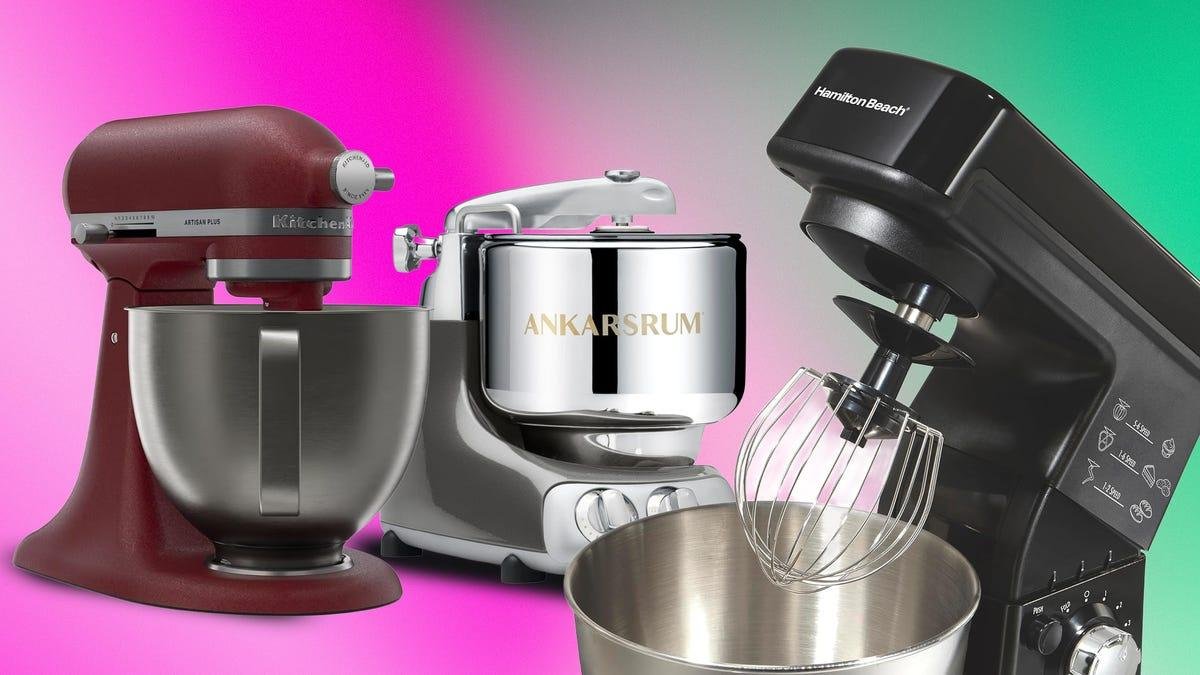
If you're a baker or enjoy cooking from scratch, aside from your fridge and stove, a stand mixer is one of the most important kitchen appliances. Beyond its utility as a countertop fixture, it lends a certain culinary seriousness to your space, whether or not you use it every day.
KitchenAid makes a number of different appliances, but somehow “mixer” seems to be the suffix that best fits the brand -- and for good reason. KitchenAid dominates the stand mixer category, and we got to test the recently launched Artisan Plus, which introduces new features and colors. The addition of a half-speed setting, a built-in LED light and a double-flex edge beater that scrapes the bowl while mixing makes this our top pick. The small-but-mighty LED light helps you see ingredients in the bowl, while the half-speed setting prevents splatter.
Pros
- LED light automatically turns on when the mixer is in use
- Tilt-head
- Double-flex edge beater ensures all ingredients are mixed together
- Variety of colors and finishes
Cons
- Pricier than other KitchenAid options
Cuisinart is to the food processor as KitchenAid is to the stand mixer, but it’s certainly no slouch when it comes to stand mixers, especially if you’re brand-loyal. If you’re also price-sensitive, this Cuisinart model offers the security of a major brand name with significant savings over a KitchenAid mixer. (It’s still on the pricey side to be considered “budget,” but that’s where the handy term “value” comes into play.) The look is a little sleeker and more industrial than the KitchenAid model, but it still comes in a generous range of colors.
Pros
- Good amount of speed settings for a budget pick
Compact and relatively light, this Hamilton Beach model was the clear winner among budget stand mixers. In both my own hands-on experience and across review evaluations, Hamilton Beach has proven to be an extremely reliable brand for those looking to save money, and it earned the “budget” spot on well over half of the review sites I consulted.
Pros
- Most affordable option on our list
Cons
- Limited purchasing options
If you don’t know what “hydration” means in baking, the Ankarsrum Assistent Original probably isn’t for you. But if you do -- and bread in all its breathtaking varieties is what you want a stand mixer for -- don’t skip this modern classic from Sweden. Its powerful motor is built into the base and turns the bowl, making this machine about as stable as it gets. That design also means it can handle super-low-hydration doughs -- whole wheat or rye, pizza and even bagels -- without breaking a sweat or moving a millimeter.
Pros
- Capable of handling low-hydration doughs such as whole-wheat, rye, pizza and bagels
- Stable and powerful
Cons
- Expensive at $800
- Lots of parts to store
- Not beginner-friendly
Same KitchenAid design, same KitchenAid color choices (mostly), but with 40% more volume, 66% more power and two additional mixing paddles to take your stand mixer functionality to a professional level. I also like the half-speed setting here for the possibility of gently folding nuts or chips into batters. The bowl-lift mechanics allow for even greater maneuverability (and far less swearing than with a tilt-head when you accidentally hit the cupboards).
Pros
- More volume and power
- Half-speed setting for gentle and precise mixing
Cons
- Fewer color options than other KitchenAid models
A stand mixer typically includes a heavy base and a powerful motor, making it a convenient tool for baking enthusiasts. Unlike a hand mixer, a stand mixer does the mixing for you without requiring much effort or time.
Whether you're making cupcake batter, whipped meringue icing or artisanal bread dough, a stand mixer can help you get the job done with ease. But the downside is that they can be pretty expensive and bulky. To help you pick the right one for your needs, we've put together a list of the best stand mixers of 2026.
What's the best stand mixer of 2026?
There are a ton of options available, but the brand-new KitchenAid Artisan Plus takes the cake as the best stand mixer of 2026. It builds on the already-great KitchenAid Artisan Series with three clever new features.
Best stand mixers of 2026
Pros
- LED light automatically turns on when the mixer is in use
- Tilt-head
- Double-flex edge beater ensures all ingredients are mixed together
- Variety of colors and finishes
Cons
- Pricier than other KitchenAid options
KitchenAid makes a number of different appliances, but somehow “mixer” seems to be the suffix that best fits the brand -- and for good reason. KitchenAid dominates the stand mixer category, and we got to test the recently launched Artisan Plus, which introduces new features and colors. The addition of a half-speed setting, a built-in LED light and a double-flex edge beater that scrapes the bowl while mixing makes this our top pick. The small-but-mighty LED light helps you see ingredients in the bowl, while the half-speed setting prevents splatter.
Bonus: The attachments that come with this mixer are stainless steel, meaning they're dishwasher-safe.
KitchenAid also makes a slightly smaller model, the Artisan Mini, for when you want the brand but don't have the space.
- Size: 14.1 x 8.7 x 13.9 inches (depth, width, height)
- Weight: 21.8 pounds
- Style: Tilt-head
- Capacity: 5 quarts
- Power: 350 watts
- Number of settings: 11, including a 1/2 option
- Attachments: Stainless steel bowl, dough hook, wire whisk, flat beater, double-flex edge beater, pouring shield; 12 optional attachments, including ice cream maker, meat grinder, pasta roller and spiralizer
Pros
- Good amount of speed settings for a budget pick
Cuisinart is to the food processor as KitchenAid is to the stand mixer, but it’s certainly no slouch when it comes to stand mixers, especially if you’re brand-loyal. If you’re also price-sensitive, this Cuisinart model offers the security of a major brand name with significant savings over a KitchenAid mixer. (It’s still on the pricey side to be considered “budget,” but that’s where the handy term “value” comes into play.) The look is a little sleeker and more industrial than the KitchenAid model, but it still comes in a generous range of colors.
A speed-adjustment dial, rather than levers, gives you more nuance when setting speeds, and it offers 12 speed settings -- the most of any mixer on this list. And while the list price is technically $250, we often find it on sale.
- Size: 14.17 x 7.87 x 14.13 inches (depth, width, height)
- Weight: 20 pounds
- Style: Tilt-head
- Capacity: 5.5 quarts
- Power: 500 watts
- Number of settings: 12
- Attachments: Paddle, whisk, dough hook, pouring shield; 12 optional attachments, including ice cream maker, meat grinder and pasta roller
Pros
- Most affordable option on our list
Cons
- Limited purchasing options
Compact and relatively light, this Hamilton Beach model was the clear winner among budget stand mixers. In both my own hands-on experience and across review evaluations, Hamilton Beach has proven to be an extremely reliable brand for those looking to save money, and it earned the “budget” spot on well over half of the review sites I consulted.
For less than $100, you still get solid power, six speed options, three mixing attachments and a 3.5-quart bowl that can handle most basic recipes. If you have a large family or plan to make big batches, it may be worth scaling up to a larger model; for small households, kitchens with limited space or occasional stand mixer use, this is an excellent option.
Your only color choice here is black, but that’s a classic look that fits many kitchens.
- Size: 8.66 x 13.58 x 11.88 inches (depth, width, height)
- Weight: 11.05 pounds
- Style: Tilt-head
- Capacity: 3.5 quarts
- Power: 300 watts
- Number of settings: Six
- Attachments: Paddle, whisk, dough hook
Pros
- Capable of handling low-hydration doughs such as whole-wheat, rye, pizza and bagels
- Stable and powerful
Cons
- Expensive at $800
- Lots of parts to store
- Not beginner-friendly
If you don’t know what “hydration” means in baking, the Ankarsrum Assistent Original probably isn’t for you. But if you do -- and bread in all its breathtaking varieties is what you want a stand mixer for -- don’t skip this modern classic from Sweden. Its powerful motor is built into the base and turns the bowl, making this machine about as stable as it gets. That design also means it can handle super-low-hydration doughs -- whole wheat or rye, pizza and even bagels -- without breaking a sweat or moving a millimeter.
The Assistent Original’s infinite speed dial and built-in timer give you plenty of flexibility for dealing with long, heavy mixing sessions, too. It also comes with a second bowl and a separate mechanism for mixing cookie doughs or cake batters, or whipping cream or egg whites. That means you’ll need plenty of space to store all the parts.
Learning the mixer’s intricacies can take a while, and it doesn’t come cheap at $800; for most people, a simpler, all-in-one KitchenAid is the better choice. But if you’re an ardent, adventurous baker, you’ll undoubtedly find that with the Ankarsrum, the dough you pay is worth it for the dough it turns out.
-- Matthew Murray, director, CNET Labs
- Size: 19 x 14.3 x 14.3 inches (depth, width, height)
- Weight: 18.3 pounds
- Style: Motor in base
- Capacity: 7.4 quarts (metal bowl), 3.7 quarts (plastic bowl)
- Power: 600W
- Number of settings: Infinite
- Attachments: Dough hook, dough scraper, balloon whisks, dough whisks, dual-bowl lid
Pros
- More volume and power
- Half-speed setting for gentle and precise mixing
Cons
- Fewer color options than other KitchenAid models
Same KitchenAid design, same KitchenAid color choices (mostly), but with 40% more volume, 66% more power and two additional mixing paddles to take your stand mixer functionality to a professional level. I also like the half-speed setting here for the possibility of gently folding nuts or chips into batters. The bowl-lift mechanics allow for even greater maneuverability (and far less swearing than with a tilt-head when you accidentally hit the cupboards).
A slightly less expensive 600 Series pro model is also available from KitchenAid, if you're interested in the bowl-lift option but don't necessarily need the greater volume.
- Size: 14.63 x 11.31 x 16.5 inches (depth, width, height)
- Weight: 31 pounds
- Style: Bowl-lift
- Capacity: 7 quarts
- Power: 500 watts
- Number of settings: 11
- Attachments: Double-flex edge beater, flat beater, dough hook, pastry beater, whisk, pouring shield; 12 optional attachments including ice cream maker, meat grinder, pasta roller and spiralizer
Pros
- Heavy-duty but with a comparatively modest footprint
- Built-in timer
- Under-head lights
- Precision operation with dial to adjust speed
Cons
- Expensive at $800
- Heavy
- Only available in two colors
The Ooni Halo Pro Spiral Mixer is an absolute tank of a stand mixer. At $799, it's not for the stand mixer-curious, but it's great for those who make dough on the regular, and we're not talking about cookie dough. Instead, this mixer excels at pizza dough, bread dough and anything where gluten needs to be worked over with serious muscle.
This monster has 650 watts of dough-mixing power and a modern industrial look. You can read our full review on the Ooni Halo Pro Spiral Mixer here.
- Size: 17.17 x 9.9 x 13.5 inches (depth, width, height)
- Weight: 32 pounds
- Style: Spiral mixer
- Capacity: 7.4 quarts
- Power: 650 watts
- Number of settings: 58
- Attachments: Flexible beater, spiral dough hook, geared whisk
Pros
- Built-in scale
- Sleek, compact design
Cons
- It's not cheap
- Only available in three colors
- Has more components that could eventually fail
When GE unveiled its Smart Mixer at CES 2023, it caught the attention of a few folks in attendance, including CNET's own Jessica Dolcourt, who deemed its entry into the category a "big deal." Dolcourt, who was able to both see the Smart Mixer in action and play around with it, was impressed by its many futuristic functions, none more useful than the built-in scale.
GE Profile’s stand mixer stands out from the crowd thanks to its -- dare I say -- genius integrated scale, which lets you measure ingredients with precision right in the bowl. The scale then zeroes out so you can add the next ingredient without having to bust out measuring cups or spoons. We simply adore skipping a step, no matter how small.
Another smart element is the mixer's auto-sense technology, which works with dozens of programmed recipes from the app to monitor viscosity changes through motor torque while in use, optimizing speed and power for best results when whipping, mixing, emulsifying and so on. Simply put, this mixer does a lot of the work for you. It's also powerful, with 540 watts of oomph, and offers a large 7-quart bowl.
- Size: 14 x 11.33 x 17.07 inches (depth, width, height)
- Weight: 22 pounds
- Style: Bowl lift
- Capacity: 7 quarts
- Power: 540 watts
- Number of settings: Dozens, including preprogrammed recipes
- Attachments: Dough hook, wire whisk, beater
Stand mixers compared
| KitchenAid Artisan Plus | Cuisinart Precision Master SM-50 | Hamilton Beach 6-speed | Ankarsrum Assistent Original | KitchenAid 7-qt | Ooni Halo Pro Spiral Mixer | GE Profile | |
|---|---|---|---|---|---|---|---|
| Size (inches; depth, width, height) | 14.1 x 8.7 x 13.9 | 14.7 x 7.87 x 14.13 | 8.66 x 13.58 x 11.88 | 19 x 14.3 x 14.3 | 14.63 x 11.31 x 16.5 | 17.17 x 9.9 x 13.5 | 14 x 1.33 x 17.07 |
| Weight (pounds) | 21.8 | 20 | 11.05 | 18.3 | 31 | 32 | 22 |
| Style | Tilt-head | Tilt-head | Tilt-head | Motor in base | Bowl-lift | Spiral mixer | Bowl-lift |
| Capacity (quarts) | 5 | 5.5 | 3.5 | 7.4 | 7 | 7.4 | 7 |
| Power (watts) | 350 | 500 | 300 | 600 | 500 | 650 | 540 |
| Settings | 11, including 1/2 speed | 12 | 6 | Infinite | 11 | 58 | infinite |
| List price | $600 | $230 | $130 | $800 | $650 | $800 | $800 |
On March 30, KitchenAid unveiled the KitchenAid Artisan Plus Stand Mixer.
Corin Cesaric-Epple/CNETIn 2026, we changed our top pick to KitchenAid's Artisan Plus after hands-on testing. It's $100 more than our previous pick, the Artisan, but we think the built-in LED light, the double-flex edge beater and the half-speed setting elevated the mixer in the best ways.
After hands-on experience, we also added the Ooni Halo Pro Spiral Mixer and the Ankarsrum Assistent Original to the list.
Both the bowl and the hook rotate on the Ooni Halo Pro Spiral for gluten development.
Corin Cesaric-Epple/CNETTypes of stand mixers
Stand mixers typically come in two different modes: tilt-head and bowl-lift. Tilt-head stand mixers have a hinge at the back of the model that literally tilts the head back and allows you to easily remove the bowl from the mixer, as well as change the mixing paddle as needed. The purpose of bowl-lift models is the same, but instead of a hinge that tilts the head, two arms are usually located toward the base of the model, with a lever that lifts up the bowl to meet the paddles.
Most average-size stand mixers are tilt-head models, while professional options tend to utilize the bowl lift. With a tilt-head model, it's important to consider that the height of the model changes when the head is tilted back, meaning that you might have to pull it out from under overhead cupboards in order to accommodate the extra height when in use.
When it comes to stand mixer color options, it's hard to beat KitchenAid's collection.
KitchenAidStand mixer size and capacity
Size-wise, the height of a stand mixer may be the most important consideration, whether you’re placing it on the counter or storing it away, with most models standing about 14 to 15 inches tall. (You’ll need another inch or two of clearance to tilt the head back.) Smaller models may save you a couple of inches, and larger professional-grade models can be as tall as 18 inches.
Volume-wise, most stand mixers come with bowls ranging from 4 to 6 quarts. Smaller models offer 3- to 4-quart bowls, which are still large enough for typical cookie and cake recipes but may feel cramped for extra-large batches or some bread recipes. Professional-grade stand mixers can offer bowls up to 8 quarts, suitable for catering-size jobs.
The half-speed setting is new to the Artisan Plus.
Corin Cesaric-Epple/CNETStand mixer features
Besides the tilt-head and bowl-lift functionality, stand mixers tend to come with several different beaters for different functions: a paddle for typical cake and cookie mixes, a whisk for whipping meringues or cream and a dough hook that approximates light kneading in how it moves the dough around the bowl. Low-, medium- and high-speed settings are generally expected, with many models offering as many as 10 or 12 speeds to meet your precise needs. Additionally, several models may offer separate-purchase attachments for additional functionality, such as making ice cream or noodles, or grinding meat.
GE Profile's Smart Mixer includes a built-in scale for accurately measuring ingredients right in the bowl.
GEOur list of the best stand mixers was compiled from a mix of hands-on testing and a review of numerous expert sites, focusing on models with the most features, as well as bestselling and top-rated models at major retailers such as Amazon, Williams Sonoma and Crate & Barrel. Of note, and good news for meticulous comparison shoppers: Stand mixers were the most consistently ranked kitchen appliance from site to site of any I have previously reviewed.
A detachable breaker bar prevents strong dough from riding up the spiral hook on the Ooni Halo Pro.
Pamela Vachon/CNETI researched the stand mixers on this list by analyzing specs and user reviews, diving deep for mentions of persistent issues and considering the available features and functionality compared to price as a measure of each model's overall value. I focused primarily on those models that had extremely high user ratings, typically 4.5 and above with at least 1,000 unique ratings. While these were not tested in person in a lab environment, as a culinary school-trained home cook, I am very familiar with the features and functionality of stand mixers, and every stand mixer on this list has been tested by numerous sites for high performance. Additionally, I was able to examine several in person (including one that I own) in order to get a feel for their footprint, weight, design and controls.
KitchenAid is certainly the most popular stand mixer and has a decades-long track record of satisfaction from bakers and home chefs alike. While it might be the safest bet, KitchenAid machines are also expensive, with most models costing well over $300. Among our list of best stand mixers, any of these should serve the purpose of consistently handling typical recipes on a regular basis and any of them can be considered a worthwhile investment. The best stand mixer for you is the one that fits your budget, space and lifestyle.
Expect to spend between $200 and $500 for an average, well-reviewed stand mixer. Very few are priced lower than $100; our budget pick here is pretty close to that mark. Professional grade or splurge-worthy options can cost $1,000 or above. Average models will be worthy investments for most home cooks and their needs. You may want to consider a higher-end model if you have an especially large household, a catering operation or the verve to make artisanal bread at home several times a week.
The base of a stand mixer can be wiped down with water and a clean dish or paper towel. It's important to do this thoroughly after each use, as residual flour or batter can build up close to the motor or hinge and inhibit its functionality. The bowl and detachable beaters or paddles of a stand mixer can be washed thoroughly with soap and water. These parts may also be dishwasher-safe; you should check the user manual of your particular model to confirm whether it's alright to put them in the dishwasher.
For more, read CNET's complete guide to cleaning your stand mixer.
There are several important factors to consider when choosing a stand mixer, including price, space requirements, bowl volume and attachments -- all of which should reflect how often and what you plan to make. If you expect to use your mixer frequently, it’s worth investing in a sturdy, well-reviewed model that'll serve you better in the long run than opting for a cheaper option. How often you use it will also help determine whether the mixer lives on your counter or gets stored in a cupboard or pantry when not in use. Either way, make sure you have enough space and can move it comfortably, as many models are quite heavy.
Most stand mixers come with bowl capacities ranging from 4 to 6 quarts, which works well for typical home baking. Smaller-capacity models are available, but these are often chosen to save space rather than because you’ll only be making half-size recipes.
Larger mixers can offer bowls up to 8 quarts, which can be helpful if you frequently make extra-large batches, though these are typically considered professional-grade models. If you plan to keep your mixer on the counter, color or design may also be important. Getting the most out of your mixer may also mean considering additional attachments, such as a meat grinder, ice cream maker or pasta roller.