Photos: How overfishing in Southeast Asia is an ecological and human crisis
Photos: How overfishing in Southeast Asia is an ecological and human crisis

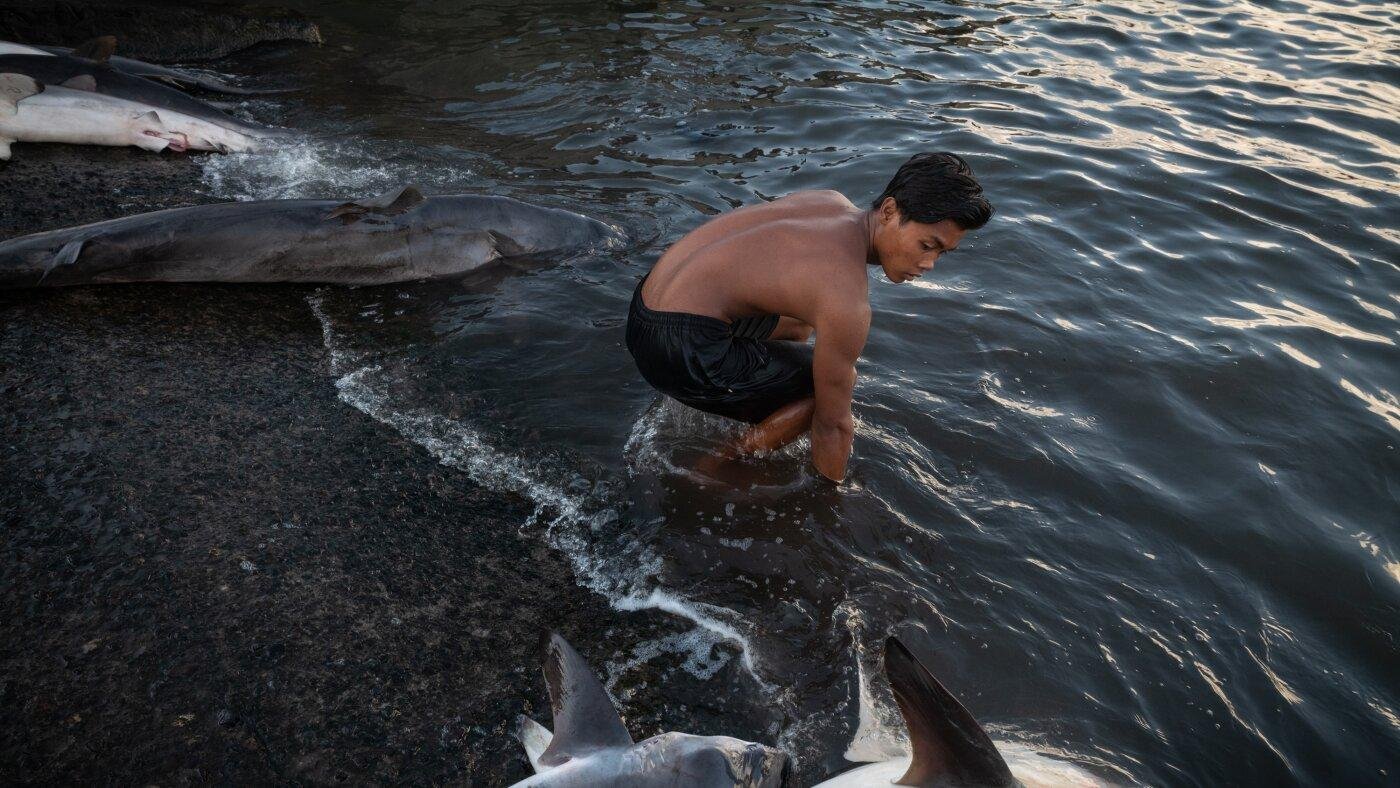
Various species of sharks — some of which are endangered, while others are listed as vulnerable — are hauled on shore at dawn at the Tanjung Luar port on June 9, 2025, in East Lombok, Indonesia. Tanjung Luar is one of the largest shark markets in Indonesia and Southeast Asia, from where shark fins are exported to other Asian markets — primarily Hong Kong and China — and their bones are used in cosmetic products also sold to China. Nicole Tung/Fondation Carmignac hide caption
toggle caption
Nicole Tung/Fondation Carmignac
"We were fighting over who had caught more fish, and then I saw my crewmate pushed overboard by the captain," Akbar Fitrian, 29, an Indonesian crewmember says as he recounts an incident aboard a Chinese-owned fishing vessel in 2022. "The ship then started to drive away as my crewmate tried to swim towards us. And then I don't know what happened. The captain never reported the incident."
The seas of Southeast Asia — home to some of the richest in biodiversity in the world — have long been in decline. Since the 1950s, the Center for Strategic and International Studies estimates that 70-95% of fish stocks have been depleted and are at risk of collapse, perpetuated by the rise of industrial-scale fishing, much of which is illegal. Legal overfishing is another factor, and both are propped up by weak regulations, insufficient monitoring and insatiable demand. Approximately half of the world's global marine fish catch comes from the seas of Southeast Asia, according to the U.N., and it comes at a calamitous cost.
In the United States, approximately 50% of the imported seafood comes from Asia, with nearly $6.3 billion in trade coming from China, Vietnam, Indonesia and India alone, according to the U.S. National Oceanic and Atmospheric Administration.
Behind the illicit seafood trade is an opaque world standing at the crossroads of intertwining issues. There is the legacy of brutal human rights violations that have enabled sea slavery to become the norm. Those involved in the efforts of organizations like the international Freedom Fund and Thailand's Labour Protection Network, which work to end modern-day slavery in the region, say many workers are murdered at sea, abused and often brought into a cycle of debt bondage.
There is the lawless nature of the seas, which has emboldened traffickers to exploit desperate fishermen and impoverished casual laborers. Then there are the geopolitical factors at play: In a race to dominate the seas, China and, to a lesser extent, Vietnam, the Philippines, Taiwan and Malaysia have all built outposts and bases on shoals, reefs and atolls. Fishing fleets — of which China has the largest in the world — are fast becoming more militarized as a result.
All of this has imposed a heavy cost on unique ecosystems and led to devastating socioeconomic impacts on artisanal and small-scale fishers.
Three countries illustrate the intersectional nature of overfishing:
Thailand

Fishing vessels are seen docked together at a landing site in Chumphon, Thailand, on Jan. 22, 2025. Nicole Tung/Fondation Carmignac hide caption
toggle caption
Nicole Tung/Fondation Carmignac
"Fish were in abundance before," says Mimit Hantele, 53, a member of the Urak Lawoi tribe on the island of Koh Lipe in Thailand. "But now, the fishing season is a lot shorter, the variety of fish is far fewer, and I sell less. So I take tourists out on scuba expeditions to earn money."
For generations, the Urak Lawoi plied the rich waters around them for sustenance. Sea gypsies in a time past, the villagers evolved to rely only on what they could catch and used simple fishing equipment cast from small wooden boats.
Then, in the 1970s, came the big Thai and Malaysian fishing boats. Fishermen on Koh Lipe say the boats fish illegally around the island, appearing only at night to escape detection and in a protected national forest area. The ships use purse seiner nets and demersal trawlers, destroying the coral underneath and, consequently, the habitat for fish. Such overexploitation has led the Indigenous group to turn to tourism to make up for lost income and declining fish stocks. "Fishing is in our blood," Hantele said, but "our way of life has changed. We can't rely only on the fish."

Frozen Spanish mackerel and other species of fish in cold storage in Samut Sakhon, Thailand, on Jan. 15, 2025. Nicole Tung/Fondation Carmignac hide caption
toggle caption
Nicole Tung/Fondation Carmignac

Fishermen mend nets in Samut Sakhon, Thailand, on Jan. 15, 2025. Nicole Tung/Fondation Carmignac hide caption
toggle caption
Nicole Tung/Fondation Carmignac

Small-scale artisanal fishermen shake sardines from nets to gather them en masse after returning to shore with their catch, in the Gulf of Thailand, off the coast of Prachuap, Thailand, on Jan. 20, 2025. Nicole Tung/Fondation Carmignac hide caption
toggle caption
Nicole Tung/Fondation Carmignac
According to a 2001 report from the U.N., roughly 80% of fishers in Southeast Asia at the time were small-scale or artisanal, relying on traditional practices. However, declining nearshore fish stocks have forced many artisanal fishers to venture farther from shore in search of commercially valuable species. Added to that are government subsidies for fuel and tax breaks for commercial fishing vessels, which have propped up the seafood industry. Rapid advancement in maritime technology has made fleets far more effective at finding rich hunting grounds while avoiding detection by switching off their monitoring systems.

Oranee Jongkolpath, 30, a veterinarian at Thailand's Department of Marine and Coastal Resources' research and development center in the Rayong province, prepares to clean a hawksbill turtle in Prasae, Thailand, on Jan. 18, 2025. The turtle was found by fishermen in a garbage patch and was likely entangled in ghost nets — fishing nets that are lost or discarded by fishermen — that had caused severe damage to its two front flippers. Nicole Tung/Fondation Carmignac hide caption
toggle caption
Nicole Tung/Fondation Carmignac

A seafood merchant displays dried seahorses for sale in Chumphon, Thailand, on Jan. 22, 2025. Dozens of countries around the world are involved in the dried seahorse trade, with Thailand, the Philippines, Vietnam and India being the largest exporters. As the trade of seahorses, which are typically used for traditional medicines, has sharply increased, the seahorse catch has declined over time. Seahorses are among the species protected under the Convention on International Trade in Endangered Species of Wild Fauna and Flora. Nicole Tung/Fondation Carmignac hide caption
toggle caption
Nicole Tung/Fondation Carmignac
Lax regulations on the most destructive types of fishing, particularly demersal trawling and cyanide fishing, the capture of juvenile fish that prevents the replenishment of stocks, the poor oversight of labor laws and the exploitation of workers desperate to earn a living have all contributed to the devastating knock-on effects for communities along coastlines and the potentially irreversible environmental consequences.

Members of a crew working on a Thai fishing vessel, most of whom are from Myanmar, prepare to show their documents to Port In Port Out (PIPO) inspectors in Chumphon, Thailand, on Jan. 22, 2025. PIPO inspection centers were set up in 2018, following an outcry in the international community over Thailand's gross human rights abuses in its fishing industry. Nicole Tung/Fondation Carmignac hide caption
toggle caption
Nicole Tung/Fondation Carmignac

A Burmese dock worker sorts fish after a catch from a Thai vessel was unloaded in Ranong, Thailand, on Jan. 23, 2025. Nicole Tung/Fondation Carmignac hide caption
toggle caption
Nicole Tung/Fondation Carmignac
In Thailand last year, artisanal fishermen held protests over the rollback of major fisheries reforms implemented a decade ago that had helped to rebuild fish stocks in Thai waters. Thai corporations, which own a significant share of commercial fishing vessels, pushed the government to deregulate the fishing industry to increase their profits. Protestors focused on their concerns that relaxing the rules would revive illegal, unreported and unregulated fishing and lead to increased overfishing. The rollbacks, they argued, would reduce transparency and accountability across the industry and reduce checks on gear and labor. Less transparency would lead to less knowledge about what is left in the sea. In turn, sustainability decreases, hurting artisanal fishers who depend on the sea for sustenance and livelihoods.
The Philippines
Sponsor
Sponsor
Sponsor
Sponsor
Zoekertjes
Categorieën
Read More
Best Cellphone Plans of 2026: Our Top PicksIt's that time when new phone models start appearing -- just the last few weeks have brought the Apple iPhone 17E, Samsung Galaxy S26 and Google Pixel 10A, for example -- so it's natural to also think about whether your current phone carrier is working for you. The T-Mobile Essentials Saver plan offers unlimited data usage and includes 50GB of...

Israel says it will keep control over part of southern Lebanon after war with Hezbollah ends47 minutes agoYolande Knell,Middle East correspondent, JerusalemandAlys DaviesAFP via Getty ImagesIsrael's defence minister has said a buffer zone will be set up inside southern Lebanon and that Israel will keep security control over a swathe of the territory even after the end of the current war against...
Uganda rhinos: 40 years after the last one was poached the huge mammals are back in the wildReutersThe northern white rhino was last seen in the wild in Uganda in 1983 For the first time in more than four decades, rhinos have returned to Uganda's Kidepo Valley National Park, where poachers once wiped them out for their horns and meat.During that period of turmoil, hunters slaughtered every...
Hades 2, the Award-Winning Sequel, Joins Xbox Game Pass in AprilHades 2 was selected as one of CNET's best games of 2025, but don't take our word for it. The game won Best Action Game at the 2025 Game of the Year awards, Best Game on Steam Deck at the Steam Awards and a bevy of other accolades after its release. If you haven't had the chance to play this stellar sequel yet, you can on Xbox Game...

Google Rolls Out New Travel Features, Just in Time for SummerIt doesn't matter that it's late April. To me, it's officially summer. With the days getting longer and warmer, and school wrapping up soon, a lot of us are dreaming of summer vacations. Google launched some new travel features just in time to start planning those trips. You might already be familiar with Google Flights...