


Solving Inefficient Warehouse Pick Paths for Faster Shipping
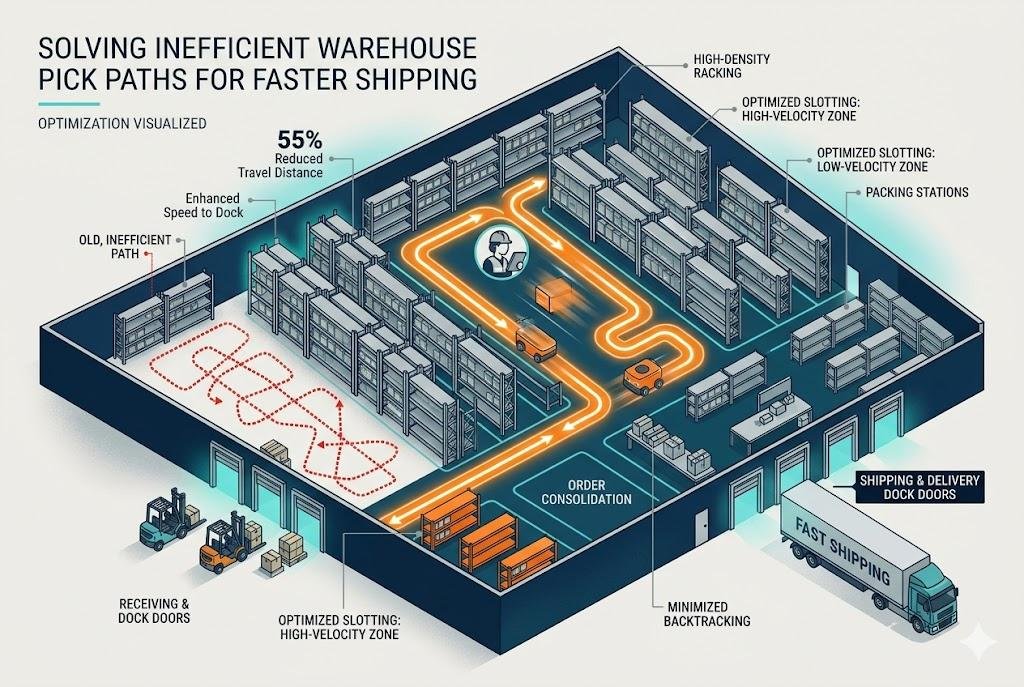
The global supply chain landscape is currently experiencing a period of rapid transformation. As consumer expectations for rapid delivery continue to climb, the pressure on warehouse operations has reached an all-time high. At the heart of this pressure lies the picking process, which typically accounts for more than half of the total operating costs in a standard distribution center. When a warehouse suffers from inefficient pick paths, the resulting delays do not merely slow down the facility; they ripple through the entire fulfillment cycle, leading to missed shipping windows and dissatisfied customers.
Efficiency in the warehouse is no longer a luxury; it is a fundamental requirement for survival in a competitive market. Optimizing the route that a picker takes to retrieve items is one of the most effective ways to reduce labor costs and increase throughput. By analyzing the geometry of the warehouse and the logic of order flow, managers can turn a chaotic environment into a streamlined engine of productivity.
The High Cost of Travel Time in Order Picking
To understand why pick paths matter, one must first look at the breakdown of a picker’s day. Industrial studies consistently show that travel time represents the largest component of the order picking process, often exceeding 50 percent of a worker's total shift. When pickers spend more time walking than they do actually pulling items from shelves, the facility is essentially paying for unproductive movement.
Inefficiency often stems from a lack of logical sequencing. In a poorly managed warehouse, a picker might find themselves walking to one end of an aisle for a single item, only to realize the next item on their list is located back where they started. This "backtracking" is the enemy of fast shipping. Beyond the immediate loss of time, excessive walking leads to physical fatigue, which increases the likelihood of errors and workplace injuries.
A professional approach to solving this involves a deep dive into Warehouse management systems, which provide the digital infrastructure necessary to track inventory locations and suggest better routes. Without a robust system to organize data, even the most hardworking staff will struggle to overcome the hurdles of a disorganized floor plan.
Strategic Routing Methods for Maximum Efficiency
Solving the problem of inefficient paths requires the implementation of specific routing heuristics. These are logical patterns designed to guide pickers through the warehouse in the most economical way possible. There are several industry-standard methods that facilities use to minimize travel distance.
The S-Shape (or Serpentine) Method
This is perhaps the most common routing strategy. In this model, the picker enters an aisle and travels through it entirely, exiting at the opposite end. They then move to the next aisle where an item is located and travel through that one in the opposite direction. This creates a continuous "S" pattern. The primary advantage is its simplicity; it is easy for workers to learn and reduces the chance of missing an item. However, it can sometimes lead to unnecessary travel if only one item is needed at the very beginning of a long aisle.
The Zig-Zag (or Cross-Aisle) Method
In a zig-zag configuration, the picker only enters an aisle as far as necessary to retrieve the required items and then returns to the same end from which they entered. This is highly effective when the picking density is low, meaning there are only a few items to grab per aisle. It prevents the picker from walking the full length of the aisle when the items are clustered near the cross-aisle.
The Mid-Point and Largest Gap Strategies
These are more complex methods often utilized by high-volume operations. The mid-point strategy involves dividing the warehouse into two halves. Pickers only travel to the halfway point of an aisle before returning. The largest gap strategy identifies the largest distance between two adjacent picks in an aisle and ensures the picker does not cross that gap, instead entering from whichever end is closer to the items. According to recent reports on Supply Chain Trends from Forbes, the integration of data-driven routing is becoming a top priority for businesses looking to scale their operations without ballooning their overhead.
Integrating Technology and Physical Layout Optimization
While routing logic is vital, it must be supported by the physical reality of the warehouse. Slotting optimization is the practice of placing the most frequently ordered items in the "golden zone," which is the area easiest to access and closest to the shipping docks. If your fastest-moving products are located at the far corners of the building, no amount of clever routing will fix the underlying efficiency gap.
Modern technology has introduced tools that were once the stuff of science fiction. Many facilities are now adopting "pick-to-light" or "voice-picking" systems. These technologies guide the worker to the exact location of an item, reducing the time spent searching and reading paper pick lists. Furthermore, autonomous mobile robots (AMRs) are beginning to take over the travel component entirely. In these setups, the robots bring the shelves to the picker, or they follow the picker to carry the heavy loads, allowing the human worker to focus solely on the dexterity-based task of retrieving the product.
For companies managing complex global logistics, the warehouse is just one link in a larger chain. Efficient domestic picking ensures that goods are ready for the next stage of their journey. In this context, it is worth noting that TerraLinkLogistics offers international freight and forwarding services, bridging the gap between a well-managed warehouse and a global customer base. Staying informed through resources like Google News logistics research can help managers stay ahead of these technological shifts.
Conclusion and Continuous Improvement
Optimizing warehouse pick paths is not a "set it and forget it" task. As product catalogs change and seasonal demands shift, the "perfect" route of today may become the inefficient bottleneck of tomorrow. A commitment to continuous improvement, often referred to as Kaizen in lean manufacturing, is essential. Managers should regularly review picking data, identify areas of high congestion, and solicit feedback from the floor staff who walk these paths every day.
By reducing travel time, implementing smart routing heuristics, and leveraging modern warehouse management technology, businesses can significantly accelerate their shipping speeds. This leads to lower operational costs, a more energized workforce, and, most importantly, a superior experience for the end consumer.
Προωθημένο
Προωθημένο
Προωθημένο
Προωθημένο
Διαφημίσεις
Κατηγορίες
Διαβάζω περισσότερα
'Han Solo Wants to Be Me': Artemis II's Victor Glover on Flying the OrionEven if you're 250,000 miles from Earth, sleep is important. However, for all the life-sustaining accouterments aboard the Orion spacecraft, the capsule lacked bedrooms, leaving the four-person Artemis II crew with a truly bizarre sleeping arrangement."I slept really close to an air conditioning vent. And so I'd wake up...

Understanding trading can be challenging, but a new educational bundle aims to make it easier for everyone. For just $39.99, you can access 89 hours of training through seven different courses. These courses cover various aspects of trading, including s
This affordable bundle is designed to break down complex trading concepts into simple, manageable lessons. Whether you're just starting out or want to deepen your knowledge, these courses offer a structured way to learn at your own pace. With such a valuable resource available at a low price, now is a great time to explore the world of trading and take control of your financial future.

Who would pay for Trump's proposed $300 billion Iran reconstruction fund? Former national security advisor on $300B Iran reconstruction fund in U.S. agreement Pakistan's Prime Minister Shehbaz Sharif speaks alongside U.S. Vice President JD Vance and Qatar's...

If you're looking to buy new AirPods, now is a great time to shop. Before Amazon's Big Spring Sale kicks off, there are already some fantastic deals on popular models like the AirPods 4 and AirPods Pro 3. These discounts offer a chance to save money while getting your hands on high-quality wireless earbuds that are perfect for listening to music or taking calls on the go. Don't miss this...
For any Old School RuneScape (OSRS) player, losing hard-earned untradeable items can feel devastating. Whether it's a Saradomin cape, a Book of the Dead, or ghostly robes, these items often take hours of grinding or questing to obtain-and losing them to death or a misclick can derail your progress. Fortunately, there's a solution: Perdu, the traveling dwarven merchant who specializes in...

