OpenAI announces new advanced security for ChatGPT accounts, including a partnership with Yubico
OpenAI announces new advanced security for ChatGPT accounts, including a partnership with Yubico
OpenAI is getting serious about account security.
The company on Thursday launched Advanced Account Security, a set of opt-in protections for ChatGPT users designed for high-value individuals — but available to anyone who wants them.
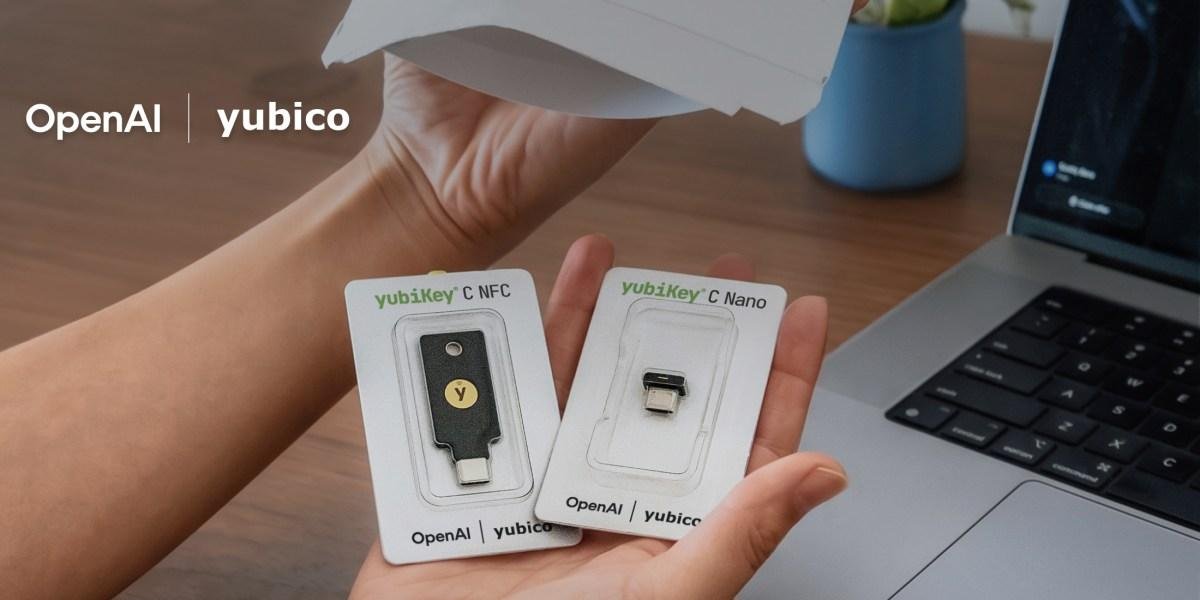
As part of that new program, digital security provider Yubico announced it has partnered with OpenAI to link two new security key products to ChatGPT accounts. The company said the partnership was designed to protect users from the threat of phishing, which is considered to be a growing threat for chatbot users.
The two companies are releasing a pair of “co-branded” YubiKeys — dubbed the YubiKey C NFC and the YubiKey C Nano.
OpenAI has suggested that AAS is a good fit for political dissidents, journalists, researchers, and elected officials — people who engage in politically charged and risky work. One would assume that it might make sense for enterprise users, whose corporate secrets are squirreled away in ChatGPT sessions.
“Ultimately, our intent is to drastically reduce the threat of unauthorized access to sensitive data in OpenAI accounts worldwide,” Yubico CEO Jerrod Chong said in press release announcing the deal.
Security keys are small pieces of hardware that can be tied to digital accounts and enacted through a computer’s USB ports. A unique cryptographic identifier lives on the key, which allows only the person in possession of it to log into a connected account.
Techcrunch event
San Francisco, CA | October 13-15, 2026
If the threat of phished ChatGPT accounts may seem somewhat abstract, there is a growing body of literature showing that bad actors are increasingly targeting chatbot users. Cybercriminals are always on the lookout for extortion-worthy information and, given the intimate nature of most chatbot conversations, there is plenty of fodder when it comes to both enterprise and personal-level users.
Digital security is also becoming a bigger focus of the AI industry. Several weeks ago, Anthropic announced a new cybersecurity model called Mythos. Perhaps seeking to steal some of its competitor’s thunder, OpenAI has also made a number of announcements related to digital security. Thursday’s news of the Yubico partnership followed OpenAI’s announcement that it’s launching a new framework for digital defense.
Of course, a security-key-enabled account does offer stronger protection, but it comes with a tradeoff: if the key is lost, OpenAI won’t be able to help recover access. In practice, that means conversations could be lost for good.
When you purchase through links in our articles, we may earn a small commission. This doesn’t affect our editorial independence.
Lucas is a senior writer at TechCrunch, where he covers artificial intelligence, consumer tech, and startups. He previously covered AI and cybersecurity at Gizmodo. You can contact Lucas by emailing lucas.ropek@techcrunch.com.
Προωθημένο
Προωθημένο
Προωθημένο
Προωθημένο
Διαφημίσεις
Κατηγορίες
Διαβάζω περισσότερα
US Navy Secretary John Phelan leaving Trump administrationUS Navy chief leaving post 'effective immediately', Pentagon says ReutersUS Navy Secretary John Phelan is leaving the Trump administration, the Pentagon announced on Wednesday.His departure will be "effective immediately", Pentagon spokesman Sean Parnell said in a social media post.Navy Undersecretary Hung Cao will serve as acting...

Today's Wordle Hints, Answer and Help for July 14, #1851Looking for the most recent Wordle answer? Click here for today's Wordle hints, as well as our daily answers and hints for The New York Times Mini Crossword, Connections, Connections: Sports Edition and Strands puzzles. Today's Wordle puzzle wasn't too difficult, for a change. If you need a new starter word, check out our...
A New Affordable OLED Monitor for Gamers
Alienware has introduced a new 27-inch QD-OLED monitor that aims to make high-quality gaming more accessible. With a refresh rate of 240Hz, this monitor promises smooth visuals, making it an exciting option for gamers seeking an immersive experience without breaking the bank. Unlike traditional monitors, OLED technology provides vibrant colors and deep blacks, enhancing overall gameplay. This...

We’re feeling cynical about xAI’s big deal with Anthropic Anthropic and xAI announced a big partnership this week, with Anthropic buying all the compute capacity at xAI’s Colossus 1 data center in Tennessee. On the latest episode of TechCrunch’s Equity podcast, Kirsten Korosec, Sean O’Kane, and I discussed what the deal might mean for xAI’s parent company SpaceX, as SpaceX prepares to go...

Why Canada has generic Ozempic, and the US doesn't15 minutes agoNadine YousifSenior Canada reporterReutersIn recent weeks, Canada became the first G7 country to approve a generic version of the popular drug Ozempic.Elizabeth Doran has been taking GLP-1 medications for nearly a year for weight loss to help reverse her prediabetes and high blood pressure. Because she had not yet developed...