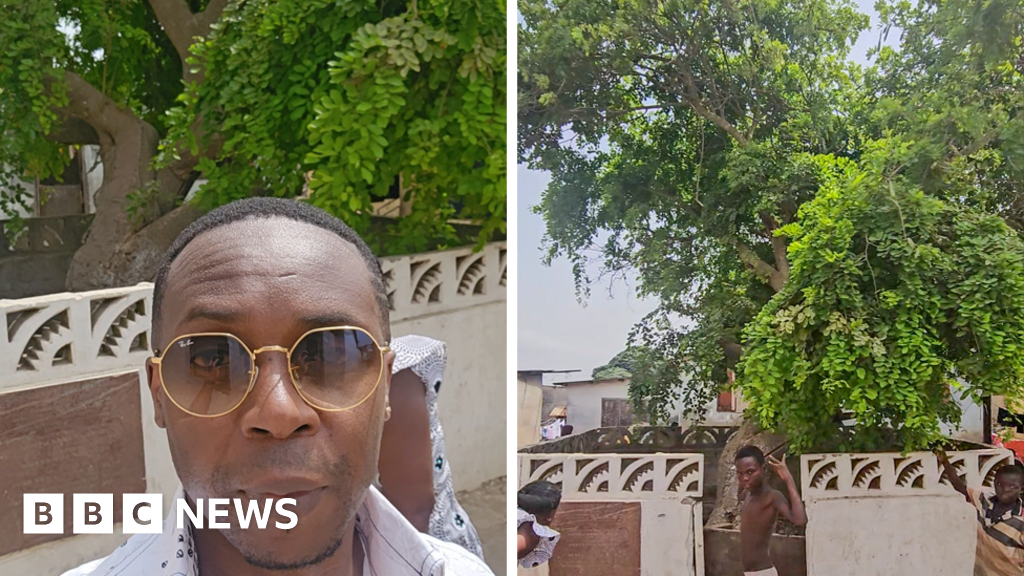
'This tree was planted by my ancestor hundreds of years ago and my family settled here'
Mark WilberforceApam, Ghana

 Mark Wilberforce
At the edge of the Atlantic Ocean, in the Ghanaian fishing town of Apam, there is a tree that most people barely notice.
It stands on a stretch of red clay earth, rooted between two landmarks that tell very different chapters of Ghana's history.
On one side is Fort Patience, built by the Dutch in 1697 during the era of European trading forts along what was then known as the Gold Coast, and used to trade in gold, ivory and enslaved people.
On the other is the Apam Methodist Church, a symbol of the Christian faith that spread through coastal communities in the centuries that followed.
Fishermen pass it before dawn, carrying their nets towards the shoreline. Children drift past it after school, their routines shaped by the same paths their parents and grandparents once walked.
And on Tuesdays, when Apam observes a long-standing spiritual tradition and no-one goes out to fish, the town falls into an unusual stillness, the Atlantic rolling quietly in the background.
For most people, the tree is simply part of the landscape. But for my family, this tree has a name: Santseo, a Fanti word loosely translated as "Under" - because people settled underneath its shade.
According to oral history passed down over the generations, Santseo was planted in the 13th Century by Komfo Nana Asumbia, a royal figure to whom we trace our lineage. However, to my knowledge, no tests have been done to check how old the tree really is.
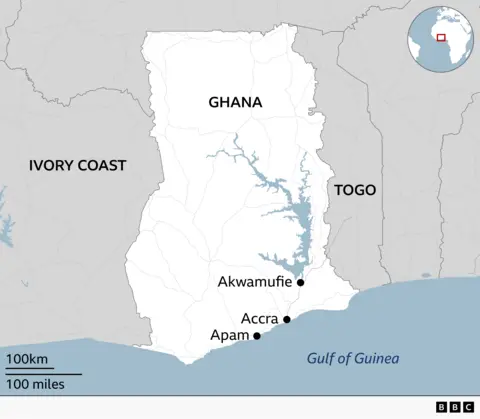
Long before forts, churches or written records marked this coastline, a group of travellers left Akwamufie, the historic capital of the Akwamu Kingdom.
They were led, family accounts say, by a woman, Nana Asumbia.
She is remembered not only as a royal figure, but also as a spiritual leader whose authority extended beyond governance into belief and ritual.
"She was a royal, but at the same time, a chief priest," says local historian Emmanuel Arkoful, a distant relative.
The plaque by the tree, just about legible despite years of erosion, reads:
"To the glory of God In commemoration of Nana Asumbia of Akwamufie in the eastern region of Ghana and grandmother of Nana Kweedwua Santsewadze Twidan Royal Family."
The precise reason for their departure from Akwamufie has been lost to time.
Some accounts suggest conflict or unrest. Others point to a people who were not sedentary but moved around when circumstances required.
But what has endured is not just the fact that they moved. It is how they chose where to stop.
"They travelled with seedlings," Arkoful explains.
Wherever the group paused along their journey westward, they planted one.
"If after a few days the tree showed signs of life and began to take root, they believed that place was meant for them," Arkoful says. "If it died, they moved on."
The tree they carried was not chosen by chance. It is now understood to be Piliostigma thonningii, a hardy species found across Africa also known as the camel's foot or monkey bread tree, known for its ability to survive in difficult conditions and endure for generations.
Across the region, the tree has long held both practical and cultural value.
Its leaves and bark have been used in traditional medicine, its canopy provides shade in exposed environments and its resilience allows it to thrive where other plants struggle.
For a travelling community searching for a place to settle, it made sense.
But for Nana Asumbia, the choice may have gone deeper.
A tree that could survive was not just useful. It was a sign.
Within the family, it came to be known as Santseo.
Oral accounts suggest the group's first major stop after leaving Akwamu was in what is now Accra.
They settled around the present-day General Post Office, in a neighbourhood known as Otublohum.
Even today, people of Akwamu origin still live there, a quiet continuation of a journey that began centuries earlier.
But this was not their final destination.
The travellers moved on, continuing westward along the coast.
The group stopped again near what is now Gomoa Buduburam, along the main Accra-Winneba road. Another sapling was planted. Again, they waited.
This time, the tree did not survive. So, they moved again.
Each failed planting was not just a disappointment.
It was a decision. A sign that they had not yet found where they were meant to be.
The story of how they finally settled in Apam is remembered through an encounter in the forest.
One version of the oral history speaks of a hunter from Gomoa Asin, a royal named Inhune Akubuha.
He had shot an elephant deep in the bush, but the wounded animal did not die immediately. It fled, leaving a trail.
Determined to retrieve it, the hunter followed that trail through dense vegetation until he eventually found the elephant dead.
He returned to inform the others.
"They all came to where the elephant had died," Arkoful says.
It was there that Nana Asumbia planted another sapling.
This time, it survived. After several days, it had taken root in the red coastal soil. For the travellers, that was enough. They settled.
And hundreds of years later the tree is still standing - and thriving. The family home has been built around it and is called Santsiwadzi, after the Santseo tree.
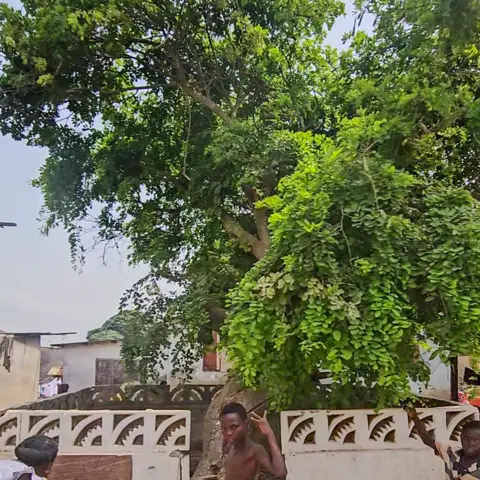
Today, Santseo stands between two visible layers of Ghana's past.
On one side is Fort Patience, a reminder of European trade and colonial ambition. On the other is the Apam Methodist Church, representing the spread of Christianity through coastal communities.
But according to oral tradition, the tree predates both.
"Our people settled here even before the Dutch built the fort," Arkoful says.
If that is true, the tree represents something rare.
A living marker of African history that existed long before it was formally documented.
Nana Asumbia is remembered as a spiritual figure, but the meaning attached to the tree has shifted over time.
With the arrival of European traders and missionaries, Christianity spread rapidly through Apam.
"Our people embraced Christianity completely," Arkoful explains.
The land on which the Methodist church now stands was donated by members of the same extended family connected to the tree.
Gradually, the spiritual significance of the Santseo tree began to fade.
"People didn't want others to think they were idol worshippers," he says.
What remained was something quieter. Not a shrine. But a memory.
 Mark Wilberforce
Today, the tree still stands, its branches shaped by centuries of coastal wind and salt air.
The surrounding area is modest but neatly kept, reflecting the rhythms of a fishing community rather than a formal heritage site.
There are no ceremonies held around it.
And attempts to preserve it can sometimes be misunderstood.
"If you tend to it too much, people think you are worshipping it," Arkoful says.
It reflects a broader tension.
How do you preserve history without being seen to revive beliefs that people have consciously moved away from?
Roughly four decades ago, members of the extended family made a journey in the opposite direction.
They travelled back to Akwamufie. "It was a big celebration," Arkoful recalls.
For generations, oral tradition in Akwamu had spoken of those who had left.
Each time their shrine was consulted, the message was said to be the same: they would return. When they finally did, the reception was emotional.
One member of the visiting group was installed as a Queen Mother, taking the title Nana Asumbia II.
It was a moment that reconnected two communities separated by centuries.
Apam remains a fishing town, its rhythms shaped by the Atlantic Ocean.
On most days, the shoreline is busy with activity. Canoes move in and out with the tide, fishermen casting and pulling nets in a routine that has changed little over time.
But on Tuesdays, everything pauses. No fishing. No boats leaving shore.
Just the sound of the sea. And the tree.
Still standing where it was planted centuries ago. Still rooted in the same red earth. Still carrying a story that was never written down, but never lost. It has lived through generations. It has witnessed movement, settlement, belief and change.
A tree that offered shade, medicine and survival. A tree that guided a people to their home. A tree that endures. Centuries after a group of travellers planted a sapling and waited to see if it would live, the answer is still there.
You may also be interested in:
 Getty Images/BBC