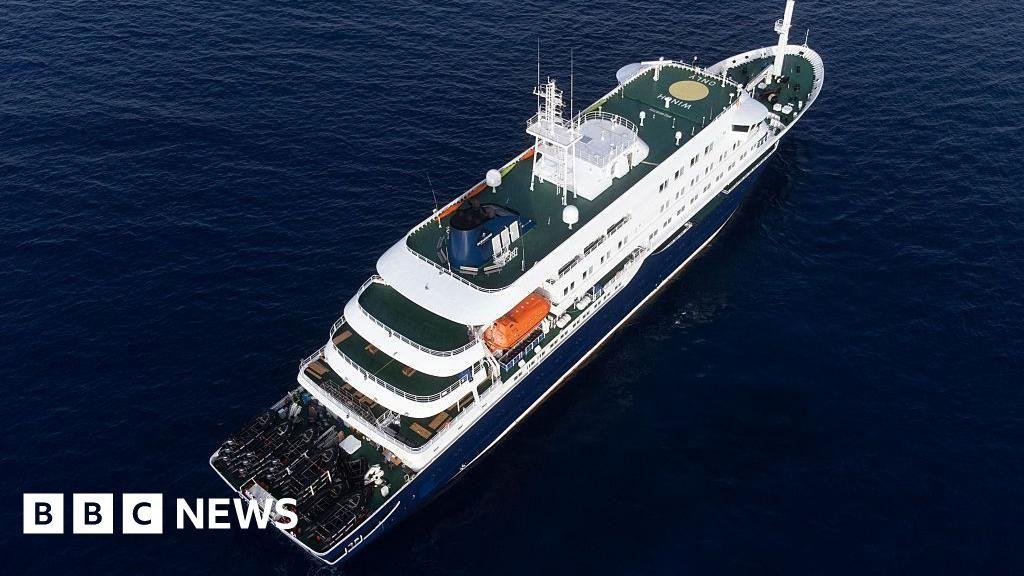
The World Health Organization says it believes there may have been human-to-human transmission of hantavirus on the Dutch cruise ship where three passengers have died.
The virus is usually spread from rodents, but the WHO said in this instance it could have been spread among "really close contacts" aboard the MV Hondius vessel, before stressing that such transmission was rare and the risk to the public was low.
"Some people on the ship were couples, they were sharing rooms, so that's quite intimate contact," WHO official Dr Maria Van Kerkhove said.
The WHO suspects that the first person to fall ill could have contracted the virus before boarding the ship, she added.
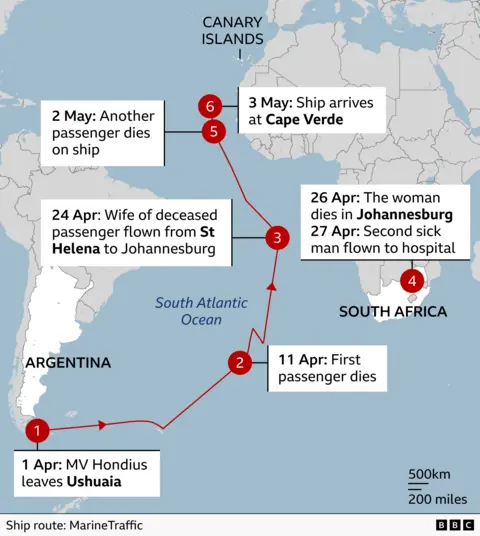
Some 149 people from 23 countries remain on the ship under "strict precautionary measures", the cruise ship's operator, Oceanwide Expeditions, has said. It has been moored off the coast of Cape Verde since Monday, according to the WHO.
Seven cases of hantavirus - two confirmed and five suspected - have so far been identified by officials.
Two of the passengers who died were a Dutch married couple. The wife is confirmed to have had the virus.
One other passenger, a 69-year-old UK national who was evacuated to South Africa for medical treatment, is also confirmed to have the virus.
Hantavirus has not been confirmed in the Dutch woman's husband or the other deceased passenger - a German national who passed away on 2 May.
In a statement, the Dutch couple's family said: "The beautiful journey they experienced together was abruptly and permanently cut short."
"We are still unable to comprehend that we have lost them. We wish to bring them home and commemorate them in peace and privacy," it added.
Testing is taking place for other passengers and crew members who are displaying symptoms.
The MV Hondius ship set sail from Argentina to start its voyage across the Atlantic Ocean around a month ago. It is currently anchored near Cape Verde, off the west coast of Africa.
Investigators are working under the assumption that the Andes strain of the virus, which spreads in South America where the cruise began, has been found in the two confirmed cases.
The organisation was told there were no rats on board, Van Kerkhove said, adding that the risk to the wider public from the disease was low and that hantavirus transmission between humans was uncommon.
She said disinfection was taking place on the ship and those with symptoms or caring for patients were wearing full personal protective equipment.
"Our working hypothesis is that there's probably a couple of different types of transmission that might be happening," Van Kerkhove told BBC Breakfast on Tuesday.
She noted the cruise had visited many different islands, some of which have rodents, which typically spread the virus through their faeces, saliva or urine.
Its "top priority" remains treating the two crew members - of Dutch and British nationality - who were on board with respiratory symptoms, Van Kerkhove said.
They are due to be medically evacuated by aircraft to the Netherlands, alongside a person "associated" with the German national who died, according to Oceanwide Expeditions.
No-one else on the vessel has shown symptoms, the WHO says.

The WHO says Spain has granted permission for the vessel to dock in the Canary Islands, where a risk assessment and further medical monitoring could take place.
But Spain's health ministry has played down speculation that it will take in the ship.
It said in a statement: "Depending on epidemiological data gathered from the boat as it travels past Cape Verde, the most appropriate next stop for it will be decided.
"Until then, the health ministry will not take a decision, as we have explained to the WHO."
A spokesman for Spain's health ministry told the BBC it had not yet received a request for the boat to stop at the Canaries.
However, Spanish authorities are prepared to take charge of the situation should that change, the spokesperson added. That would include providing medical attention, analysis and disinfection.
They would not say whether passengers would be allowed to disembark.
Though they cannot yet leave the ship, one passenger told the BBC on Monday that the mood on the vessel was "pretty good".
"Hopefully the other patients on board will be tested soon and then we'll know what's going on," the passenger, who asked to remain anonymous, added.
Another passenger, travel vlogger Jake Rosmarin, said in a social media post: "There's a lot of uncertainty, and that's the hardest part. All we want right now is to feel safe, to have clarity and to get home."
Are you on the ship or do you know someone who is? If you feel able to do so, please get in touch by using this link or the form below.