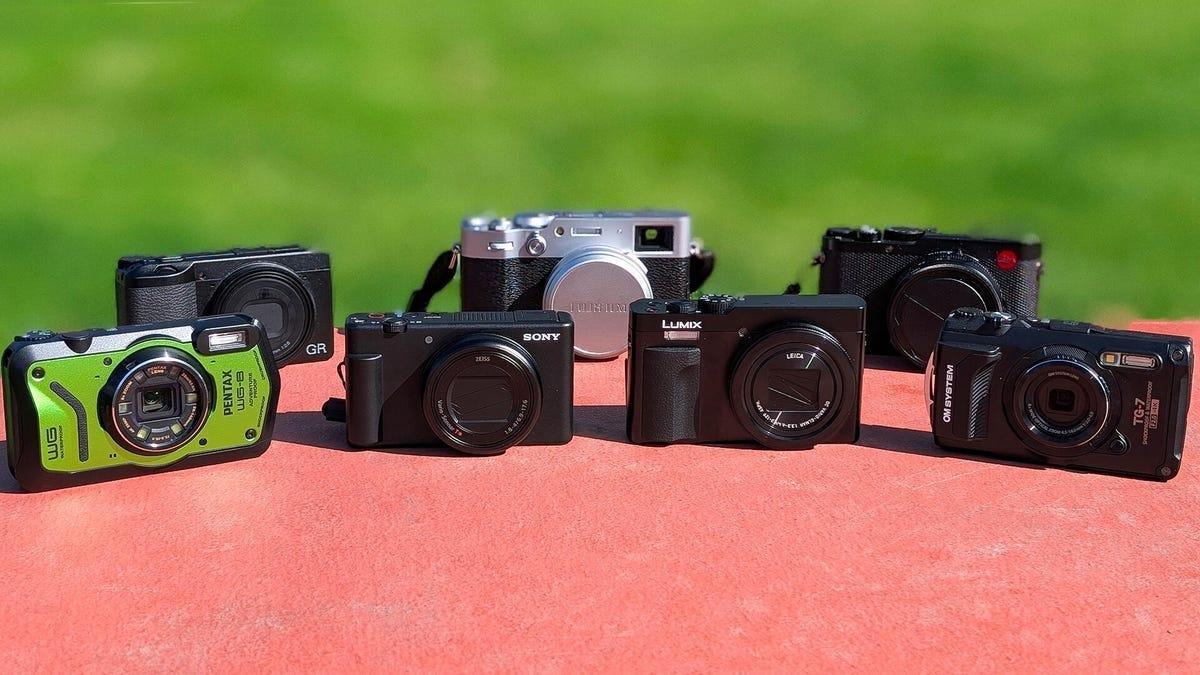
A compact point-and-shoot camera can let you take better, or at least different, photos compared with what you can get with your phone. With bigger image sensors, greater optical zooms and in some cases more rugged bodies, they can do things and go where your phone can't. After more than a decade of decreasing sales, the point-and-shoot camera category is becoming more popular, especially among younger people who didn't grow up with dedicated cameras. Brands like Canon, Fujifilm, Nikon, Panasonic and others have all released new models recently. While most phones can take good photos, the cameras here can help you capture great photos. Here are the best point-and-shoot cameras to get in 2026.
The Lumix ZS99 is a compact point-and-shoot camera with a big zoom range, making it easy to take everything from big group photos to close-ups of wildlife, the moon and architecture. It even records 4K video. It's a great option for taking photos that aren't possible with a phone, though its overall image quality lags behind others on this list.
Pros
- Impressive zoom for its size
- Screen rotates for easy selfies
- Easy to use for beginners, plus some manual features
Cons
- Image quality is decent, but not great
- Compact, but not "small"
- Low-light performance is mediocre
The Ricoh GR IV is an extremely compact, fixed-lens camera with a larger APS-C-size sensor (more typically found in DSLRs). It's capable of impressive image quality, but it's this camera's ability to capture that quality while still fitting in a pocket that makes it stand out from its direct competitors, like the Fujifilm X100VI and Leica D-Lux 8.
Pros
- Excellent size
- Big image sensor
- The ultimate, high-quality stealth camera
Cons
- Fixed screen
- Other cameras on this list offer more flexibility
- Mediocre video
If you'd told me before I started testing point-and-shoots for this guide that not only would I want an expensive, fixed-lens, APS-C camera, but I'd also actually buy one, I wouldn't have believed you. Yet here we are. After two weeks with the Fujifilm X100VI, I spent my own money and bought one. In two decades of reviewing gear, that's only happened a handful of times. This camera is special, but it's not for everyone.
Pros
- A photographer's camera
- Capable of fantastic images
- Film simulation not a gimmick
Cons
- Good luck finding one
- Overkill for most people
- Similar results are possible with other cameras
The Kodak PixPro FZ55 looks like a camera transported through time from 2008... and it performs like it too. If you want that classic digital camera aesthetic to your photos, this camera can absolutely do that.
Pros
- Optical zoom
- Good variety of picture modes, including manual
- A 2000s digital camera transported through time
Cons
- Micro USB
- Feels very cheap
- Not bad but also not great
The Fujifilm Instax Mini LiPlay Plus is a portable photo printer with a built-in digital camera. Essentially, it's a Polaroid instant camera for the modern age. It's chunkier than many of the cameras on this list because it's mostly a printer, housing a replaceable cartridge with 10 prints inside. The camera portion itself is fairly mediocre, leaning perhaps a bit too hard into the "classic" digital camera aesthetic that's quite popular right now. The LiPlay Plus has an interesting twist: Sound. When you take a picture, you can record a few seconds of audio, which will get uploaded to Fujifilm's servers via the camera's app. A QR code is printed on the photo that links to a site where you can hear the audio. It's a clever way to capture a moment. Perhaps most usefully, the LiPlay Plus has image sensors on the front and back, making lining up selfies significantly easier than with previous Instax models.
Pros
- Dual-camera design works well
- Doubles as a printer
- Sound Prints are a neat idea
Cons
- Necessarily a bit chunky
- Odd shutter button placement
- Sound clips disappear after 2 years
What we updated: May 2026
Replaced the Ricoh GR III HDF with the newer Ricoh GR IV. Also added the Fujifilm Instax Mini LiPlay Plus as a pick.
What is the best overall point-and-shoot camera?
The Panasonic Lumix ZS99 is the best point-and-shoot camera overall. Though specific needs might make one of our other picks a better fit, the ZS99 is the quintessential point-and-shoot. It has a compact, pocketable size and an impressive 30x optical zoom. While it shines as a fully automatic camera, it also has manual controls to experiment with. Its 1/2.3-inch sensor is small compared with others on this list, and as a result, its low-light performance isn't great; otherwise, it can capture great photos and videos of subjects near and (very) far.
Pros
- Impressive zoom for its size
- Screen rotates for easy selfies
- Easy to use for beginners, plus some manual features
Cons
- Image quality is decent, but not great
- Compact, but not "small"
- Low-light performance is mediocre
The Lumix ZS99 is a compact point-and-shoot camera with a big zoom range, making it easy to take everything from big group photos to close-ups of wildlife, the moon and architecture. It even records 4K video. It's a great option for taking photos that aren't possible with a phone, though its overall image quality lags behind others on this list.
Why I like it:
It's compact, has a great zoom range and takes good pictures in a variety of situations.
Who is this for?
Anyone who wants a versatile digital camera that will work great in a variety of situations. It's an easy-to-use camera for travel and wildlife photography for posting on social media.
Who shouldn’t buy it:
The image quality is good, but not amazing. There are other cameras on this list that can take better-looking photos, but each has their own drawbacks. The Panasonic's biggest issue is that it's not great in low light, though it does have a built-in flash for that retro "Y2K" look. Also, while there are manual features so you can adjust shutter speed and aperture like a "big" camera, they don't have the range of higher-end cameras, so there's little reason to use any manual modes beyond learning how to use them. Also, the screen, which can pivot up so you can take a selfie, doesn't rotate like others.
The Sony ZV-1 II recommended below is also worth considering. It's more expensive but smaller and has a big 1-inch sensor, so it's better in low light and captures smoother out-of-focus backgrounds (bokeh) for better portraits. Its zoom lens can go wider, but it lacks Panasonic's telephoto reach.
Pros
- Excellent size
- Big image sensor
- The ultimate, high-quality stealth camera
Cons
- Fixed screen
- Other cameras on this list offer more flexibility
- Mediocre video
The Ricoh GR IV is an extremely compact, fixed-lens camera with a larger APS-C-size sensor (more typically found in DSLRs). It's capable of impressive image quality, but it's this camera's ability to capture that quality while still fitting in a pocket that makes it stand out from its direct competitors, like the Fujifilm X100VI and Leica D-Lux 8.
Why I like it:
The small size and big image sensor are a fantastic combination, resulting in extremely high-quality images from a camera that can fit in your pocket. There's a naturalness to its photos that is hard, if not impossible, to match with phone cameras. It's significantly less conspicuous than any other large-sensor camera on this list. It's so pocketable that you can just have it on you at all times, ready to capture a moment, without the bulk of any other camera with this level of image quality. The larger, more expensive Fujifilm X100VI has easier access to functions with its many dials, plus its famous picture recipes, but pretty much everything you can do with the X100VI you can do with the GR IV, with either a few extra steps in the menus and/or some additional work in Photoshop or Lightroom.
Who is this for?
Anyone interested in a compact, stealthy camera for travel, street photography or everyday use that delivers better image quality than phone cameras.
Who shouldn’t buy it:
Updated in 2025, the GR IV isn't much different than its predecessor, the GR III. However, that camera has held its value so well that it's hard to find it used for much less than the GR IV is new. The IV is better enough that it's worth that premium. Like its predecessor, the IV's video capabilities are mediocre, maxing out at 1080p/60. Your phone will likely take better videos. The IV also lacks some of the fancier shooting options of the Fujifilm X100VI, but with a little extra work, you can get similar results. For most people, the base GR IV and its built-in neutral density filter is the best option. There's also the GR IV HDF, which swaps out the NDF for a Highlight Diffusion Filter that softens highlights for an ethereal, otherworldly glow. If you want to restrict yourself to black-and-white photography, there's also the GR IV Monochrome.
Pros
- A photographer's camera
- Capable of fantastic images
- Film simulation not a gimmick
Cons
- Good luck finding one
- Overkill for most people
- Similar results are possible with other cameras
If you'd told me before I started testing point-and-shoots for this guide that not only would I want an expensive, fixed-lens, APS-C camera, but I'd also actually buy one, I wouldn't have believed you. Yet here we are. After two weeks with the Fujifilm X100VI, I spent my own money and bought one. In two decades of reviewing gear, that's only happened a handful of times. This camera is special, but it's not for everyone.
The raw specs are impressive for the category, though not hugely so. It has a clever hybrid viewfinder, with an optical view, an electronic view and a combination of both. Myriad dials and buttons give you fast access to various (and often programmable) features to help you capture the photo you want. The large screen folds out to assist when the camera is above or below eye level.
While the larger sensor and bright lens are certainly a good foundation for quality photos, it's the camera's film simulations that make it such a joy to use. Until this camera, I've never used a color mode preset in any camera I've owned. I want a natural look from the camera, letting me edit to taste later before I post an image. But the film simulations here do such a good job of adjusting an image's aesthetic that little to no editing is required. It's a radically different way to photograph anything in the modern era -- a more filmlike way, if you will.
Why I like it:
People thought I was crazy buying a camera like this when I had a full-frame DSLR, but after owning it for 6 months, including 2 months of travel, I still absolutely love it, and I'm glad I bought it. I'm able to take photos I love with it, with little to know post processing. I still think it's not for everyone, but if you know how to take advantage of its features or are willing to learn, it's great.
Who is this for?
Anyone looking to elevate their photos and who has the knowledge of how to take advantage of the X100VI's various modes and settings (or are willing to learn).
Who shouldn’t buy it:
It's not impossible to get similar results with a different camera, with a small amount of effort. Both the Ricoh GR III (which also has an APS-C sensor) and the Leica D-Lux 8 can capture images of similar quality, for instance. With some time in a photo editor, or just "slapping a filter" on a photo before posting on Instagram, you can get very similar results. You can even save presets, though not as many as the Fuji, to get specific results directly from other cameras.
The biggest issue with the X100VI, however, is its popularity. Good luck finding one. Or at least, good luck finding one at the manufacturer's suggested retail price. Waiting lists are long, and despite Fujifilm continually ramping up production, limited availability seems like it'll be the case for the near future. Also, for a point-and-shoot, it's larger than you might expect. It's bigger than the Leica or Ricoh, though it's still smaller than a typical DSLR and many interchangeable-lens mirrorless cameras. Overall, this shouldn't be a first real camera unless you know exactly what its myriad features do and why you'd want them.
Pros
- Optical zoom
- Good variety of picture modes, including manual
- A 2000s digital camera transported through time
Cons
- Micro USB
- Feels very cheap
- Not bad but also not great
The Kodak PixPro FZ55 looks like a camera transported through time from 2008... and it performs like it too. If you want that classic digital camera aesthetic to your photos, this camera can absolutely do that.
Why I like it:
The FZ55 is a fully-functional digital camera, including optical zoom, a flash and even some manual settings. If you're going for that 2000s "digicam" vibe every shot will have that look.
Who is this for?
Nostalgia hunters or anyone looking for an inexpensive digital camera. The other options here offer better image quality, as do most phones, but the FZ55 works and doesn't cost a lot.
Who shouldn’t buy it:
Image quality is pretty mediocre and even a phone from a few years ago will take better photos. This is just for people who don't want to use a phone or who specifically want that 2000s-era look to their pics.
Pros
- Dual-camera design works well
- Doubles as a printer
- Sound Prints are a neat idea
Cons
- Necessarily a bit chunky
- Odd shutter button placement
- Sound clips disappear after 2 years
The Fujifilm Instax Mini LiPlay Plus is a portable photo printer with a built-in digital camera. Essentially, it's a Polaroid instant camera for the modern age. It's chunkier than many of the cameras on this list because it's mostly a printer, housing a replaceable cartridge with 10 prints inside. The camera portion itself is fairly mediocre, leaning perhaps a bit too hard into the "classic" digital camera aesthetic that's quite popular right now. The LiPlay Plus has an interesting twist: Sound. When you take a picture, you can record a few seconds of audio, which will get uploaded to Fujifilm's servers via the camera's app. A QR code is printed on the photo that links to a site where you can hear the audio. It's a clever way to capture a moment. Perhaps most usefully, the LiPlay Plus has image sensors on the front and back, making lining up selfies significantly easier than with previous Instax models.
Why I like it:
It's a camera and a printer. It's great to be able to physically share a picture you just took with a friend. The LiPlay Plus isn't quite pocketable, but it's small enough to be portable. The printer is actually better than the camera, but conveniently, you can connect to the LiPlay Plus to your phone and have it print photos you took with it or any other camera.
Who is this for?
Anyone who likes the idea of being able to print photos on the go while having the convenience of a screen and the ability to record a few seconds of audio.
Who shouldn’t buy it:
The built-in cameras are quite poor, about on par with the cheapest options on this list. It's convenient if you don't want to carry another camera, but for many people, the low-fi nature might get old, and they'll just use the LiPlay Plus as a photo printer.
Pros
- Leica aesthetic
- Great lens
- A bit of zoom for flexibility
Cons
- Expensive for a Micro 4/3 camera
- Not as pocketable as the Ricoh GR III
- Not as "fun" as the Fujifilm X100VI
The Leica D-Lux 8 is a sort of runner-up in both the travel and phone upgrade categories. It has something neither the Ricoh nor the Fujifilm do: an optical zoom. It's not much, ranging from a fairly wide 24mm to a slight telephoto 75mm, but it's more than the fixed offerings of the others. Inside is a 22MP Micro 4/3 sensor, of which 17MP is used. The body's design is gorgeous in that timeless Leica way.
Why I like it:
It's a compact camera with some zoom and great image quality. Images are sharp with rich color and a soft bokeh. It's not specifically "better" than the Ricoh or Fuji but does offer something a bit different than both.
Who is this for?
Anyone who wants something smaller than the Fuji and with the added flexibility of a zoom lens.
Who shouldn’t buy it:
Like any Leica product, it's pricey. The Fujifilm has a larger APS-C sensor for similar money and has all its fun film simulations. The Ricoh GR III also has a larger sensor and is even smaller and cheaper. Neither has a zoom, however. Other than the price, there's nothing wrong with the D-Lux 8, but it's not the standout in any particular category either.
Pros
- Remarkable 125x optical zoom
- Bluetooth and USB-C
- Some use beyond its zoom
Cons
- An absolute unit of a camera
- Zoom is conspicuous (to put it mildly)
- Slow lens and small sensor
The Nikon Coolpix P1100 is in a class by itself, mostly because the superzoom camera category has basically disappeared. The fact that Nikon released this refreshed model last year is all the more astonishing. The P1100's 125x optical zoom range, 24-3,000mm (35mm equivalent) is rather remarkable for a camera this size and price. It's capable of zooming in on subjects really far away for photos that seem like you were right next to them. It lets you capture images and videos that you couldn't get at all with a phone and really, any other camera without spending many thousands of dollars on lenses.
Why I like it:
It offers more zoom than any other camera. If your goal is to get up close to something, nothing can do that better more than the P1100.
Who is this for?
If you're an avid birder, you're headed on a safari or visiting a National Park known for animals, the P1100 can absolutely let you capture images not possible with other cameras. However, other cameras can take better photos. So it comes down to what you're really looking for. If you don't absolutely need that incredible zoom range, the Panasonic ZS99 (at the top of this guide) has "just" a 30x zoom but uses the same size image sensor, is cheaper and far smaller.
Who shouldn’t buy it:
There are some tradeoffs. The P1100 uses a very small image sensor, smaller than what's found on many modern phones. As such, the camera struggles in low light. Compounding that issue, the lens is a fairly slow f8 when fully zoomed in, meaning you need a fairly slow shutter speed to let in enough light to get a correctly-exposed image. This means that even with optical image stabilization, you're usually dealing with lens shake/blur and if your subject is moving at all, it could be blurred to. The images you capture also don't have the detail or vibrancy of other modern cameras. However, none of those have the P1100's zoom range.
Pros
- Waterproof to 20m
- 4K video recording
- 5x zoom
Cons
- Image quality isn't impressive
- Few first-party accessories
The Pentax WG-8 is a compact, rugged point-and-shoot camera that's waterproof down to 65.6 feet (20 meters). Its 20-megapixel sensor can record 4K30 video, and it even has a 5x optical zoom. However, the camera's small sensor size and relatively slow lens make low-light imaging poor. A bright flash, though, helps underwater.
Why I like it:
It's a rugged and inexpensive waterproof camera with optical zoom and a built-in flash.
Who is this for?
Anyone looking for a rugged camera, either as a kids first camera or to take on adventures where it will get wet.
Who shouldn’t buy it:
The image quality is reasonable but definitely doesn't stand out. This camera's main selling point is its ruggedness. It will work great for images and videos, especially while you're snorkeling or swimming and for posting on social media.
There are two things to consider. First, a GoPro or other action camera will produce better images and video and be physically smaller. With a dive case, they can go even deeper than the WG-8 for around the same price. However, GoPros have a fixed, wide-angle lens, which isn't as flexible as the WG-8's zoom in some situations.
The other thing to consider is the OM System TG-7, mentioned below. On the outside, it's nearly identical to the WG-8, but it has a slightly different zoom range. Its image quality is generally better, and it can zoom while recording. More usefully, there are a lot of accessories available from OM System, including a dive case that lets you get to scuba depths with the camera, as well as wide and tele lens converters, flash diffusers and more. The TG-7's starting price is higher, though, at $500. It's a better camera; if image quality is your primary goal, that's the one to get. If the camera's ruggedness is what's most important, the price of the WG-8 makes it the best option.
Pros
- Small
- Fully articulated screen
- 1-inch sensor
Cons
- Screen impossible to see with some sunglasses
- Video-focused (possibly a good thing)
- Almost as expensive as some APS-C cameras
Ostensibly a vlogger camera, the Sony ZV-1 II is an extremely capable point-and-shoot overall. A large, 1-inch sensor sits behind a zoom lens that ranges from an ultrawide, GoPro-esque 18mm to a portrait-friendly 50mm. A fully articulated screen lets you see what you're capturing with the camera in nearly any position. If you don't need the long reach of the Panasonic ZS99's zoom, the Sony can capture better photos and does so in a smaller body. It's far more expensive, though.
Why I like it:
This is a great step up from a phone or GoPro while offering similar ease-of-use to both.
Who is this for?
Anyone who wants to get better photos and videos compared to their phone, but isn't interested in spending the money on a larger, more elaborate setup.
Who shouldn’t buy it:
Though it's generally easy to use, there are a few issues. The LCD screen was nearly impossible to see when using the camera outside with my sunglasses on. The polarization matched perfectly -- a problem I didn't have with any other camera I tested in normal use. The lens, great for selfies and arms-length recording, doesn't let you "zoom in" on things, like the Panasonic can. A list price of $900 is also expensive, close in price to the Ricoh GR III with that camera's far larger, better in low light, APS-C sensor. Though with that camera, you lose any zoom or articulated screen.
If you don't mind the higher price and prefer wide over telephoto, the ZV-1 II is a great all-around point-and-shoot camera that takes great photos and videos.
OM System TG-7: The TG-7 from the company formerly known as Olympus is a step up from the Pentax WG-8 we recommend above. It has slightly better image quality, especially underwater, and has a variety of accessories available to make it far more capable in a wider range of situations. It can also shoot raw images, so if you're editing photos in Lightroom/Photoshop you'll have more range to make changes. The only reason it's not the main pick is its price, 30% more than the Pentax. The savings seem logical for most people for something designed to be abused. For anyone who knows they want more than the Pentax can offer, the TG-7 is a superior camera.
Gavonde S100: The Gavonde S100 is an ultra-cheap ($50 as of this writing) digital camera. Its specs are exaggerated to the point of absurdity, but the images it captures are not terrible. They're not good, either, but they're better than other cameras in this price range. Even a 10-year-old phone will take better images, but for kid's first camera it's impressively not bad.
Ricoh GR III HDF: The GR IV, recommended above, is the newer version of this camera. They're not hugely different, but used GR IIIs are hard to find and not much cheaper than the GR IV which is a better camera overall.
Gavonde S100 image sample. Note: For the best results, set the exposure to -2.
Geoffrey Morrison/CNETWhat is a point-and-shoot camera?
A point-and-shoot camera has a fixed lens, i.e., it can't be removed. And the camera is typically small and easily portable. Compare this to DSLR and most mirrorless cameras, which are usually much larger and have interchangeable lenses. In their heyday, most point-and-shoots had 3x or longer zoom lenses. However, with many people using their phones as their main camera, the category has shifted to lenses with a single focal length, called a prime lens.
Will a point-and-shoot camera let me take better photos?
Possibly. A point-and-shoot camera, in itself, won't necessarily take "better" photos. In the hands of a skilled photographer, even a phone camera can take remarkable shots. The camera doesn't matter nearly as much as the photographer's skill (which anyone can learn, if interested). That said, the lenses and large image sensors in many point-and-shoots can definitely help you take different photos than what's possible with a phone. (Plus, it's distraction-free.) If your interest grows and you learn more about photography, these cameras can offer additional tools to get the photos you want.
Should I get a mirrorless or DSLR instead?
It depends. The same caveats in the above question apply here. Getting a better camera doesn't automatically mean you'll take better photos. You should learn all you can with the camera you have -- phone or otherwise -- and "grow into" a more expensive camera once you know what you're looking for. If you know why you'd want a prime lens over a zoom, why you'd want f2 over f4, what aperture priority is and why you'd like to use it, then perhaps a mirrorless or DSLR is right for you.
Is a point-and-shoot camera good for beginners?
Generally, yes, given the caveats listed in the above two questions. Be sure the camera has manual modes to adjust the aperture and shutter speed. Learning how those, along with ISO, will change how an image looks is the foundation of all photography.
Should I buy used instead?
Maybe. There's a strong resurgence in the popularity of older point-and-shoot cameras, sometimes called "digicams" on social media. These cameras, with their, let's be honest, ancient tech, often have a unique look that's hard to mimic with postprocessing and filters. If that's what you're going for, and not the ultimate in picture quality, but a specific aesthetic, sometimes an inexpensive used camera can do that without any editing.
However, many of these popular cameras are upward of 20 years old. That's multiple lifetimes in tech. Not being able to find a battery, not being able to find a memory card (remember MemoryStick? No? There's a reason), and definitely not being able to wirelessly connect to your phone, all present significant challenges, especially for anyone not super techy. As long as you keep all that in mind, you can definitely save money getting used.
I've bought used camera gear on KEH, and a similar company is MPB. Both offer used gear that's been checked out by experts to ensure it actually works. What you find there might cost a little more money, but it offers peace of mind that you'll get a working camera. There's also Adorama, B&H Photo, local stores (if you're lucky) and, of course, there's Facebook Marketplace, Craigslist and eBay.
For more info, check out my article on How and Where to Buy Used Camera Gear to Save Money.
What about this Canon/Sony/Nikon/etc. camera I heard about?
There are several popular cameras we haven't covered in this guide, including models from Sony, Canon, Nikon, Panasonic and others. These cameras often appear on these company's websites with a cryptic "out of stock" message. Does this mean they might someday be in stock? Maybe, maybe not. In several cases, in my initial research for this guide, I was told by representatives that the company was "de-prioritizing" a camera and wanted to focus on another model. This is almost always company-speak for "if there's any left in some random warehouse, we're selling them, but we're not making more." If a camera is a few years old, especially pre-2020, used is probably the only option, as it's doubtful it's coming back.
What is happening is that companies are refreshing older models, usually adding USB-C so they can be sold in Europe, and Bluetooth 5.x for easier connectivity with modern phones. That's something we'll likely see more of in the future.
Beyond megapixels and sensor sizes, the main question is how you plan on using the camera. We've set up our recommendations based on that idea. Are you looking for something with a greater zoom than your phone, for wildlife photos? Do you want something that lets you capture better images than your phone? How about something small and discrete for travel and street photography? All the cameras on our list can take "good" photos, some better than others, but as the saying goes, the best camera is the one you have with you. One that fits your needs is more important than its raw specs.
Sensor sizes
Broadly speaking, a larger sensor can absorb more light. This improves image quality in low light and also makes better bokeh possible, which is the soft, pleasing, out-of-focus background common with close-up and portrait photography. So, all else being equal, a larger image sensor makes better photos possible.
This isn't an absolute, carved-in-stone rule, however. In most situations, many people would have a hard time telling the difference between the APS-C sensor in the Ricoh GR III and the smaller Micro Four Thirds sensor in the Leica. Lenses matter, processing matters, the specific sensor matters and more than all that, the photographer's skill matters. An experienced photographer with a high-end phone could easily take "better" pictures than someone with a huge, full-frame mirrorless camera who doesn't know how to use it. Learning to use whatever camera you have will result in better photos, not just buying a more expensive camera.
In terms of what we've reviewed here, these are sensor sizes from smallest to largest:
- 1/2.3-inch: Panasonic ZS99, Ricoh WG-8, Nikon P1100, many phones
- 1-inch: Sony ZV-1 II
- Micro 4/3: Leica D-Lux 8
- APS-C: Fujifilm X100VI, Ricoh GR III
- Full-frame (no cameras in this guide): The same size as a 35mm negative used in many mid- and higher-end mirrorless and DSLR cameras.
The smallest sensors in the cameras we've reviewed in this guide are slightly larger than the smallest shown in this diagram (green box).
By Autopilot, CC BY-SA 3.0Megapixels
All modern cameras can take extremely high-resolution images. You can print these images, and all will look fine on social media. Most point-and-shoot cameras are usually in the 20-25 megapixel range. This allows for a fair amount of cropping and you'll still have a detailed image. The Fujifilm X100VI is an exception, with a 40-megapixel sensor. You can zoom in on the images from this camera or print larger images that still look sharp.
Higher megapixel numbers don't reflect overall image quality. Resolution is merely one aspect of an image's appearance, and many other factors are more important. A camera with a big 2-megapixel full-frame sensor will be able to produce a better-looking image than a tiny 50-megapixel 1/2.6-inch sensor in a phone.
After checking settings and features, I spent several days, often more, with each camera, taking photos and videos in a variety of situations. This included day and night, inside and out, and a variety of subjects, including animals, people, landscapes and more. In the case of this guide, most of the cameras were available at the same time, allowing for the comparison of nearly exact subjects and lighting conditions.
The results are then scrutinized and pixel-peeped on a QD-OLED monitor and compared side by side.
In addition to covering audio and display tech, Geoff does photo tours of cool museums and locations around the world, including nuclear submarines, aircraft carriers, medieval castles, epic 10,000-mile road trips and more.
Also, check out Budget Travel for Dummies, his travel book, and his bestselling sci-fi novel about city-size submarines. You can follow him on Instagram and YouTube.