I've been testing Bluetooth speakers for 14 years, starting with 2012's Jawbone Big Jambox. Today, wireless speakers come in all shapes and sizes, everything from tiny "micro" Bluetooth speakers that you can wear to big Bluetooth boom boxes that pump out powerful sound that can fuel your outdoor pool and beach parties. Many are fully waterproof, and some even float. I've included options across every size and price range, with plenty of affordable picks for those who don't want to spend much.
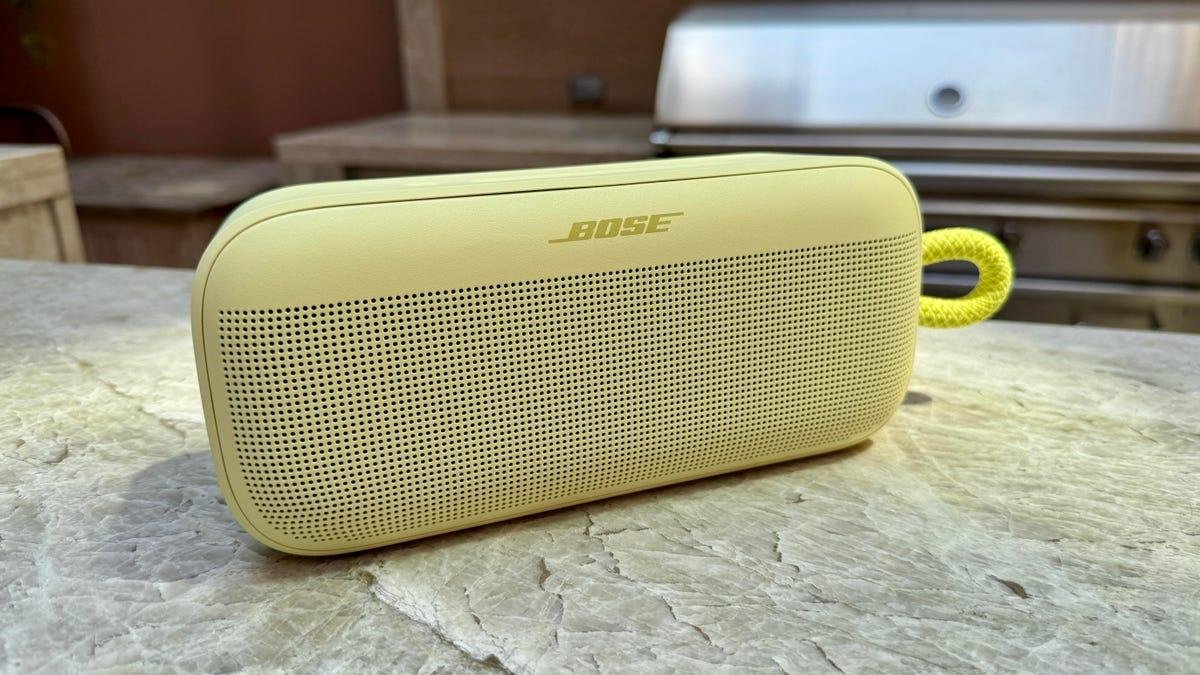
As Bose continues to expand its SoundLink portable Bluetooth speaker line, it's become harder to choose which is best for you. That said, the new-for-2025 SoundLink Plus ($269, £250, AU$430), which sits between the more compact second-gen SoundLink Flex ($149, £150, AU$250) and the beefier and pricier SoundLink Max ($399, £400, AU$600), may just be the best of the bunch, the goldilocks of Bose Bluetooth speakers. While it can't play quite as loud or deliver as much bass as the larger Max, it costs significantly less and puts out clear, potent sound that's a big step up from the Flex's sound. It strikes the right balance of performance and price, earning a CNET Editors' Choice award in the process. Read my full review.
Pros
- Sleek design with integrated rope loop
- IP67 waterproof, dustproof and shock-resistant
- Impressive sound for its size with fairly robust, well-defined bass and good clarity
- EQ settings in Bose companion
- USB-C charge out allows you to power up a phone and other devices
Cons
- While it's $130 less than the SoundLink Max, it's still pricey
- No built-in microphone for speakerphone capabilities
- No auxiliary input
I liked the original Soundcore Motion Boom, which made our best Bluetooth speakers list and was one of the better mini boom box Bluetooth speaker values over the last few years, selling for around $80. The 3.75-pound Boom 2 costs more but sounds substantially better (read full review), with more than double the power rating of the original, so it not only plays louder but kicks out more bass and offers better clarity at higher volumes (it's equipped with two tweeters and one subwoofer). It also has a couple of built-in LED lights to help create that party vibe. It's an impressive-sounding speaker for its size and a good value.
Pros
- Well-priced
- Fairly compact yet delivers impressive sound with big volume and strong bass
- Waterproof and floats
- USB-out port
- LED lighting
- Good battery life
Cons
- No dust-resistance rating
While the Ranger features very good sound for its size and puts up an admirable fight against other premium Bluetooth speakers like the Bose SoundLink Plus and JBL Charge 6, what really sets it apart is its design, especially its built-in magnets. I've tried a few other speakers with integrated magnets aimed at golfers and boaters, including the Rokform G-Rok ($100), but the Ranger plays louder and sounds better. Although it's somewhat pricey, it's easy to recommend. Read my full review.
Pros
- Very good sound with surprising amount of bass for a compact Bluetooth speaker
- Waterproof and dust-proof rugged design with built-in handle and tie-down anchor
- Strong magnets allow you to stick the speaker to anything metal
- Good battery life (up to 25 hours)
Cons
- No companion app
- No sound modes or equalizer option to tweak the sound
Sony released a couple of new-for-2025 portable Bluetooth speakers, the ULT Field 3 ($200) and ULT Field 5 ($330), to fill out its ULT line, which now includes six models. I liked both the ULT Field 3 and ULT Field 5. Both are IP67 waterproof, dustproof, rustproof and shock-resistant. They include a removable shoulder strap and offer significantly improved sound over their predecessors, with more bass and better overall clarity. As you might guess, the larger ULT Field 5 delivers a bigger sound with more bass than the ULT Field 3. While somewhat pricey, it's one of the best-sounding Bluetooth speakers I've tested in its size class and is also equipped with party lighting and a USB charge-out port. Battery life is rated for up to 20 hours at moderate volume levels (or 10 with party lighting on).
Pros
- Impressive sound
- Attractively styled
- P67 waterproof, dustproof, rustproof and shock-resistant
- Party lighting
- USB-C charge out
- Decent party life
Cons
- Fairly pricey
- Somewhat hefty
When the SoundLink Flex speaker launched, Bose made some bold claims about its new Bluetooth speaker, particularly its bass performance. But it mostly lived up to the hype and is arguably the best-sounding wireless speaker for its compact size. A second-gen model quietly arrived in October 2024 that adds a few new features, including a new customizable shortcut button, Bose app compatibility (you can now tweak the sound profile with an equalizer and create a SimpleSync connection with another compatible Bose product) and support for the AAC and AptX audio codecs. It's also equipped with Bluetooth 5.3 instead of Bluetooth 4.2. While those aren't major upgrades, they do make an excellent portable Bluetooth speaker slightly better.
Pros
- Impressive volume for its compact size, can fill a living room with sound with no distortion at higher volumes
- Very good bass and good clarity in the treble and midrange
- Prop it up horizontally, lay it down flat or hang it vertically by its sturdy integrated loop
- Fully waterproof and dustproof with IP67 rating (and also floats)
- Automatically optimized speakerphone with built-in microphone for voice calling
- Longer battery life
Cons
- No audio input for wired listening
- Silicone finish on back attracts some dust and lint
- Uses Bluetooth 4.2 instead of 5.1
BLUETOOTH SPEAKER DEALS OF THE WEEK
Deals are selected by the CNET Group commerce team, and may be unrelated to this article.
What is the best Bluetooth speaker overall?
Currently, the Bose SoundLink Plus tops our list, striking the right balance of performance and price, earning a CNET Editors' Choice award in the process. But there are plenty of other great options depending on your use-case scenario, including the value-priced Soundcore by Anker Boom 2, the rugged Turtlebox Ranger, tiny Tribit Stormbox Micro 3 and very good sounding Sony ULT Field 5.
What we updated: May 2026
We added the Turtlebox Ranger, Tribit Stormbox Micro 3 and Anker Soundcore Boom Go 3i and moved several products to the Other Bluetooth Speakers We Tested section.
Pros
- Sleek design with integrated rope loop
- IP67 waterproof, dustproof and shock-resistant
- Impressive sound for its size with fairly robust, well-defined bass and good clarity
- EQ settings in Bose companion
- USB-C charge out allows you to power up a phone and other devices
Cons
- While it's $130 less than the SoundLink Max, it's still pricey
- No built-in microphone for speakerphone capabilities
- No auxiliary input
As Bose continues to expand its SoundLink portable Bluetooth speaker line, it's become harder to choose which is best for you. That said, the new-for-2025 SoundLink Plus ($269, £250, AU$430), which sits between the more compact second-gen SoundLink Flex ($149, £150, AU$250) and the beefier and pricier SoundLink Max ($399, £400, AU$600), may just be the best of the bunch, the goldilocks of Bose Bluetooth speakers. While it can't play quite as loud or deliver as much bass as the larger Max, it costs significantly less and puts out clear, potent sound that's a big step up from the Flex's sound. It strikes the right balance of performance and price, earning a CNET Editors' Choice award in the process. Read my full review.
Pros
- Well-priced
- Fairly compact yet delivers impressive sound with big volume and strong bass
- Waterproof and floats
- USB-out port
- LED lighting
- Good battery life
Cons
- No dust-resistance rating
I liked the original Soundcore Motion Boom, which made our best Bluetooth speakers list and was one of the better mini boom box Bluetooth speaker values over the last few years, selling for around $80. The 3.75-pound Boom 2 costs more but sounds substantially better (read full review), with more than double the power rating of the original, so it not only plays louder but kicks out more bass and offers better clarity at higher volumes (it's equipped with two tweeters and one subwoofer). It also has a couple of built-in LED lights to help create that party vibe. It's an impressive-sounding speaker for its size and a good value.
Waterproof (IPX7-rated) with a floatable design, the speaker's battery life is rated at up to 24 hours at moderate volume levels (it charges via USB-C), and you can tweak the sound and customize the lighting with the Soundcore app for iOS and Android. There's also a USB-out port to charge your devices. Read full review.
Pros
- Very good sound with surprising amount of bass for a compact Bluetooth speaker
- Waterproof and dust-proof rugged design with built-in handle and tie-down anchor
- Strong magnets allow you to stick the speaker to anything metal
- Good battery life (up to 25 hours)
Cons
- No companion app
- No sound modes or equalizer option to tweak the sound
While the Ranger features very good sound for its size and puts up an admirable fight against other premium Bluetooth speakers like the Bose SoundLink Plus and JBL Charge 6, what really sets it apart is its design, especially its built-in magnets. I've tried a few other speakers with integrated magnets aimed at golfers and boaters, including the Rokform G-Rok ($100), but the Ranger plays louder and sounds better. Although it's somewhat pricey, it's easy to recommend. Read my full review.
Pros
- Impressive sound
- Attractively styled
- P67 waterproof, dustproof, rustproof and shock-resistant
- Party lighting
- USB-C charge out
- Decent party life
Cons
- Fairly pricey
- Somewhat hefty
Sony released a couple of new-for-2025 portable Bluetooth speakers, the ULT Field 3 ($200) and ULT Field 5 ($330), to fill out its ULT line, which now includes six models. I liked both the ULT Field 3 and ULT Field 5. Both are IP67 waterproof, dustproof, rustproof and shock-resistant. They include a removable shoulder strap and offer significantly improved sound over their predecessors, with more bass and better overall clarity. As you might guess, the larger ULT Field 5 delivers a bigger sound with more bass than the ULT Field 3. While somewhat pricey, it's one of the best-sounding Bluetooth speakers I've tested in its size class and is also equipped with party lighting and a USB charge-out port. Battery life is rated for up to 20 hours at moderate volume levels (or 10 with party lighting on).
Pros
- Impressive volume for its compact size, can fill a living room with sound with no distortion at higher volumes
- Very good bass and good clarity in the treble and midrange
- Prop it up horizontally, lay it down flat or hang it vertically by its sturdy integrated loop
- Fully waterproof and dustproof with IP67 rating (and also floats)
- Automatically optimized speakerphone with built-in microphone for voice calling
- Longer battery life
Cons
- No audio input for wired listening
- Silicone finish on back attracts some dust and lint
- Uses Bluetooth 4.2 instead of 5.1
When the SoundLink Flex speaker launched, Bose made some bold claims about its new Bluetooth speaker, particularly its bass performance. But it mostly lived up to the hype and is arguably the best-sounding wireless speaker for its compact size. A second-gen model quietly arrived in October 2024 that adds a few new features, including a new customizable shortcut button, Bose app compatibility (you can now tweak the sound profile with an equalizer and create a SimpleSync connection with another compatible Bose product) and support for the AAC and AptX audio codecs. It's also equipped with Bluetooth 5.3 instead of Bluetooth 4.2. While those aren't major upgrades, they do make an excellent portable Bluetooth speaker slightly better.
The second-gen SoundLink Flex is available in black, blue dusk, sandstone and a new alpine sage color. Like the original, it's equipped with Bose's PositionIQ technology to automatically detect the speaker's orientation and deliver optimized sound based on whether it's upright, hanging or flat on its back.
Pros
- Palm-size Bluetooth speaker sounds impressive for its ultracompact size with better sound than its predecessor
- Built-in strap and magnets in base
- Half the price of Bose's SoundLink Micro 2
- Long wireless range (up to 45 meters) with reliable connection
- Strong battery life (up to 24 hours)
- Can be used as a speakerphone and a power bank to charge your phone
Cons
- Design is a little generic
- Distorts at higher volumes (you can only push it so hard)
- Speakerphone performance is only OK
While Tribit's palm-size Stormbox Micro Bluetooth speakers have always had somewhat generic designs, they've managed to exceed my expectations for sound quality for their size. The third-generation Stormbox Micro 3 is still a little generic looking, but it adds a magnetic base and improves upon the acoustics of its predecessors, as well as doubling its battery life. A worthy upgrade, it earns a CNET Editors' Choice as a value pick in the micro speaker category, costing half the price of Bose's SoundLink Micro 2. Read my full review.
Pros
- It's a little bigger than the original but still very compact
- Impressive sound for its tiny size
- Sound is improved with more bass and better overall clarity
- Fully water- and dustproof with IP67 rating
- Durable design
- Double the battery life of the original (up 12 hours)
- USB-C charging
Cons
- Pricey for a tiny Bluetooth speaker
- No speakerphone capabilities (no microphone)
- Despite sound improvements, don't expect it to produce a ton of bass
Bose's most compact Bluetooth speaker, the SoundLink Micro, has finally been upgraded after eight years (yes, it was first released in 2017). Slightly larger than the original, this second-gen model offers Bluetooth 5.4, USB-C charging instead of the old micro USB, improved battery life and sound quality, plus a new integrated Velcro strap for attaching it to a backpack strap, bike handlebar or just about anything else. Although its list price has gone up to $129, the Bose SoundLink Micro sounds remarkably decent for its tiny size, delivering more bass than other pocketable speakers. It's a fully waterproof Bluetooth speaker and available in two color options: blue and black.
While this model is truly pocket-size -- and that's certainly an appealing feature -- the bigger but still compact SoundLink Flex sounds better and is also the better value, though it costs more.
Pros
- 15W palm-sized Bluetooth speaker sounds impressive for its ultracompact size
- Good build quality
- Dual-slot strap transforms between clip mode (attach to backpack/bike) and loop mode (for holding)
- Half the price of Bose's SoundLink Micro 2
- Built-in lighting element and precise battery life indicator
- Strong battery life (up to 24 hours)
- Can be used as a power bank to charge your phone
- Equalizer settings and voice amplifier feature in companion app
Cons
- No speakerphone functionality
- Arguably doesn't sound quite as good competing models from Bose and Tribit (but it's close)
Anker sells a lot of its cheaper Soundcore Select 4 Go micro Bluetooth speakers, which sell for a little more than $20. But its newer Soundcore Go 3i (not to be confused with the larger Boom 3i) is a significantly better-sounding 15W palm-sized speaker with far superior build quality and a built-in lighting element to jazz things up (you can turn it off if you want). Like the Bose SoundLink Micro (2nd Gen) and Tribit Stormbox Micro 3, the Soundcore Go 3i has an integrated strap that lets you attach the speaker to your bike's handlebars or clip it to a backpack strap. I didn't think it sounded quite as good as those competing models, but it does play pretty loud and produces a decent amount of bass for its ultracompact size (I thought the similarly priced Stormbox Micro 3 had slightly better clarity and a slightly wider soundstage, but the differences are small). I appreciated the built-in LED that shows just how much battery life is remaining, and that you can use the speaker as a power bank to charge your phone in a pinch. It's one of top micro Bluetooth speakers out there for the money.
Pros
- Impressive sound quality with newly-engineered woofer system for better bass definition and wide soundstages
- Very good volume for its size, and can link multiple Pills in amplify mode to further boost sound
- USB-C audio for lossless wired listening and charge-out feature
- IP67 waterproof and dustproof with soft-to-the-touch rubber finish
- Good speakerphone functionality with clear voice calling and background noise elimination
- Integrated detachable lanyard for easy portability and listening options
Cons
- No auxiliary input for wired lossless listening
- Heavier than Bose SoundLink Flex
The Beats Pill has improved in some key ways from its predecessor, particularly when it comes to sound quality, durability, battery life and price point. I do like the form factor and lighter weight of the Bose SoundLink Flex. But the Pill does have a few extras like USB-C audio wired mode and speakerphone functionality that are appealing.
You'll have to decide how important those extras are when weighing the Pill against the Bose SoundLink Flex. But any way you look at it, the Pill is a very good compact Bluetooth speaker. Like the Bose, it's an easy portable wireless speaker to recommend, especially if its price dips by $20 to $30, as the SoundLink Flex's price sometimes does during flash sales.
Pros
- Excellent sound with better bass, clarity and minimal distortion at higher volumes
- Fully dust- and waterproof and ruggedly designed with removable handle for easy portability and more listening options
- USB-C audio for lossless wired connection that can also be used as a charge-in or charge-out port
- Good battery life (up to 24 hours)
JBL hasn't radically redesigned the Charge 6 on the outside -- it looks pretty similar to its predecessor and weighs the same (2.11 pounds) -- but it does feature better sound, battery life and lossless audio over a USB-C connection. One of the more noticeable external changes is to the new model's charge-out port (that port is why the speaker line is called "Charge"). Instead of a USB-A out port hidden under a gasket, there's a single exposed USB-C port that's both charge-in and charge-out. It allows you to use this fully waterproof and dustproof (IP68) speaker as a power bank and charge devices like your smartphone while streaming music to the speaker. Additionally, JBL has added a removable handle to the Charge 6.
The larger Charge has always sounded significantly better than the smaller Flip, and that hasn't changed with the Charge 6, even as the Flip 7 has also improved its sound quality. The Charge 6 produces more bass and a bigger overall sound with minimal distortion at higher volumes (both speakers feature better overall clarity). While the Flip 7's smaller size makes it easier to carry around, the Charge 6 is worth the extra money if sound quality is a priority. I have some quibbles with its somewhat high price -- its list price is $20 higher than the Charge 5's -- but the Charge 6 is easily one of the best speakers in its size class.
Pros
- Improved sound from its predecessor, with superior bass and treble performance (excellent sound for its size)
- Improved battery life (up to 30 hours)
- Battery is replaceable
- Fully waterproof and dustproof (IP67 rating)
- Built-in microphone for speakerphone capabilities
- USB-C charge in/out port and auxiliary input
Cons
- Fairly pricey
- No USB-C audio (wired is supported only through 3.5mm aux input)
I liked Marshall's original Middleton speaker, which sounded very good for its size, and this second-gen Middleton sounds noticeably better, with improved tonal balance and a deeper, better-defined bass (superior bass extension overall). Plus, it has improved treble performance that adds more depth and detail to the sound. Like its predecessor, the Middleton 2 is equipped with Marshall's 360-degree True Stereophonic technology, which helps widen the soundstage and makes the speaker sound much bigger than its relatively compact size.
Much of the sound improvements are due to the speaker's upgraded amps, which deliver 80W of power compared to the original's 60-watt power rating, with more power devoted to driving the two woofers (30 watts instead of 20 watts). Battery life has also been boosted from a little more than 20 hours to 30 hours at moderate volume levels, and the speaker's battery is replaceable, according to Marshall.
Additionally, the speaker has an auxiliary input and USB-C charging port that not only allows you to charge the speaker but charge other devices, turning the speaker into a power bank.
Not only is this new model fully waterproof and dustproof (IP67 rating), it also has a built-in microphone, so you can use it as a speakerphone. (The original was missing that feature.) Auracast is supported for linking multiple speakers wirelessly.
Weighing 3.9 pounds, the Middleton 2 is very similar in size to the original, though significantly smaller than the step-up Kilburn 3, which weighs 6.2 pounds and delivers an even bigger, fuller sound. That said, I prefer that the Middleton 2 is more compact and easier to carry around while still managing to deliver impressive sound quality. (It's able to fill a small- to medium-size room with sound.)
Pros
- Sleek design thats fits well in a home
- Impressive volume and bass for its small size, with decent sound clarity
- Two-device linking compatibility to create a stereo pair for even better sound
- Solid speakerphone capabilities, with clear voice calling and good background noise reduction
- USB-C audio for wired, lossless listening from devices
Cons
- Doesn't link with Bose app to tweak sound profile
- No water resistance rating
- Somewhat expensive
- Some sound limitations due to size
The best way to describe Bose's new SoundLink Home speaker is as the spiritual successor to the SoundLink Mini 2, which was quietly discontinued in late 2018. Available in two color options, the SoundLink Home is a portable Bluetooth speaker with up to nine hours of battery life, but it has more of an indoor design, with an aluminum chassis and no water resistance (you can move it around, but it's not a speaker you'd take to the beach or camping).
Equipped with Bluetooth 5.3 and weighing slightly more than 2 pounds, it's able to deliver an impressive amount of bass sound for its compact size. Overall, it sounds excellent for a mini Bluetooth speaker, offering decent clarity and bigger sound than the SoundLink Flex. However, like any small speaker, it has its sound limitations (if you push the volume up with certain tracks, it can sound a bit restrained in certain frequencies, as its digital processing seeks to prevent distortion). Pairing two of these speakers together as a stereo pair produces significantly better sound, and you can link the speaker directly to a computer, smartphone or tablet with a USB-C cable for wired sound (it does sound a little better in wired USB-C mode). On a more critical note, it's somewhat expensive and doesn't link to Bose's companion app for headphones and other Bluetooth speakers, so you can't tweak the sound profile.
Pros
- Excellent sound for a relatively compact speaker
- Premium design with replaceable rope handle
- Fully waterproof, dustproof and shock-resistant
- Up to 20 hours of battery life
- USB-C port also charges out
Cons
- Pricey
- No speakerphone capabilities
When I first heard about the SoundLink Max, I was a little surprised that Bose would put out a $399 Bluetooth speaker after the $149 SoundLink Flex speaker did so well. The Flex was so successful because it not only sounds good for its compact size, but it also doesn't cost that much, at least not for a Bose product. Not surprisingly, the 4.89-pound Max also sounds impressive -- it may just be the best-sounding for its size -- and has a premium design with a built-in rope handle that's replaceable (the Max is fully waterproof and dustproof). It's a great Bluetooth speaker, but its high price tag may turn some folks off.
Pros
- Attractive, retro-modern design similar to Marshall speakers (but costs less
- Very good sound for its size and price class that offers good clarity and punchy bass
- Integrated lighting element that's customizable
- USB-C audio
- Built-in microphone (speakerphone capabilities)
Cons
- Battery life could be better
- Doesn't play as loud in USB-C audio wired mode (but sounds a little cleaner in wired mode).
Edifier is known for making very good PC speakers that deliver good bang for the buck. Some of its standalone Bluetooth speakers haven't been so noteworthy, but I like its new-for-2025 ES60 speaker, which is compact but not tiny like its new ES20 speaker, which sounds good for a micro Bluetooth speaker. The ES60's retro-modern design is suspiciously reminiscent of Marshall's portable Bluetooth speakers, though it costs less than the 1.5-pound Marshall Emberton 3 and, at 2.2 pounds, it weighs about half a pound more. Also, it has a lighting element built into its bass that you can customize via the Edifier ConneX app for iOS and Android (I also used the app to update the speaker's firmware, but its equalizer settings for tweaking the sound are quite limited).
Equipped with Bluetooth 5.4 and IP66 waterproof and dustproof, Edifier says the speaker is rated for 34 watts of power output and features 22mm dual tweeters, an oval mid-low driver and an oval passive bass radiator. JBL's more expensive Charge 6 outputs a little more bass and volume, but overall, I was impressed with the ES60's sound. The bass is indeed punchy (as Edifier describes it), and I thought the treble clarity was good and the mids sounded pretty natural. The speaker mostly manages to avoid distorting at higher volumes, and you do get slightly cleaner sound by going with USB-C wired sound, though the speaker doesn't play quite as loud in USB-C audio mode (I cranked the volume to the top). Note that you have to quick press the power button to swap between USB-C and Bluetooth modes.
While the battery life isn't bad, at up to 9 hours at moderate volume levels, that's not nearly as good as what you get with some competitors. For instance, the JBL Charge 6 is rated for up to 24 hours of battery life and has a charge-out feature should you need to charge your phone in a pinch. On a more positive note, the ES60 does have a built-in microphone so it can be used as a speakerphone.
Pros
- Compact with an attractive design
- Decent sound for its tiny size
- Improved sound from predecessor
- Durable carrying strap for on-the-go listening
Cons
- Micro design can only deliver so much bass and volume
- Pricier than the previous model
The fourth generation of JBL's smallest Bluetooth speaker not only has an upgraded design but it delivers slightly better sound and significantly better battery life -- up to 7 hours versus the JBL Go 3's 5 hours at moderate volume levels. The speaker can only deliver so much sound for its tiny size (don't get your expectations up too high), but it sounds better than you think, given just how small it is (it truly fits in a pocket) and manages to output just enough bass to avoid sounding tinny. Available in multiple colors, the speaker is also durable and has an IP67 water-resistance rating, which means it can survive being submerged in water and is also dustproof. All in all, it's one of the top micro Bluetooth speakers out there.
Pros
- Attractively designed and fairly compact (2.1 pounds) for travel-friendly listening
- Excellent sound for its size with punchy bass and nice detail
- Fully waterproof and dustproof (IP67 rating) and floats for outdoor use
- Good battery life (up to 20 hours)
- Links with other UE Boom speakers for impressive volume or stereo sound
Not too long ago, Ultimate Ears released its higher-end Epicboom Bluetooth speaker, which sounds very good but is pretty pricey at $300 and somewhat large. The newer Everboom is about half the size, weighing in at 2.1 pounds (the Epicboom weighs 4.36 pounds), and is more travel-friendly. It can't produce as much sound or bass as the Epicboom, but it does play relatively loud, and I was in some ways more impressed with its sound than the Epicboom's. By that I mean for its size, it's one of the best-sounding speakers out there, delivering punchy bass and nicely detailed sound.
Fully waterproof (it floats) and dustproof with an IP67 rating, it offers up to 20 hours of battery life at moderate volume levels and can be wirelessly linked up with most of UE's current family of Boom Bluetooth speakers, which includes the Boom 4, Megaboom 4, Epicboom and Hyperboom. Alas, the only strike against it is its relatively high price tag ($250).
Pros
- Good sound for its compact design
- Slightly improved sound from predecessor
- Redesigned carabiner
- Improved battery life
- Waterproof and dustproof
Cons
- Slightly expensive when not on sale
- Can deliver only so much bass
The JBL Clip 5 has a redesigned carabiner with a "bigger and more accessible opening, making it easier to clip on anywhere." In my tests, the speaker ended up sounding slightly better than its predecessor, which JBL says is because the increased driver power allows for more "streamlined sound and consistent bass at every volume."
Battery life is rated at 12 hours at moderate volume levels, and the speaker is equipped with Bluetooth 5.3 with LE audio capabilities. It's IP67 waterproof and dustproof and has JBL Portable app support, along with multispeaker connectivity via Auracast. It's available in several colors.
Pros
- Universal USB-C charging
- Very good sound for its size with decent bass
- Rugged design thats dust- and waterproof and floats
- Extended wireless range (40 meters)
- "Party mode" enabled to connect two Wonderbooms together
Cons
- Less slim than some micro Bluetooth speakers and slightly too bulky for travel use
- No speakerphone capabilities
Ultimate Ears' fourth-generation Wonderboom 4 offers some small improvements over its predecessor, including USB-C charging (finally) and a new Podcast EQ mode. Otherwise, the speaker is unchanged and sounds very similar, with an identical battery life rating of 14 hours (at moderate volume levels) and a Bluetooth chip that allows for an extended wireless range of over 130 feet (40 meters). The design hasn't been altered either, though the speaker now comes in different color options.
Like its predecessor, the Wonderboom 4 carries a list price of $100, but sometimes sells for a little less. Its IP67 rating means that it's not only waterproof but also dustproof (and able to float).
This model retains the Outdoor Boost mode that boosts treble, and you can link two together (or pair up with a Wonderboom 3 or Wonderboom 2) to create a stereo pair by simply pressing a button on each speaker. Featuring very good sound for its small size, there's some decent punch to the bass (being short yet squat helps it produce more low end), but it can only deliver so much kick.
Pros
- Big sound that packs some serious punch
- Guitar and mic inputs
- Built-in light show
- IPX4 splash-proof
- Replaceable battery
- Link multiple JBL Auracast-enabled speakers
The successor to JBL's popular PartyBox 110, the Club 120 packs some serious punch and delivers a bigger sound than many portable boombox speakers, including JBL's own Boombox 3. The speaker has been slightly redesigned from its predecessor and now features a replaceable battery (you can swap in a second battery to extend battery life, but only one battery is included) and Bluetooth 5.4 with Auracast.
There's an integrated foldable handle for toting the speaker, but the Club 120 is pretty hefty, weighing in at 24.4 pounds (1 pound more than the PartyBox 110) and measuring slightly more than 22 inches tall. You can stand this Bluetooth boom box up vertically, as shown in the picture above, or place it horizontally, as it has rubber feet on both sides of the speaker.
It's rated for up to 12 hours of playback time at moderate volume levels and has a light show that syncs to the beat of your music (you can customize the light show from the speaker itself or use the JBL PartyBox companion app). The speaker has Bluetooth or a wired USB connection, and there are guitar and mic inputs. It's also worth noting that the speaker is IPX4 splash-proof, and you can wirelessly link multiple JBL Auracast-enabled speakers for even bigger sound.
Budget
Before anything else, you'll want to figure out how much you're willing to spend on a new Bluetooth speaker. Value-priced wireless speakers continue to improve, so you can find good "cheap" Bluetooth speakers from Chinese brands like Tribit for not too much money (less than $60). If you're looking for a more premium speaker, you can expect to pay $100 or more, especially for larger portable speakers that deliver better sound.
Size
Bigger speakers tend to sound better, delivering a bigger sound with more bass. Going bigger means they weigh more, which can make them a little harder to carry around. So you have to balance size with performance if you're looking for something that's easily portable. If you're interested in a larger portable speaker, one feature worth looking out for is a built-in handle.
Durability
Many Bluetooth speakers are now fully waterproof and some are fully dustproof. If you're planning on taking the speaker with you to the beach, pool party or hiking trip, having a more durable speaker is a desirable trait.
Speakerphone capabilities
Some speakers have a built-in microphone that turns them into a speakerphone when making calls on your cell phone. Many speakers don't offer that feature, so choose accordingly if that's something you're looking for. If you're looking for more speakers that fit this bill, check out our roundup of the best speakerphones here.
In assessing what the best Bluetooth speakers are, we consider six key criteria. These criteria include design, durability, sound quality, battery life, extra features and