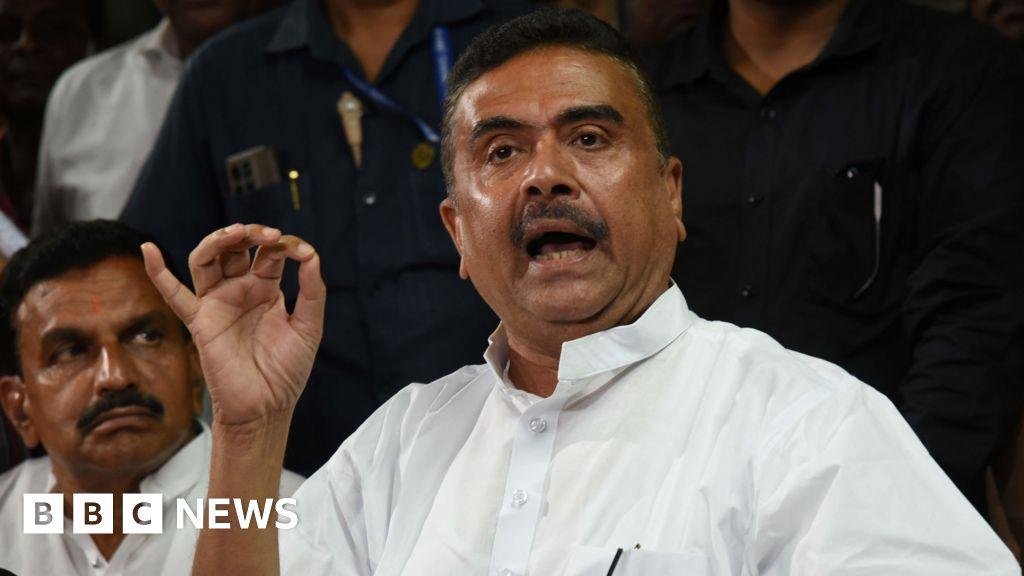
From trusted aide to biggest rival: Suvendu Adhikari set to become West Bengal chief minister

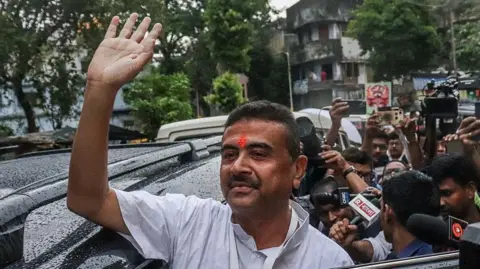 Getty Images
An Indian politician once seen as a protege of a long-serving chief minister of West Bengal state is set to replace her.
Suvendu Adhikari of the Bharatiya Janata Party (BJP) was a close aide of outgoing chief minister Mamata Banerjee until their bitter falling out a few years ago. The BJP on Friday said that Adhikari would be the state's next chief minister, to be sworn in on Saturday.
The BJP won 207 of the state's 294 assembly seats in Monday's vote counting, ending the 15-year rule of Banerjee's All India Trinamool Congress (TMC) and bringing the Hindu nationalist party to power in the state for the first time.
For years, Adhikari cultivated the image of a combative organiser with a sharp instinct for power and an ability to turn Bengal's shifting political currents to his advantage.
To supporters, he is the BJP's most recognisable face in West Bengal, a leader rooted in local networks and street-level politics rather than Delhi's political establishment.
To critics, he embodies the increasingly polarised rhetoric that has come to define the state.
Now, after his party's sweeping victory, he finds himself at the centre of one of the most dramatic political transitions West Bengal has seen in recent years.
But for Adhikari, personally, the rise did not begin with the BJP.
Born in Purba Medinipur district in 1970 into one of Bengal's most influential political families, he emerged through the Congress party before joining the TMC during its years as an anti-Left force.
His father Sisir Adhikari was a veteran MP and the family built a political network across parts of coastal West Bengal, with several relatives holding elected office over the years.
It was in Nandigram town, though, that he first became a major political figure.
The violent protests there in 2007 against a proposed land acquisition project transformed politics in West Bengal.
The agitation weakened the then-ruling Left Front government and helped propel Banerjee and the TMC to power in 2011.
Adhikari, who helped organise much of the movement on the ground, emerged from that battle with a reputation as one of the state's most effective political organisers.
For years, he was seen as one of Banerjee's closest lieutenants.
In 2016, Adhikari was embroiled in a controversy over a sting operation, in which several senior TMC leaders were filmed allegedly accepting cash from a fake businessman posing as an investor.
Videos released before state elections that year appeared to show Adhikari taking money in his office, allegations he denied while questioning the authenticity and context of the footage.
But his relations with the TMC leadership deteriorated with time, culminating in his dramatic defection to the BJP in 2020, months before the 2021 state election.
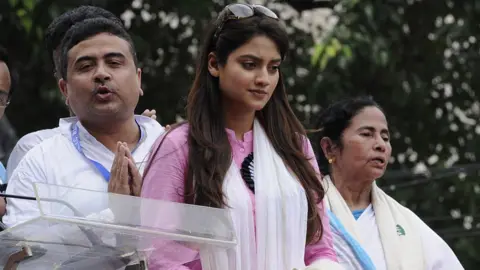 AFP via Getty Images
Contesting from Nandigram, Adhikari defeated Banerjee in one of the most closely watched races.
The BJP lost the wider election, but his victory elevated him inside the party and cemented his reputation as Banerjee's principal challenger.
Five years later, he has helped engineer an even bigger upset.
In the 2026 election, the BJP not only swept to power but also defeated Banerjee in her long-time stronghold of Bhabanipur, where Adhikari contested against her while simultaneously retaining Nandigram.
His rise marks a striking political reversal in West Bengal - a state where the BJP was once a marginal force.
But Adhikari's ascent has also been shadowed by repeated controversy over inflammatory and communal remarks.
In 2021, the Election Commission issued a notice to him over a speech in which he allegedly referred to his opponent as "Begum" and suggested voting for her meant voting for a "mini-Pakistan".
Last year, Adhikari triggered outrage after declaring the BJP would "physically throw Muslim MLAs out of the assembly" if the party came to power in West Bengal in 2026.
The remarks drew accusations of hate speech from the TMC and led to a privilege motion and suspension from the assembly.
Adhikari has also faced criticism for comments alleging that medicines distributed at a TMC-run medical camp could lead to "birth control" and reduce the Hindu population in Bengal - remarks widely condemned by opponents as inflammatory and conspiratorial.
Now, even as power shifts in West Bengal, the transition has unfolded amid renewed violence.
On Wednesday, a close aide and personal assistant to Adhikari was shot dead in what BJP leaders described as a targeted attack. Police said unidentified assailants opened fire near Rath's home, intensifying concerns over post-election violence in the state.
Adhikari takes charge at a time when the state is facing deep economic challenges as well.
West Bengal has long struggled to attract large-scale private investment compared with some other Indian states and unemployment, particularly among the youth, remains a major concern - all issues the BJP campaigned on.
Adhikari will also govern a state that has become intensely polarised after years of bitter political rivalry between the BJP and the TMC, often accompanied by allegations of intimidation and outbreaks of election-related violence.
There are other challenges too.
Throughout his career, Adhikari has cultivated the image of a leader who is admired by supporters for his aggressive campaigning style, but criticised by opponents as a political rabble-rouser who helped deepen divisions in the state.
As chief minister, he will now face pressure to shift from a firebrand politician to administrator: reassuring investors, delivering jobs and governing a state where political loyalties run fiercely deep.