With the arrival of the MacBook Neo, Apple now has three MacBook lines. Starting at $599, the Neo is Apple’s budget laptop. Sitting in the middle with a balance of price, performance and portability, the MacBook Air is for mainstream shoppers. The MacBook Pro is geared toward creatives and other power users who need the most performance and have the money to get it. With the MacBook Air and Pro each available in two sizes, there are really five distinct MacBooks from which to choose. Below you’ll find the Windows laptops we’ve tested that come closest to matching the sleek style and strong build quality of each variety of MacBook, as well as its level of performance and battery life.
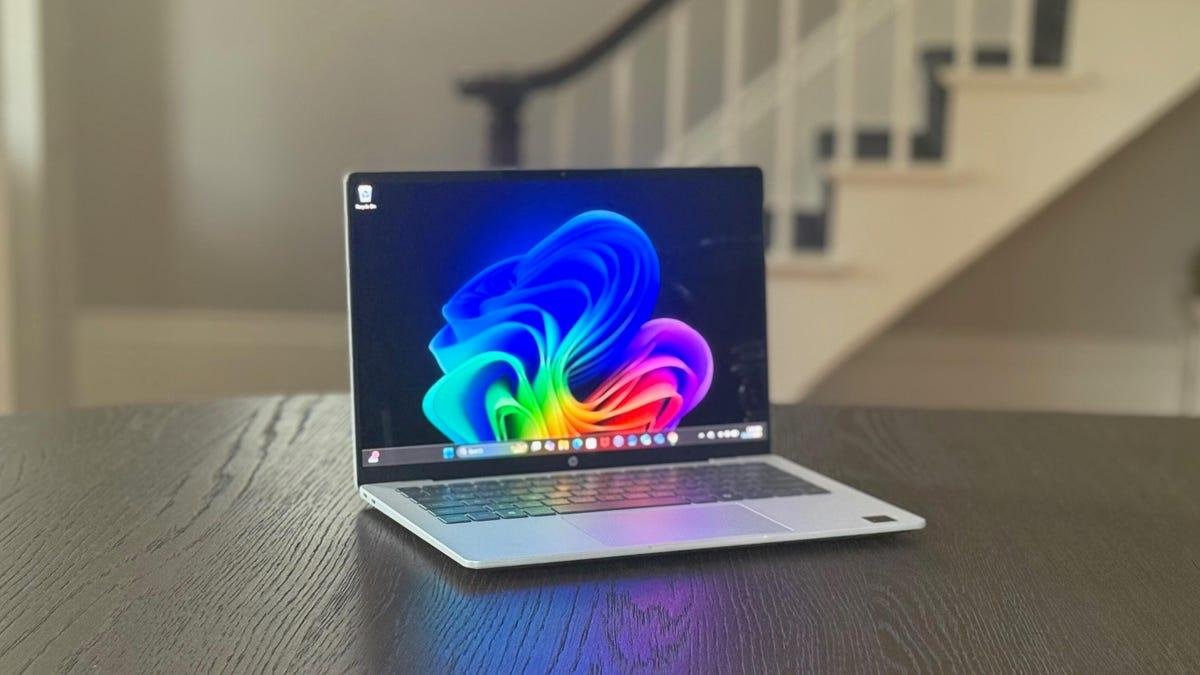
Only a few weeks after ceding the battery life throne to Lenovo in our tests, HP has snatched back the crown with the OmniBook 5 14.
Pros
- Unbelievable battery life
- Sturdy, stylish and compact design
- OLED display delivers deep blacks, vivid colors
- Generous RAM and SSD for the price
Cons
- OLED display isn't the brightest
- Slow USB-C ports
The Lenovo Yoga Slim 7x is a midrange OLED laptop that delivers strong application and AI performance and lengthy battery life inside a sleek, blue chassis. Now in its 11th generation, this year's Yoga Slim 7x offers a choice of a second-gen Snapdragon X2 CPU and a mishmash of mainstream and premium features. Pricing starts at a very mainstream $1,200 but can quickly escalate into premium territory.
Pros
- Fantastic application, AI performance
- Nearly 24 hours of battery life
- Trim, solid design
- OLED display delivers accurate, vivid colors and deep black levels
- Excellent high-res webcam
Cons
- Qualcomm Adreno can't match Intel Arc B390 for integrated 3D graphics power
- Heavier than it looks
- Mechanical touchpad is just OK
- Fingerprint magnet
- Limited port selection
Based on a Qualcomm Snapdragon X2 Elite Extreme processor, the Zenbook A16 is a rightful successor to last year's excellent Zenbook A14 and one of the best 16-inch laptops you can buy.
Pros
- Leading application and AI performance
- Thin and light, yet has a rigid design
- Huge OLED is crisp, smooth and bright
- Good sound from six-speaker array
Cons
- Lackluster 3D performance
- Meh mechanical touch pad
- No room for internal expansion
- Beige = boring
After killing it off last year, Dell turned right around and brought back the XPS. The XPS 14 marks a grand return for Dell’s longtime premium laptop brand.
Pros
- Sleek, solid design at a reasonable weight
- Strong performance with long battery life
- Quiet and cool operation
- Physical keys have returned to the Function row
- Huge, haptic touchpad
- Quad speakers produce great sound
Cons
- Matches MacBook Pro in price but not performance
- Seams along the edges and below the keyboard are magnets for debris
- Limited port selection with no adapter included
- No fingerprint reader
The ProArt P16 boasts a big, beautiful 16-inch 4K OLED display alongside enough graphics horsepower to deliver the performance in Adobe and CapCut that creators crave, all inside a reasonably slender, lightweight chassis.
Pros
- Gorgeous 16-inch, 4K OLED touchscreen
- Strong component lineup, including RTX 5070 GPU
- Slim and light given the size and what's under the hood
- DialPad controller on touchpad is useful
Cons
- Runs hot and loud
- 3D frame rates are good but not great
- Display bezels are a bit thick
- Stylus not included for the touchscreen
LAPTOP DEALS OF THE WEEK
Deals are selected by the CNET Group commerce team, and may be unrelated to this article.
The best MacBook alternatives for 2026
The HP OmniBook 5 14 has a simple, elegant design that’s on par with the Neo’s look and build quality. With a plastic keyboard deck, it lacks the Neo’s all-metal construction, but it offers an OLED display, which you don’t get with the Neo. You’ll also need to wait for HP’s revolving discount to land on the OmniBook 5 14 to get it for the Neo’s low price of $599. I’ve seen it at that price with some regularity, which is a hefty $500 less than its list price. Other highlights of the OmniBook 5 14 include ample RAM and storage and record-setting battery life. It’s a fantastic Windows laptop for students and others constantly on the go.
For the MacBook Air, the best Windows alternatives are the Lenovo Yoga Slim 7x and Asus Zenbook A16. The Yoga Slim 7x is one of the few laptops with better multi-core application and AI performance than the M5 MacBook Air. Its battery life is hours better, too. The Yoga Slim 7x also has a trim, solid design and a good-looking OLED display. For a larger laptop that’s shockingly portable, check out the Asus Zenbook A16. A strong overall performer, the Zenbook A16 serves up a roomy 16-inch OLED and a sub-3-pound weight.
The Dell XPS 14 is a great pick if you are eying a 14-inch MacBook Pro but want a Windows machine. The understated design was clearly inspired by the MacBook Pro’s look, and its Intel Panther Lake CPU delivers strong performance and long battery life. A worthy competitor to the 16-inch MacBook Pro is the Asus ProArt P16. It boasts a big, beautiful 16-inch 4K OLED and the graphics horsepower that creators crave inside a reasonably slender, lightweight chassis.
With decades of experience testing and reviewing laptops, our laptop experts conduct performance testing under controlled conditions in the CNET Labs and also perform extensive hands-on tests to assess the design, features and performance of each laptop we review. Check out the best MacBook alternatives we've reviewed.
Pros
- Unbelievable battery life
- Sturdy, stylish and compact design
- OLED display delivers deep blacks, vivid colors
- Generous RAM and SSD for the price
Cons
- OLED display isn't the brightest
- Slow USB-C ports
Only a few weeks after ceding the battery life throne to Lenovo in our tests, HP has snatched back the crown with the OmniBook 5 14.
Why we like it
For starters, it runs and runs (and runs and runs). It’s the current battery life champ, lasting more than 28 hours in testing. In addition to record-setting battery life, the OmniBook 5 14 offers a simple, elegant design and easy-to-carry weight -- plus, an OLED display that delivers stellar contrast and vivid colors. It also supplies an ample 32GB of RAM and a roomy 1TB SSD, neither of which is a given in a laptop that costs less than $1,000. It has a full price of $1,100, but can usually be found for hundreds less from HP.
Who it’s best for
For students and others constantly on the go, the OmniBook 5 14 is a fantastic pick at a great price.
Who shouldn’t buy it
If you're concerned about Windows-on-Arm compatibility issues, then you should skip the Snapdragon X-based OmniBook 5 14 and go for an Intel- or AMD-based laptop.
Pros
- Fantastic application, AI performance
- Nearly 24 hours of battery life
- Trim, solid design
- OLED display delivers accurate, vivid colors and deep black levels
- Excellent high-res webcam
Cons
- Qualcomm Adreno can't match Intel Arc B390 for integrated 3D graphics power
- Heavier than it looks
- Mechanical touchpad is just OK
- Fingerprint magnet
- Limited port selection
The Lenovo Yoga Slim 7x is a midrange OLED laptop that delivers strong application and AI performance and lengthy battery life inside a sleek, blue chassis. Now in its 11th generation, this year's Yoga Slim 7x offers a choice of a second-gen Snapdragon X2 CPU and a mishmash of mainstream and premium features. Pricing starts at a very mainstream $1,200 but can quickly escalate into premium territory.
Why we like it
With its Snapdragon X2 Elite CPU and ample 32GB of RAM, the Yoga Slim 7x Gen 11 excels as a general-purpose laptop, and it will run all day and into the night without needing to recharge. I like the solid and compact, all-metal design and the two OLED display options.
Who it’s best for
The Lenovo Yoga Slim 7x is great if you want an easily portable OLED laptop with strong overall performance, but don't plan to lean into any heavy lifting in terms of 3D graphics work or gaming.
Who shouldn’t buy it
The Yoga Slim 7x's marginal 3D performance means it's not the best pick as a compact content creation or gaming machine, and you'll need to perform a Windows-on-Arm compatibility check -- as you would with any Snapdragon X-based laptop -- to verify all the software you rely on has native Arm versions.
Pros
- Leading application and AI performance
- Thin and light, yet has a rigid design
- Huge OLED is crisp, smooth and bright
- Good sound from six-speaker array
Cons
- Lackluster 3D performance
- Meh mechanical touch pad
- No room for internal expansion
- Beige = boring
Based on a Qualcomm Snapdragon X2 Elite Extreme processor, the Zenbook A16 is a rightful successor to last year's excellent Zenbook A14 and one of the best 16-inch laptops you can buy.
Why we like it
The Asus Zenbook A16 has a lot going for it. It boasts leading AI performance and is also fast with non-AI tasks. It offers good battery life, has a beautiful 3K OLED display and is the lightest 16-inch laptop I've ever tested
Who it’s best for
Anyone who wants a big, 16-inch laptop that they can take with them. The 16-inch OLED provides a wonderful work surface, and the sub-3-pound weight makes the Zenbook A16 an easy travel companion. Plus, it’s well-equipped to last a long time. With its stellar application and AI performance, the Zenbook A16 is a modern laptop well equipped for today's demands and those of tomorrow. Because even if you aren't using your laptop to perform AI tasks now, you might next week, next month or next year.
Who shouldn’t buy it
While the Snapdragon X2-based Zenbook A16 outpaced competing Intel Panther Lake laptops in AI and application performance, Qualcomm's Adreno graphics chips can't match Intel's integrated GPU in 3D performance. The Zenbook A16 model I tested costs $1,700, which is pricey for a laptop with little to no gaming capacity.
Pros
- Sleek, solid design at a reasonable weight
- Strong performance with long battery life
- Quiet and cool operation
- Physical keys have returned to the Function row
- Huge, haptic touchpad
- Quad speakers produce great sound
Cons
- Matches MacBook Pro in price but not performance
- Seams along the edges and below the keyboard are magnets for debris
- Limited port selection with no adapter included
- No fingerprint reader
After killing it off last year, Dell turned right around and brought back the XPS. The XPS 14 marks a grand return for Dell’s longtime premium laptop brand.
Why we like it
The XPS 14 corrects many of the errors of the Dell 14 Premium, including the most egregious ones, while coming in at a reasonable weight and retaining a solid, well-built chassis. Physical keys returning to the Function is another move in the right direction. Based on Intel’s latest Panther Lake processors, the XPS 14 delivers strong overall performance and long battery life.
Who it’s best for
Creators and other power users who want the power and style of a MacBook Pro in a Windows laptop.
Who shouldn’t buy it
If you're OS agnostic, the MacBook Pro offers better performance and battery life for the same price.
Pros
- Gorgeous 16-inch, 4K OLED touchscreen
- Strong component lineup, including RTX 5070 GPU
- Slim and light given the size and what's under the hood
- DialPad controller on touchpad is useful
Cons
- Runs hot and loud
- 3D frame rates are good but not great
- Display bezels are a bit thick
- Stylus not included for the touchscreen
The ProArt P16 boasts a big, beautiful 16-inch 4K OLED display alongside enough graphics horsepower to deliver the performance in Adobe and CapCut that creators crave, all inside a reasonably slender, lightweight chassis.
Why we like it
The ProArt P16 series is built around a powerful AMD Strix Point processor, the Ryzen AI 9 HX 370. Our P16 test system also features an RTX 5070 GPU from Nvidia's latest series, along with an ample 32GB of RAM and a roomy 2TB SSD, a welcome inclusion for video editors and gamers who tend to require capacious storage. The port selection is fairly standard, but includes an SD card slot -- something creators will appreciate.
Who it's best for
Creators and media editors. The ProArt P16 is an extremely capable workday companion that can also double as a suitable gaming machine for anything short of 4K.
Who shouldn't get it
Gamers looking to squeeze out the highest frame rates possible from an RTX 5070 laptop.
Dell XPS 16: It costs as much as Nvidia RTX models but lacks RTX graphics. Still, the XPS 16 is a strong overall performer with a thin-and-light design.
Acer Swift Edge 14 AI: It’s a sleek and solid OLED laptop but forces some compromises.
Alienware 18 Area-51: It's a dazzling and heavy-duty (emphasis on "heavy") showcase of laptop technology for deep-pocketed gamers.
M5 MacBook Air Review (13-inch, 2026): Go big or go Neo.
MacBook Neo Review: It’s an absolute banger of a budget laptop, but life's too short to live without Touch ID.
GeekBook X14 Pro: Geekom’s first laptop is impressively thin and light but battery life disappoints. And I detest the touch pad.
Lenovo IdeaPad 5i 16 2-in-1 Gen 10: Lenovo's low-cost, 16-inch two-in-one is a versatile machine, but it forces you to live with more than a couple of compromises in the design.
Lenovo Yoga Pro 9i Pro 16 Aura Edition: Centered around a gorgeous 16-inch OLED display, this kick-ass Yoga laptop provides the performance and build that graphics pros demand.
Microsoft Surface Pro (12-inch): The 12-inch version of Microsoft's detachable two-in-one will suffice for most users, but getting nickel-and-dimed by optional accessories that feel quite necessary is annoying.
Acer Aspire 16 AI: Weighing less than 3.5 pounds and offering amazing battery life, this is the rare 16-inch laptop that's easy to take with you.
Lenovo Yoga 9i 2-in-1 Aura Edition: This premium two-in-one is a near-perfect package with a fantastic OLED display and record-setting battery life.
Lenovo LOQ 15: This budget gaming laptop has an outdated design but serves up modern components and good 3D performance for the price.
Lenovo ThinkPad X1 2-in-1: This business convertible boasts great build quality and battery life but the display disappoints.
HP Omen 16: This Nvidia GeForce RTX 5060 rig offers good looks and competitive 1080p performance along with surprisingly long battery life and a cool twist on four-zone RGB keyboard backlighting
Alienware Aurora 16: I tested two Alienware Aurora gaming laptops, and this is not the one to get.
Alienware Aurora 16X: This is the Aurora to get.
The review process for laptops consists of two parts: performance testing under controlled conditions in the CNET Labs and extensive hands-on use by our reviewers. This includes evaluating a device's aesthetics, ergonomics and features with respect to price. A final review verdict is a combination of both objective and subjective judgments.
We test all laptops with a core set of benchmarks, including Primate Labs Geekbench 6, Cinebench 2024, PCMark 10, a variety of 3DMark benchmarks (whichever can run on the laptop), UL Procyon Photo and Video (where supported), and our own battery life test. If a laptop is intended for gaming, we'll also run benchmarks from Guardians of the Galaxy, The Rift Breaker (CPU and GPU) and Shadow of the Tomb Raider.
For the hands-on, the reviewer uses it for their work during the review period, evaluating how well the design, features (such as the screen, camera and speakers) and manufacturer-supplied software operate as a cohesive whole. We also place importance on how well they work, given their cost and where the manufacturer has potentially made upgrades or trade-offs for their price.
The list of benchmarking software and comparison criteria we use changes over time as the devices we test evolve. You can find a more detailed description of our test methodology on our How We Test Computers page.
There are a ton of laptops on the market at any given moment, and almost all of those models are available in multiple configurations to match your performance and budget needs. So if you're feeling overwhelmed with options when looking for a new laptop, it's understandable. To help simplify things for you, here are the main things you should consider when you start looking.
Price
The search for a new laptop for most people starts with price. If the statistics chipmaker Intel and PC manufacturers hurl at us are correct, you'll be holding onto your next laptop for at least three years. If you can afford to stretch your budget a little to get better specs, do it. And that stands whether you're spending $500 or more than $1,000. In the past, you could get away with spending less upfront with an eye toward upgrading memory and storage in the future. But laptop makers have moved away from making components easily upgradable, so again, it's best to get as much laptop as you can afford from the start.
Generally speaking, the more you spend, the better the laptop. That could mean better components for faster performance, a nicer display, sturdier build quality, a smaller or lighter design from higher-end materials or even a more comfortable keyboard. All of these things add to the cost of a laptop. I'd love to say $500 will get you a powerful gaming laptop, for example, but that's not the case. Right now, the sweet spot for a reliable laptop that can handle average work, home office or school tasks has risen to around $1,000, thanks to RAMageddon. A reasonable model for creative work or gaming will run you at least $1,500. The key is to look for discounts on models in all price ranges so you can get more laptop for less.
Operating system
Choosing an operating system is part personal preference and part budget. For the most part, Microsoft Windows and Apple's MacOS do the same things (except for gaming, where Windows is the winner), but they do them differently. Unless there's an OS-specific application you need, go with the one you feel most comfortable using. And if you're not sure which that is, head to an Apple store or a local electronics store and test them out. Or ask friends or family to let you test theirs for a bit. If you have an iPhone or iPad and like it, chances are you'll like MacOS too.
If you are on a tight budget, consider a Chromebook. ChromeOS is a different experience than Windows; make sure the applications you need have a Chrome, Android or Linux app before making the leap. But if you spend most of your time roaming the web, writing, streaming video or using cloud-gaming services, they're a good fit.
Size
Remember to consider whether having a lighter, thinner laptop or a touchscreen laptop with a good battery life will be important to you in the future. Size is primarily determined by the screen -- hello, laws of physics -- which in turn factors into battery size, laptop thickness, weight and price. And keep in mind other physics-related characteristics, such as an ultrathin laptop isn't necessarily lighter than a thick one, you can't expect a wide array of connections on a small or ultrathin model and so on.
Screen
When it comes to deciding on a screen, there are myriad considerations: how much you need to display (which is surprisingly more about resolution than screen size), what types of content you'll be looking at and whether you'll be using it for gaming or creative work.
You really want to optimize pixel density; that is, the number of pixels per inch the screen can display. Though there are other factors that contribute to sharpness, a higher pixel density usually means sharper rendering of text and interface elements. (You can easily calculate the pixel density of any screen at DPI Calculator if you don't feel like doing the math, and you can also find out what math you need to do there.) We recommend a dot pitch of at least 100 pixels per inch as a rule of thumb.
Because of the way Windows and MacOS scale for the display, you're frequently better off with a higher resolution than you'd think. You can always make things bigger on a high-resolution screen, but you can never make them smaller -- to fit more content in the view -- on a low-resolution screen. This is why a 4K, 14-inch screen may sound like unnecessary overkill, but may not be if you need to, say, view a wide spreadsheet.
If you need a laptop with relatively accurate color, that displays the most colors possible or that supports HDR, you can't simply trust the specs -- not because manufacturers lie, but because they usually fail to provide the necessary context to understand what the specs they quote mean. You can find a ton of detail about considerations for different types of screen uses in our monitor buying guides for general purpose monitors, creators, gamers and HDR viewing.
Processor
The processor, aka the CPU, is the brains of a laptop. Intel, AMD and Qualcomm are the main CPU makers for Windows laptops. Both offer a staggering selection of mobile processors. Making things trickier, both manufacturers have chips designed for different laptop styles, like power-saving chips for ultraportables or faster processors for gaming laptops. Their naming conventions will let you know what type is used. You can head to Intel's, AMD's and Qualcomm's sites for explanations so you get the performance you want. Generally speaking, though, the faster the processor speed and the more cores it has, the better the performance will be.
Apple makes its own chips for MacBooks, which makes things slightly more straightforward. But, like Intel and AMD, you'll still want to pay attention to the naming conventions to know what kind of performance to expect. Apple uses its M-series chipsets in Macs. The entry-level MacBook Neo uses an iPhone processor, but the MacBook Air and Pro models feature a CPU from Apple's M series designed for MacOS. The current models have M5 chips that start with an eight-core CPU and 10-core GPU and go up to the M5 Max with an 18-core CPU and a 40-core GPU. Again, generally speaking, the more cores it has, the better the performance.
Graphics
The graphics processor handles all the work of driving the screen and generating what gets displayed, as well as speeding up a lot of graphics-related (and increasingly, AI-related) operations. For Windows laptops, there are two types of GPUs: integrated (iGPU) or discrete (dGPU). As the names imply, an iGPU is part of the CPU package, while a dGPU is a separate chip with dedicated memory (VRAM) that it communicates with directly, making it faster than sharing memory with the CPU.
Because the iGPU splits space, memory and power with the CPU, it's constrained by the limits of those. It allows for smaller, lighter laptops, but doesn't perform nearly as well as a dGPU. In fact, there are some games and creative software that won't run unless they detect a dGPU or sufficient VRAM. Most productivity software, video streaming, web browsing and other nonspecialized apps will run fine on an iGPU, though.
For more power-hungry graphics needs, like video editing, gaming and streaming, design and so on, you'll need a dGPU; there are only two real companies that make them, Nvidia and AMD, with Intel offering some based on the Xe-branded (or the older UHD Graphics branding) iGPU technology in its CPUs.
Memory
For memory, we highly recommend 16GB of RAM (8GB absolute minimum). RAM is where the operating system stores all the data for currently running applications, and it can fill up fast. After that, it starts swapping between RAM and SSD, which is slower. A lot of sub-$500 laptops have 4GB or 8GB, which, in conjunction with a slower disc, can make for a frustratingly slow Windows laptop experience. Also, many laptops now have the memory soldered onto the motherboard. Most manufacturers disclose this, but if the RAM type is LPDDR, assume it's soldered and can't be upgraded.
However, some PC makers will solder memory on and also leave an empty internal slot for adding a stick of RAM. You may need to contact the laptop manufacturer or find the laptop's full specs online to confirm. And check the web for user experiences, because the slot may still be hard to get to, it may require nonstandard or hard-to-get memory or other pitfalls.
Storage
You'll still find cheaper hard drives in budget laptops and larger hard drives in gaming laptops, but faster solid-state drives have all but replaced hard drives in laptops. They can make a big difference in performance. But not all SSDs are equally speedy, and cheaper laptops typically have slower drives; if the laptop has only 4GB or 8GB of RAM, it may end up swapping to that drive, and the system may slow down quickly while you're working.
Get what you can afford, and if you need to go with a smaller drive, you can always add an external drive or two down the road or use cloud storage to bolster a small internal drive. The one exception is gaming laptops: We don't recommend going with less than a 512GB SSD unless you really like uninstalling games every time you want to play a new game.
Setting a budget is a good place to start when shopping for the best laptop for yourself. The good news is you can get a nice-looking, lightweight laptop with excellent battery life at prices around $600 to $800. If you're shopping for a budget laptop, check out our top picks here, as well as more specific buying advice for that price range.
Higher-end components like Intel Core Ultra and AMD Ryzen processors and premium design touches like thin-display bezels and aluminum or magnesium bodies have made their way to laptops priced at $1,000 and up. You can also find touchscreens and two-in-one designs that can be used as a tablet or a laptop -- and a couple other positions in between. In this price range, you'll also find faster memory and SSD storage -- and more of it -- to improve performance.
Above $1,500 is where you'll find premium laptops and two-in-ones. If you're looking for the fastest performance, the best battery life, the slimmest, lightest designs and top-notch display quality with an adequate screen size, expect to spend at least $1,500.
Deciding between a MacOS and a Windows laptop for many people will come down to personal preference and budget. Apple's base model laptop, the M1 MacBook Air, starts at $999. You can sometimes find it discounted, or you can get educational pricing from Apple and other retailers. But in general, it'll be at least $1,000 for a new MacBook, and the prices just go up from there.
For the money, though, you're getting great hardware top to bottom, inside and out. Apple recently moved to using its own processors, which resulted in across-the-board performance improvements compared to older Intel-based models. But the company's most powerful laptop, the 16-inch MacBook Pro, still hasn't been updated to Apple silicon.
But, again, that great hardware comes at a price. Also, you're limited to just Apple laptops. With Windows and Chromebooks (more on these below), you get an amazing variety of devices at a wide range of prices.
Software between the two is plentiful, so unless you need to run something that's only available on one platform or the other, you should be fine to go with either. Gaming is definitely an advantage for a Windows laptop, though.
MacOS is also considered to be easier and safer to use than Windows, especially for people who want their computers to get out of the way so they can get things done. Over the years, though, Microsoft has done its best to follow suit and, with Windows 11 here, it's trying to remove any barriers. Also, while Macs might have a reputation for being safer, with the popularity of the iPhone and iPad helping to drive Mac sales, they've become bigger targets for malware.
Yes, they are, but they're not for everyone. Google's ChromeOS has come a long way in the 10-plus years since it arrived, and Chromebooks -- laptops that run on ChromeOS -- are great for people who do most of their work in a web browser or using mobile apps. They are secure, simple and, more often than not, a bargain. What they can't do is run Windows or Mac software natively.
The pandemic changed how and where a lot of people work. The small, ultraportable laptops valued by people who regularly traveled may have suddenly become woefully inadequate for working from home. Or maybe instead of needing long battery life, you'd rather have a bigger display with more graphics power for gaming.
If you're going to be working on a laptop and don't need more mobility than moving it from room to room, consider a 15.6-inch laptop or larger. In general, a bigger screen makes life easier for work and is more enjoyable for entertainment, and it is also better if you're using it as an extended display with an external monitor. It typically means you're getting more ports too, so connecting an external display, storage, or a keyboard and mouse is easier without requiring a hub or dock.
For travel, stay with 13- or 14-inch laptops or two-in-ones. They'll be the lightest and smallest while still delivering excellent battery life. What's nice is that PC-makers are moving away from 16:9 widescreens toward 16:10- or 3:2-ratio displays, which gives you more vertical screen space for work without significantly increasing the footprint. These models usually don't have discrete graphics or powerful processors, though that's not always the case.
You can play games and create content on any laptop. That said, what games you play and what content you create -- and the speed at which you do them -- is going to vary greatly depending on the components inside the laptop.
For casual browser-based games or using streaming-game services like Nvidia GeForce Now and Xbox Cloud Gaming, you don't need a powerful gaming laptop. And similarly, if you're trimming video clips, cropping photos or livestreaming video from your webcam, you can get by with a modestly priced laptop or Chromebook with integrated graphics.
For anything more demanding, you'll need to invest more money in discrete graphics like Nvidia's RTX 30- or 40-series GPUs. Increased system memory of 16GB or more, having a speedy SSD of at least 512GB for storage, and a faster processor such as an Intel Core i7 or AMD Ryzen 7 will all help you get things moving faster, too.
The other piece you'll want to consider is the display. For gaming, look for screens with a high refresh rate of 120Hz or faster so games look smoother while playing. For content creation, look for displays that cover at least 100% sRGB color space or, better yet, 100% DCI-P3.