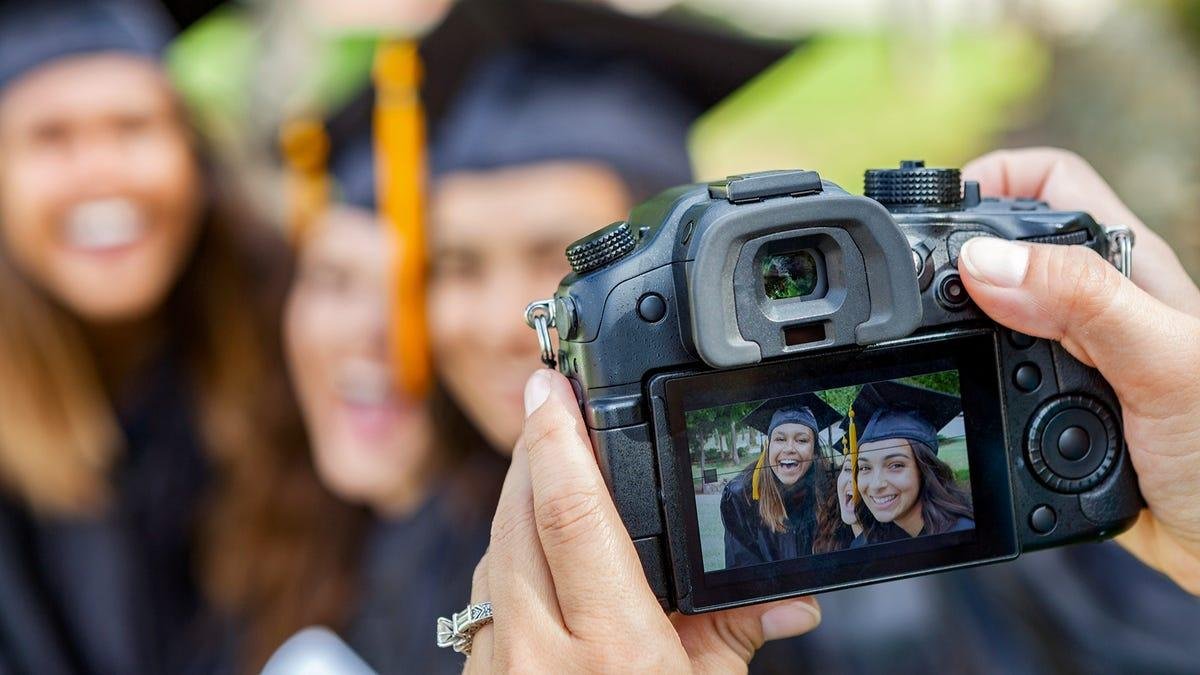
It’s that time of year where weddings and graduations bring families and friends together to share a special moment. While your phone can probably do a great job saving those memories, there are certain photos that you can only get with a real camera.
Fortunately, you don’t need to spend a ton to get a decent camera perfect for these events. Whether you want to make sure you get closeups of vow exchanges or the first smile holding a diploma, these are the best point-and-shoot cameras for weddings and graduations.
What is the best camera overall for weddings and graduations?
The best camera overall for weddings and graduations is the Panasonic Lumix ZS99. It's a compact camera with a big optical zoom so you can get great closeup pictures. Image quality is good, but not great, and without using its built-in flash it doesn't do well in low light. To step up in image quality, the Ricoh GR IV has a big APS-C-sized image sensor in an even smaller size than the ZS99. It doesn't have a zoom, however, nor a built-in flash. You can get one as an accessory, though.
These are all great cameras to take on your summer travels as well, but we have a few more recommendations if that's your goal.
Best cameras for weddings and graduations in 2026
Pros
- Impressive zoom for its size
- Screen rotates for easy selfies
- Easy to use for beginners, plus some manual features
Cons
- Image quality is decent, but not great
- Compact but not "small"
- Low-light performance is mediocre
The compact Lumix ZS99 has an impressive 30x optical zoom that can get you better close-ups from a distance than most phones. Overall image quality isn’t quite as good as some of the other cameras on this list, especially in low light, but for its size and zoom range, it works great.
Why I like it
The ZS99 is like an updated version of the point-and-shoot cameras of old. It’s compact, but has a great zoom for its size.
Who this is for
If you want something small that can still get good close-ups from a distance, the Z99 works great.
Who shouldn’t get it
The image sensor is quite small, and the lens isn’t very fast, which means in low light, the Z99 struggles. If you have a recent mid- to high-end phone with an optical zoom, it might perform similarly or even better than the Z99 in many situations.
Pros
- Remarkable 125x optical zoom
- Bluetooth and USB-C
- Some use beyond its zoom
Cons
- An absolute unit of a camera
- Zoom is conspicuous (to put it mildly)
- Slow lens and small sensor
The Coolpix P1100 is a large camera with a huge zoom. Basically no other new camera on the market can match its zoom range, especially for the price. If you want to make sure you get the smiles of the newlyweds even if you’re sitting in the back row, this is the camera for you.
Why I like it
It’s hard to beat a 125x optical zoom range. You’d have to spend thousands on a DSLR or mirrorless camera and then even more on huge lenses to match the P1100’s reach.
Who this is for
If you don’t mind lugging around a big camera, the P1100 is larger than most DSLRs at this point, but if you want great close-ups from just about anywhere at the venue, the P1100’s zoom is unbeatable at its price.
Who shouldn’t get it
While the P1100’s zoom lets you capture photos not possible with a phone or most other cameras, the quality of those photos isn’t as good as some of the other cameras on this list. This is especially true in low light, where the P1100 is nearly unusable. Also, the P1100 is, to put it mildly, conspicuous.
Pros
- Fantastic size
- Fast and easy to use
- Takes great photos
Cons
- Only slightly different to the GR III
- Video is only 1080p
The GR IV is a very small camera with a big, APS-C-sized image sensor, something typically only found in larger cameras. It can take beautiful photos while fitting easily in a pocket or small purse. There’s no zoom, but for group shots and close-ups it can capture better quality images than the Panasonic at the top of this list.
Why I like it
The GR IV is the ultimate stealth camera. It’s tiny and unobtrusive, yet it can take gorgeous photos thanks to its big image sensor. It can take better pictures than your phone, yet takes up basically the same amount of space (shorter than most phones but about twice as thick).
Who this is for
Anyone who wants to take better quality pictures than what’s possible with their phone but doesn’t want to lug around a big camera.
Who shouldn’t get it
The GR IV has no zoom. It’s a fixed lens camera, so you have to zoom with your feet. The field of view is similar to the main camera on most phones, which is to say, fairly wide. So, for group shots and close-ups, it’s fantastic. But, to get those close-ups, you’ll need to either physically move close to your subject or crop into the photo when editing, losing resolution.
There's no built-in flash, like some others on this list, but Ricoh sells the thin GF-2 that mounts discreetly on top.
Pros
- Dual-camera design works well
- Doubles as a printer
- Sound prints are a neat idea
Cons
- Necessarily a bit chunky
- Odd shutter button placement
- Sound clips disappear after 2 years
The Fujifilm Instax Mini LiPlay Plus lets you take photos and print them out on the spot, a physical keepsake for you or someone else. You can even connect to your phone and print out photos you or someone else took with other cameras.
Why I like it
Like the old Polaroid instant cameras, the Mini LiPlay Plus gives you physical prints in seconds. It can also record brief audio clips and then, via a QR code printed on the picture, you can hear them later. There are also two image sensors (front and back), plus a screen to make lining up selfies easier.
Who this is for
Anyone who wants to print out small photos to keep or share.
Who shouldn’t get it
The image quality of the built-in cameras isn’t great, but since the LiPlay Plus doubles as a printer, that’s not a huge deal.
Pros
- Nails the retro vibe
- Image quality is decent for a budget camera
- Can function as a "regular" digital camera
Cons
- More than a gimmick or a toy, but not by much
- Phones or "real" cameras will take better photos
- No settings/adjustments at all other than the filters
The Flashback One35 V2 is a flashback to disposable film cameras, complete with a ratchety “film advance” dial. Its native mode even takes 24 hours to “develop” the images so you can’t see what you shot until the next day. It can also be used as a regular digital camera and you can see the images as soon as you connect your phone.
Why I like it
If you want to go screen free, the Flashback is a surprisingly good digital camera for the price. The built-in filters are fun, but it also saves non-filtered versions of the images if you want to edit them yourself later. The flash is decent as well, a rarity among cheap cameras.
Who this is for
Anyone who doesn’t want to be staring at their phone or other screen during a special event.
Who shouldn’t get it
There’s no zoom or settings of any kind, really. It's just like a disposable camera from 25-plus years ago, except digital. Also, the sound from the “film” advance wheel that’s required to turn on the camera and take a photo can be very noticeable in quiet spaces.
| Brand | Model | Photo resolution | Video resolution | Price |
|---|---|---|---|---|
| Flashback | One35 V2 | 4,144x3,088 | N/A | $120 |
| Fujifilm | Instax Mini LiPlay Plus | 1,920x2,560 | N/A | $225 |
| Nikon | Coolpix P1100 | Nikon Coolpix P1100 | 4K30 | $750 |
| Panasonic | Lumix ZS99 | 5,184x3,888 | 4K30 | $700 |
| Ricoh | GR IV | 6,192x4,128 | 1080p60 | $1,500 |
The main thing to consider before buying any camera is if you'll actually use it. No, seriously. All modern phones take decent pictures and video, and the better phones can take excellent wide-angle and close-up images. The cameras on this list, with the exception of the Ricoh, might be able to take different pictures compared to your phone, but not necessarily "better."
For instance, the Nikon P1100 has an incredible zoom, so you can capture closeups of faces from the cheap seats, but the images themselves won't have the detail and sharpness of a good phone camera. However, that phone would need to be significantly closer to the subject to get the same close-up.
The Ricoh, with its excellent lens and big image sensor, can capture better photos than a phone camera. That's the kind of money you'll need to spend to get that step up in quality, however.
Fujifilm X100VI: I liked this camera so much when I reviewed it last year for our guide to the best point-and-shoot cameras that I went out and bought my own. I love it, but it's overkill for most people. The Ricoh GR IV can do many of the same things and is smaller and cheaper. If you really want to step up the quality of your photos, though, this is a great way to do it.
Mirrorless and DSLRs: There are a ton of DSLR and mirrorless cameras on the market. These have interchangeable lenses that offer near-infinite options for style and framing. If you don't have any experience with cameras, however, these are likely an unnecessary expense. If you don't know how to use them, the images they capture won't be much different than what you can get with something like the Ricoh GR IV or Fujifilm X100VI. If you want to check out what's available, we have a guide for the best camera.
Used: I highly recommend buying used when you can. There are multiple websites that buy used gear, check it out, then sell it at a slight premium compared to eBay or Facebook Marketplace. That slight premium comes with the peace of mind that the gear will work as described. This is an especially good idea for situations like weddings and graduations, where you might not feel you need the camera after the event and can sell it and recoup some of your money. Also consider Lens Rentals, which rents cameras by the week for less money than buying.
Do I need a camera for weddings and graduations?
Yes and no, with a lean toward the latter. Phones can take great photos and videos, and if you have one with multiple lenses (like a good telephoto), there's even less difference between what you can get with an inexpensive camera.
That said, the cameras on this list can help you take photos and videos that wouldn't have been possible with most phones. Some, like the Ricoh GR IV, can take better quality photos than what's possible with your phone, though that performance doesn't come cheap.
What do "telephoto" and "wide angle" mean?
A telephoto lens can bring distant subjects "closer." So if you're sitting in the back, you can still get close-ups of the happy couple or ecstatic graduate. In most cases, with the cameras on this list, you're looking for "optical zoom," which uses physical lenses (like a telescope) to make things far away appear closer, and lets you capture subjects near and far. Many cameras offer a "digital zoom," which merely crops into the photo, drastically reducing resolution and image quality. Digital zooms should not be considered a feature and generally shouldn't be used.
A wide-angle lens lets you capture landscapes, group shots or close-ups when you're near the subject. This will be similar to the main camera on most phones.
Should I rent or buy used?
Yes or yes. Renting, via places like Lens Rentals, can be an inexpensive way to have a great camera just for the important event. True, you'll need to be careful with the camera since it's only temporarily yours, but that seems a small price to pay to save hundreds or even thousands of dollars. If you already have a camera with interchangeable lenses, you can simply rent the lens you need for the event instead of buying a pricey lens for the occasion.
If you think you might want a camera after the event, potentially to learn more about photography in general, awesome. Used is a great way to dip your toes into what can be a very expensive hobby. Check out How and Where to Buy Used Camera Gear to Save Money for more info.
In addition to covering cameras and display tech, Geoff does photo essays about cool museums and other stuff, including nuclear submarines, aircraft carriers, 10,000-mile road trips.
Also, check out Budget Travel for Dummies, his travel book and his bestselling sci-fi novel about city-size submarines. You can follow him on Instagram and YouTube.