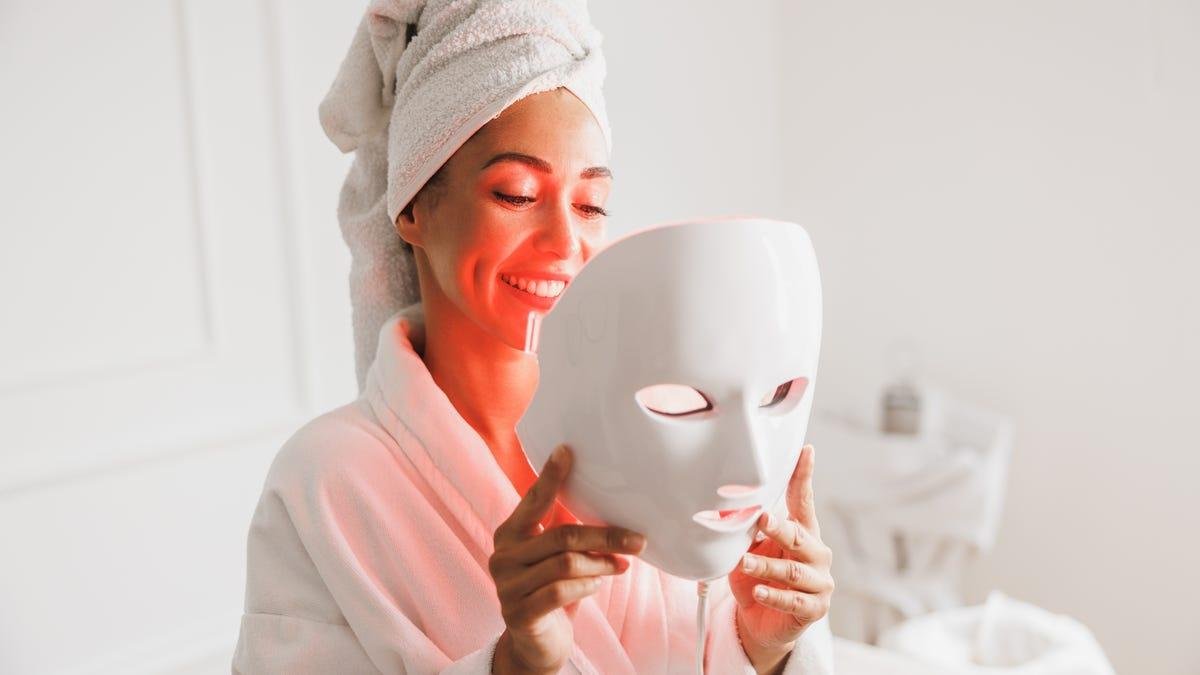
Red light therapy face masks have gained popularity during the 2020s thanks to beauty and wellness influencers on social media. Also known as LED masks, they use red, near-infrared or blue light at different wavelengths with claims that they can improve your skin’s appearance, boost collagen production and, if they have blue light, target acne.
The best part is that you can use these masks at home without setting foot in an aesthetician’s office. However, these LED masks aren’t cheap and can cost you hundreds of dollars, depending on the brand. There are also some that are FDA-cleared, and others that aren’t.
If you’re going to invest in an LED mask, it’s important to know how to use it correctly and what to look for when choosing the best one for your needs. I spoke with a dermatologist and plastic surgeon to learn the best way to use your LED light therapy mask, as well as any risks and benefits to consider.
Where to include an LED mask in your skin care routine
When you use red light therapy during your skin care regimen is important to get the best results.
GaudiLab/ShutterstockA skin care routine usually includes serums, creams, ointments and other topical products targeting your skin’s needs. If you’re using an LED mask, it’s important to know the best placement in your routine to get the most out of it.
Dr. Eleonora Fedonenko, the medical director and a dermatologist at Your Laser Skin Care in Los Angeles, told CNET that she recommends starting any LED mask treatment on a clean face, free of creams and serums. “If there is residue from makeup or sunscreen, it can block the light from getting to the skin and reduce the effectiveness of the session,” Fedonenko says.
Important considerations
When choosing an LED therapy mask, it’s important to opt for one that has FDA clearance, as this indicates the product has been tested for safety and efficacy. Fedonenko also recommends researching the company and verifying that it has done clinical studies regarding the wavelengths used.
“Red light should be between 630 and 660 nanometers, and near-infrared light should be between 830 and 850 nanometers since they’re the two wavelengths most commonly shown to promote collagen growth while reducing inflammation,” Fedonenko explains.
You’ll also want to make sure that the mask fits your face properly and evenly distributes the light across your skin for the best results. Some models CNET recommends: Shark CryoGlow LED Face Mask, RENPHO Artemis LED face mask and Omnilux Contour Face.
How often to use your LED mask
Using a red light therapy mask a few times a week should be enough to see improvement in your skin.
Anton Vierietin/ ShutterstockKnowing how often to use an LED therapy mask is important since you don’t want to overdo it. Fedonenko recommends aiming for 10- to 20-minute treatments, three to five times per week.
“There is a timing that is correct depending on the power output of the device. For example, 10 minutes may suffice with a high-output irradiance mask and more with a low-output mask,” Fedonenko says. Irradiance refers to the amount of light reaching the skin.
Dr. Amy Bandy, a board-certified plastic and reconstructive surgeon, recommends an at-home red light therapy mask with an irradiance of approximately 20 to 50 milliwatts per square centimeter, stating, "This level of irradiance has been shown to be sufficient to deliver measurable results from home use while providing comfort and safety."
Fedonenko notes that FDA-cleared devices usually have an irradiance of at least 30 mW/cm2. Try to avoid masks with light levels between 10-30 mW/cm2, because even though the light penetrates the skin, Fedonenko says it's not strong enough to yield results, as it elicits little measurable cellular response.
Use caution with masks with irradiance levels above 100 mW/cm2, as these tend to be too strong, especially if you switch from a lower-intensity version. Fodenenko says," Many of my patients have come to me with redness that continues due to their change from a lower-powered device to a higher-powered one, with the output being the cause and not due to frequency used."
Fodenenko warns against using your LED mask daily because some people think doing more will speed up the process, when it can have the opposite effect. “Patients have come in with skin that was so tight and raw, they were using the mask every day in order to speed up their results,” Fedonenko says. Instead, it’s important to give your skin time to recover between red light therapy treatments because the light stimulates cellular repair.
Bandy agrees and says that frequent use and strong products can also cause damage. “If someone is treating themselves too frequently and/or simultaneously utilizing very harsh skin care products such as retinoids or exfoliating acids, the skin barrier may become damaged, which leads to further inflammation and irritation,” Bandy says.
However, it’s common for the skin to have some redness, dryness, itchiness or tightness when using an LED mask. If these symptoms don’t subside or get worse after a treatment, it’s best to seek medical guidance.
Precautions to take with LED masks
Be mindful of the type of red light therapy mask you're using because it can cause other skin issues if it isn't the right fit.
shisu_ka/ ShutterstockOne thing people may not consider with LED therapy masks is that the eyes need protection.
“The masks are worn near the face, and wearing them without goggles for long periods of time can cause eye fatigue,” Bandy says.
This is because the mask can cause light-induced headaches in those sensitive to light or those with certain eye conditions. It’s something to keep in mind if you have sensitive eyes or ocular conditions.
Fortunately, many LED masks have built-in goggles, so you should think twice before purchasing one that doesn’t. You should also ensure this part of the mask fits correctly before turning it on. If you still end up with a headache or sensitivity, stop using the mask.
Other non-eye-related signs you should take a break include peeling or acne on areas of the skin where you don't normally experience breakouts or flaking. “Slow down the number of sessions and allow your skin time to heal,” Bandy says.
Signs the LED mask is working
If you’re new to using an LED mask, there are some ways to tell if it’s working on your skin. In general, you may start to see improvements within a few weeks. “These improvements include reduced inflammation, improved brightness and clarity of their skin and a better overall complexion,” Bandy says.
Smoother skin and reduced fine lines are common weeks after using an LED therapy mask because light therapy stimulates collagen production. Acne sufferers may notice fewer breakouts and improvement in hyperpigmentation. Those with rosacea or who deal with redness will notice their skin start to calm down. ”That's surprising to them as they came in with the idea that they were there for skin aging concerns,” Fodonenko says.
However, if it’s been eight weeks and you notice no difference in your skin, Fodonenko says the device's irradiance output may be the issue, so you may want to replace your current model with one that has a higher irradiance.
The verdict on LED masks
As with any product, you find yourself influenced to buy on social media, it’s still important to approach these trends with precaution. If you’re interested in adding an LED mask to your skin care regimen, make sure you do your research and choose an FDA-cleared product. This reassures you that it’s safe overall and tested for efficacy, so you know you’re getting your money’s worth.
Remember that it can also take time to see improvements, so if you don’t see results right away, give it several weeks to see any changes. If you notice your skin worsening, stop treatment and seek medical attention for further assistance.