

Google's smartwatch operating system took a back seat at I/O this year, and its lack of prominence reveals where AI is heading next: your body.
Last year, Wear OS 6 debuted a redesigned interface, smoother animations, battery optimizations and, most importantly, Gemini on the wrist. The company framed smartwatches as the next major surface for AI, with Wear OS positioned as a central part of Android's future.
Turns out this may have marked the beginning of a larger shift.
This year, Wear OS 7 got little more than a passing mention. Instead, Google I/O focused heavily on AI health tools, Gemini integrations, XR glasses and supporting hardware like the screenless Fitbit Air, a $100 band with no display, designed primarily as a gateway into Google's health ecosystem. The redesigned Fitbit app has now become the Google Health hub, which centers around an AI health coach/concierge (with a $10 per month Premium subscription) that can give personalized training recommendations and surface broader health trends.
Google's new Fitbit Air is a screen-less fitness tracker with a built-in coach.
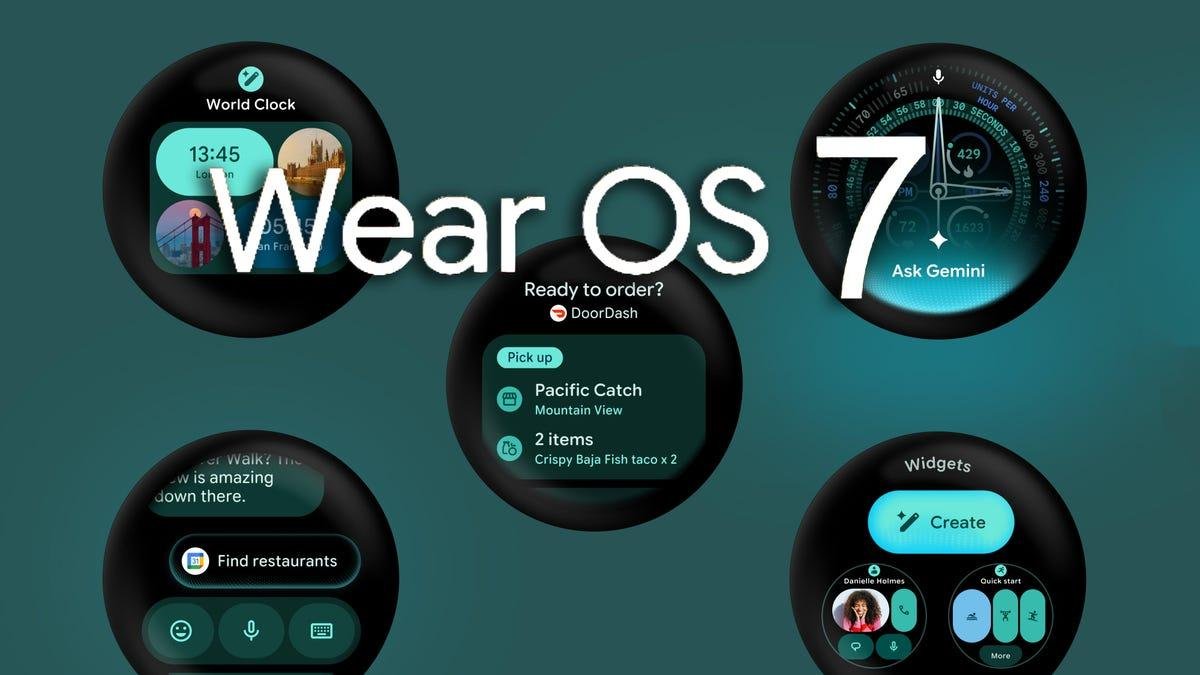
Google/Jeffrey Hazelwood/CNETWear OS 7 updates, as described in an official blog post, focus mostly on minor tweaks under the hood: battery life improvements (10% over Wear OS 6), a shift from full-screen tiles to smaller Android-style widgets, refreshed Live Update notifications with dynamic information, a standardized universal workout-tracking experience for exercise apps and expanded Gemini Intelligence for "select" watches. This includes a new AppFunctions API that lets developers tie their apps into Gemini for task automation. Developers can now test features in the Wear OS 7 Canary emulator, based on Android 17. A broader consumer rollout is expected later this year.
That shift signals where Google sees hardware heading overall, with wearables taking a supporting role in Google's main AI story. Phones, watches, glasses and earbuds are starting to feel secondary to the AI layer sitting on top of them. Hardware will still be important, but mostly because it gives Gemini more context, more sensors and more access to your life (and body). Google's new AI health coach can now analyze biometric trends and even medical records to generate personalized recommendations.
Google isn't alone in this broader industry trend. Apple is leaning on Google's Gemini to power a revamped Siri, while also expanding its Apple Intelligence to watchOS on the Apple Watch. Companies like Whoop and Oura are building similar AI-driven coaching systems. Across the industry, hardware is increasingly presented as a delivery mechanism for AI services rather than the main product itself.
The Google Pixel Watch 4.
Celso Bulgatti/CNETBut before this AI-driven health future becomes reality, companies like Google will need to convince their customers that their most sensitive data is actually safe.
Google says its health features are designed with user privacy controls in mind, but the company hasn't yet fully outlined how biometric and medical record data will be processed across Gemini-powered experiences.
Health data has a long history of being exposed, shared or sold, and even strong privacy promises have failed before. Anonymized health data can still be traced back to a specific person. Google will likely face an uphill climb to entice people to hand over access to their medical records.
Wear OS 7 is now available through the Canary Emulator for developers, giving app makers early access to new APIs and compatibility testing ahead of launch. Google says the broader Wear OS 7 rollout will begin later this year (no specific watch models have been listed yet), with some Gemini Intelligence features arriving independently on supported hardware based on region, manufacturer and account eligibility.