Google I/O 2026 was deathly boring. Speakers talked about AI -- of course -- tokens, agents and other things that put me to sleep. Until I was shocked awake by Google's Varun Mohan. He took the stage and dealt me a psychic blow I wasn't prepared for when he included Doom in his portion of the presentation.
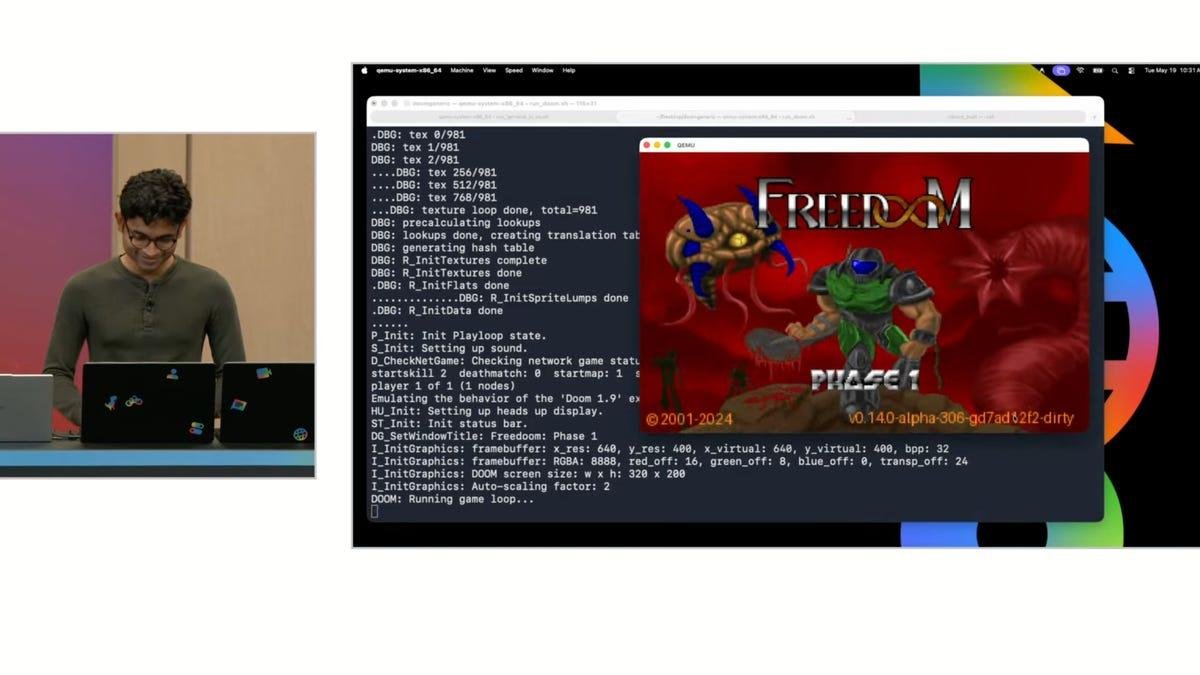
Mohan showed Google using its AI agent-infused development platform Antigravity to build an operating system and asked it to play Doom as a sort of QA test. It couldn't because it lacked video and keyboard drivers, he explained. Mohan then prompted Antigravity to add the necessary drivers, which it did, allowing him to launch Freedoom, the free open-source game based on one of the most influential video games ever made.
Doom is a foundational first-person shooter game, full of demon-slaying action and over-the-top fun, while Google's I/O presentation was a lifeless parade of unasked-for AI features. As CNET's Lori Grunin wrote in a roundup of her favorite things from I/O, there was "a lot ... that looked problematic at best and dystopian at worst."
Doom and Google's AI ambitions are so far apart conceptually that hearing them in the same sentence side by side hurt. Those AI tools could never have the ingenuity or creativity needed to build something as lasting as Doom.
When Id Software released Doom in 1993, its complex level design was a major achievement. The game featured varying landscapes, locked doors, hidden chambers and even different types of elevation within a level. Years before GoldenEye 64 left its mark on the first-person shooter genre, Doom introduced mazes of death and destruction with tight hallways and narrow hiding spaces, and the lighting helped make these levels, filled with plenty of places for enemies to hide, feel truly scary. The ingenuity of its level design is still studied today and continues to inspire communities of players and creators who design levels and modify the game.
Google's Varun Mohan.
GoogleDoom's art direction was also unique. It combined sci-fi, fantasy and heavy metal influences in a way that made it feel wholly original. It's essentially a cross between Dungeons & Dragons, Ridley Scott's Alien and the band Slayer. That creative vision helped shape countless games that followed. I can't imagine films such as Event Horizon or games like Halo ever being made without Doom.
The current slate of AI tools, however, lacks the creativity needed to push any boundary forward or create something that feels lastingly influential. These tools rely on chainsawing past works into mincemeat and reassembling them into a simulacrum of novelty. There's no forward thinking involved, only derivatives of what has already been made.
That lack of creativity was especially apparent while I watched presenters try to hype up Gemini's ability to [checks notes] write emails and come up with ideas for family activities. There wasn't anything particularly inspiring about the technology or the ways Google told us we could use it.
And sure, Doom was an original game that borrowed from earlier works, but it built on those influences to create something new and lasting. These AI tools don't have -- and never will have -- the ingenuity to make something with Doom's staying power. Instead, they just give us back versions of things that have already been made, covered in a weird, creepy sheen.
For more from Google I/O 2026, here's what to know about Google's Project Aura and what to know about Ask YouTube.