
Motorola Razr 2026
Pros
- Solid, reliable design with fun colors
- Good cover screen for selfies
- Fast-charging battery
Cons
- Price hike of $100
- Specs struggle with multitasking
- Limited 3-year Android support
After seven years of making foldables, Motorola has the design down. It's so confident that it has debuted a book-style foldable in the Razr Fold. But instead of novelty, the newest baseline 2026 Razr is about small refinements. If only the price bump weren't so painful.
Mark my words: This time next year, every phone will have suffered a similar jump in price to account for the RAM shortage, tariffs and other inflationary factors. Right now, though, the Razr 2026's $100 hike is hard to stomach, as there haven't been that many improvements over last year's Razr 2025, which can be found for even cheaper now. However, Motorola's limited software support for only three years of Android updates makes picking up an older Razr less appealing.
Even so, an $800 Razr 2026 is appealing for its refined design. It seems former iPhone owners agree, as a large segment of Razr converts come from iOS device owners tired of waiting for Apple to release a folding phone. They'll likely have to wait even longer for a Razr-like clamshell foldable, as leaks suggest the rumored iPhone Fold will be a book-style folding phone like the Samsung Galaxy Z Fold 7.
The Motorola Razr in a half-fold position.
David Lumb/CNETOutside of design, the Motorola Razr 2026 has some compromises, with limited performance and software support balanced out by good battery life and recharging. This isn't a surprise for Motorola phones, but for someone who handled the comparatively rickety original clamshell Razr in 2020, the brand's foldables have come a long, long way. The Razr 2026's 3.6-inch cover display in particular is big enough to question whether there's any reason to bother upgrading to the Razr Plus 2026, which got its own price bump to $1,100.
On the other hand, there's not much new for this year's foldable, making it hard to recommend over last year's Motorola Razr -- if it wasn't for the limited Android support. If you bought the preceding baseline Razr, you'd only get two more years of operating system upgrades, making it harder to recommend, even with discounts. The Razr 2026 has a similar three-year support guarantee, but to sweeten the deal for paying more this year, Motorola is throwing in a pair of Moto Buds 2 Plus headphones and up to $200 off when trading in qualifying phones.
The Razr 2026 feels great and draws eyes whenever I flip it out in public. Even if clamshell foldables have settled into a reliable format, most people who still have flat phones are at least intrigued by -- if not entranced with -- the idea that they too could have folding phones.
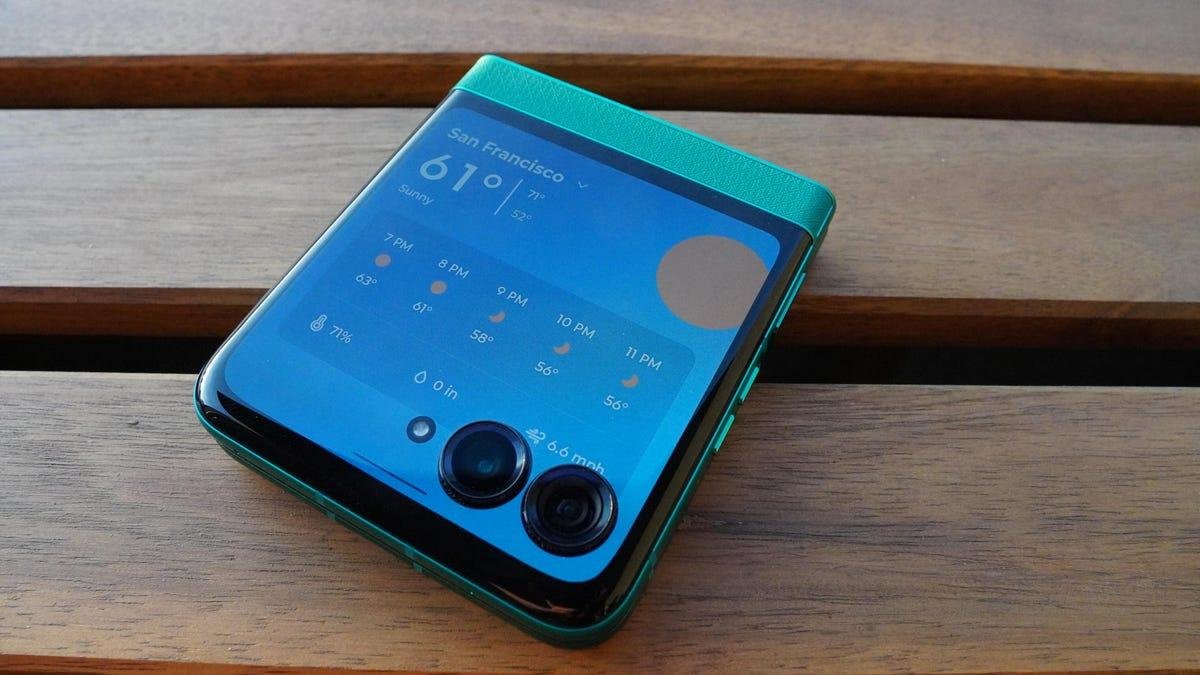
The Motorola Razr 2026 has a handful of widgets for the cover screen, including weather.
David Lumb/CNETRazr 2026 pairs great design with respectable screens
By far the Razr 2026's greatest strength is its long-refined design into a clamshell foldable that feels solid, reasonably lightweight, compact and durable. Not much has changed from last year's Razr, which is a little tough to swallow with an even higher base price, but there's no glaring downside to its solid design.
Folding and unfolding the phone was smooth with a satisfying snap at either extreme, though it stays open at any angle in between -- helpful when setting the phone down and tilting the display up for video chats.
All three Razr 2026 models are largely the same size, with the big difference being in colors and materials. As in previous years, Motorola has wrapped the back of some models in varying textures, which are all pleasing but different in feel. The standard Razr comes in four Pantone hues: hematite (gray), violet Ice (light purple), bright white and a punchy sporting green. I had the last color, which paired with a cross-hatched rubber material that felt pleasantly synthetic.
The back side of my Razr 2026 is wrapped in this grippy rubberized material.
David Lumb/CNETAfter years of Motorola making folding clamshell phones, the Razr's smaller outer screen and folding inner display is old hat — and that's a good thing. I remember the original 2019 Razr's 2.6-inch outer display, which was barely large enough to read text messages and email headlines. Despite being only slightly larger on paper, the Razr 2026's 3.6-inch OLED outer display is bright and spacious enough for light use, like checking notifications and texts along with sliding through at-a-glance widgets for calendar and weather.
The best use of the cover screen is for selfies -- it never fails to impress when I twist the phone (the Moto Gesture to open the camera) and then line up a well-framed shot. There's enough screen area to see yourself and other subjects, even though there's a fairly prominent bezel around the edge, unlike the pricier Razr Plus and Razr Ultra models with their 4-inch outer displays.
The inner 6.9-inch AMOLED display unfolds with a crease over the hinge that's barely visible and can be felt when running a finger over it, though it isn't obtrusive enough to bother when tapping or scrolling. The display has sharp visuals (2,640x1,080 pixels), yet the format is narrow, with a taller (or wider, when held sideways) ratio than folks might expect from a typical flat phone. While playing Dead Cells, the on-screen buttons were spaced farther apart than I was used to on nonfolding phones.
Motorola Razr 2026's cameras are better in daylight
The Razr packs the same cameras as its pricier siblings -- a 50-megapixel main, a 50-megapixel ultrawide and a 32-megapixel selfie camera above the inner display -- making it more convincing to stick with the cheaper model. Indeed, the only thing that limits the standard Razr is its processor, a MediaTek Dimensity 7450X that's not as powerful as the silicon in the Razr Plus and Razr Ultra.
That didn't seem to hold the phone's photo capabilities back as much as I feared. The Razr's rear cameras handled color nicely and depth well enough, in broad daylight outdoors and in dimmer light indoors. Unsurprisingly, without a telephoto camera, the cameras rely on digital crop zoom, which isn't terribly usable beyond 5x.
Here are some sample photos showing off the Razr's decent but not show-stopping capabilities, which is about right for its price and feature range.
A shot of a baseball field with the Motorola Razr 2026's main camera.
David Lumb/CNETI'll start with a crowd-pleaser -- a view of a baseball stadium on a cloudy day. There's a good spread of color and detail, without much smudging of individual elements together. Some of the colors are saturated, especially on the outfield displays.
A shot of a baseball stadium taken with the Motorola Razr 2026's ultrawide camera.
David Lumb/CNETHere's the same shot with the ultrawide camera, which has a bit of fishbowl-esque distortion yet still catches a lot of detail and color. Note the extra saturation of colors in some areas, adding a reddish tint to the dirt at the edge of the field and slightly greener grass.
A selfie taken with the Motorola Razr 2026's main camera when the foldable is folded closed.
David Lumb/CNETLet's switch to selfies taken while the phone is folded up. Here's me hiking with a view overlooking downtown Los Angeles in the background, showing some nice detail up front and depth in back. I tried rotating the phone to see if it would give me selfies in both vertical and horizontal orientations, but no dice -- when the Razr is folded shut, the cameras auto-crop selfies.
A selfie taken with the Motorola Razr 2026's ultrawide camera while the phone is folded closed.
David Lumb/CNETAnd for kicks, here's the same view shot with the ultrawide camera.
A shot with the Motorola Razr 2026's main camera zoomed in to the 10x maximum.
David Lumb/CNETHere's what I mean about the digital zoom. I cranked it up to the maximum 10x to get a shot of this hawk, about 100 feet above the trail, but the phone just can't get much detail.
A shot with the Motorola Razr 2026's main camera.
David Lumb/CNETThe camera's low-light performance is more impressive in detail than in color-matching. In this moodily lit bar, you can see the drink's details and light reflections on the countertop.
A shot of a bar from the Motorola Razr 2026's ultrawide camera.
David Lumb/CNETHere's the same shot with the ultrawide camera, and in dimmer light, you can see more of the color processing differences between this and the main camera. The detail is still captured -- notice the light and shadow on the robot heads in the center of the bar above the drink.
A shot within a theater using the Motorola Razr 2026's main camera.
David Lumb/CNETThe main camera performs acceptably in shots of event venues, capturing a range of colors, though the phone again struggles to capture subject details from afar. Still, it's a decent phone to take when, say, watching a celebrity dungeon master run a tabletop game fundraiser for local politicians.
A Motorola Razr 2026 using camcorder mode to record video of a sumo tournament.
David Lumb/CNETThe Razr 2026 records video in 4K, but it does have an extra feature called "camcorder mode" that works as one might imagine: fold the phone in half and you can shoot video with the top half of the phone acting as a viewfinder, while the bottom turns into a big button you can press to start and stop recording. You can also tilt the phone left and right to zoom in and out. All in all, it's more of a novelty than a superior method to shoot videos, but it also never failed to delight the people I showed.
The Motorola Razr 2026's screen is 6.9 inches.
David Lumb/CNETThe Razr (2026) has better battery life, good enough performance
As an entry-level foldable, the Razr's specs of a MediaTek Dimensity 7450X chip and 8GB of RAM lead it to handle regular phone tasks well, but it won't take home any prizes. Depending on the benchmark, the phone gets performance results about a third (3DMark Wild Life Extreme) to half (Geekbench 6) that of even the Razr Plus with its three-year-old Snapdragon 8S Gen 3, and far below this year's top phones with the latest silicon.
Practically, those middling specs only slow the Razr down when multitasking: opening apps can result in a second of pause, but it's situations like screen-splitting (swiping down on the screen with three fingers to load two apps at once) that grinds the phone's OS to a screeching halt. It's somewhat challenged by graphically intensive situations, like running high-performance games. The phone handled the older Dead Cells fairly well, and even managed some higher graphics settings on Diablo Immortal, albeit with occasional stuttering and lag.
The cover display is 3.6 inches.
David Lumb/CNETThe Razr packs 256GB of storage, which should be the minimum all phones include, especially those priced at $800 or above. Yet there will be another configuration of the foldable with 128GB that will be "available through select channel partners," Motorola told CNET. Without expandable storage, this feels like too little storage to use the phone for years on end; the Android installation alone takes up 26GB.
Like most phone brands, Motorola has its own bespoke AI offerings. Moto AI, which requires a sign-in to a Motorola account, is a handful of generative AI task-helpers divided between creative (generate AI images, make a playlist) and productive (transcribe audio conversations, get summaries of notifications). You can access some of these from the cover screen, which I imagine would make the audio transcription pretty handy and a lot quicker to fire up than my current process: hunt down the Otter app, tap to start a recording and wait for it to start.
The Razr packs Android 16 out of the box, and on par with previous years of Motorola foldables, guarantees three years of operating system updates and five years of security patches. With the new book-style Motorola Razr Fold getting the industry-standard seven years of software support, matching guarantees for Samsung and Google phones, I'd hoped that Motorola would extend that to its clamshell foldables as well. It's one of the biggest reasons prospective buyers may want to look elsewhere for a flip smartphone, like the Galaxy Z Flip 7, Z Flip 7 FE or the foldables Samsung is expected to release over the summer.
What the Razr does well is battery life and charging. Its silicon-carbon 4,800-mAh battery lasts all day and has more capacity than those on the Razr Plus. In our 45-minute stress test combining varied uses like streaming video, playing games and video chats, the phone dropped 4%. Its 30-watt wired charging refilled 68% of the handset's battery in 30 minutes, outperforming its pricier siblings. It also has 15-watt wireless charging and can donate capacity with 5-watt reverse wireless charging.
You can "tent" the Razr to use the cover display but also use a
David Lumb/CNETMotorola Razr 2026 bottom line
The Motorola Razr 2026 remains a good pick for the foldable-curious, and though it's gotten pricier, so have many other phones. The strides made in previous years -- upgrading both rear cameras to 50-megapixel shooters, expanding its cover screen to 3.6 inches -- make it premium enough to warrant serious consideration over its even more expensive siblings (which also got price bumps).
Where the foldable makes compromises, namely in a chip that's slower than other phones at its price range, it's not hindering enough to dissuade favor -- though if you plan to keep your phone longer than four or five years, the Galaxy Z line of foldables is a better investment. Where the foldable excels in design, display and battery, it justifies recommendation as the most affordable clamshell foldable available on the market.
Motorola Razr 2026 vs. Motorola Razr Plus 2026 vs. Motorola Razr Ultra 2026
| Motorola Razr 2026 | Motorola Razr Plus 2026 | Motorola Razr Ultra 2026 | |
|---|---|---|---|
| Cover display size, tech, resolution, refresh rate | 3.6-inch pOLED; 1,066x1,056 pixels; up to 90Hz variable refresh rate | 4-inch pOLED; 1,272x1,080 pixels; up to 165Hz variable refresh rate | 4-inch pOLED, 1,272x1,080 pixels; up to 165Hz variable refresh rate |
| Internal display size, tech, resolution, refresh rate | 6.9-inch AMOLED; 2,640x1,080 pixels; up to 120Hz variable refresh rate | 6.9-inch pOLED; FHD+; 2,640x1,080 pixels; up to 165Hz variable refresh rate | 7-inch AMOLED; 2,992x1,224 pixels; up to 165Hz variable refresh rate |
| Pixel density | Cover: 413 ppi; Internal: 413 ppi | Cover: 417 ppi; Internal: 413 ppi | Cover: 417 ppi; Internal: 464 ppi |
| Dimensions (inches) | Open: 2.91 x 6.74 x 0.29 in; Closed: 2.91 x 3.47 x 0.62 in | Open: 2.91 x 6.75 x 0.28 in; Closed: 2.91 x 3.47 x 0.6 in | Open: 2.91 x 6.75 x 0.28 in; Closed: 2.91 x 3.47 x 0.62 in |
| Dimensions (millimeters) | Open: 73.99 x 171.30 x 7.25mm; Closed: 73.99 x 88.08 x 15.85mm | Open: 73.99 x 171.42 x 7.09mm; Closed: 73.99 x 88.09 x 15.32mm | Open: 73.99 x 171.48 x 7.19mm; Closed: 73.99 x 88.12 x 15.69mm |
| Weight (grams, ounces) | 188g (6.63 oz) | 189g (6.67 oz) | 199g (7 oz) |
| Mobile software | Android 16 | Android 16 | Android 16 |
| Cameras | 50-megapixel (wide), 50-megapixel (ultrawide) | 50-megapixel (wide), 50-megapixel (ultrawide) | 50-megapixel (wide), 50-megapixel (ultrawide) |
| Internal screen camera | 32-megapixel | 32-megapixel | 50-megapixel |
| Video capture | 4K | 4K | 4K |
| Processor | MediaTek Dimensity 7450X | Snapdragon 8s Gen 3 | Snapdragon 8 Elite |
| RAM/storage | 8GB + 128GB, 256GB | 12GB + 256GB | 16GB + 512GB |
| Expandable storage | None | None | None |
| Battery | 4,800 mAh | 4,500 mAh | 5,000 mAh |
| Fingerprint sensor | Side | Side | Side |
| Connector | USB-C | USB-C | USB-C |
| Headphone jack | None | None | None |
| Special features | IP48 rating, dual stereo speakers, 30-watt wired charging, 15-watt wireless charging, 1,700 nit peak brightness on cover display, 3,000 nit peak brightness on main display, 5G (sub-6) | IP48 rating, Corning Gorilla Glass Victus on front, titanium-reinforced hinge, 2,400 peak brightness on cover display; 3,000 nit peak brightness on main display, 5G (sub-6), Wi-Fi 6/6E, Wi-Fi 7, 45-watt wired charging, 15-watt wireless charging, 5-watt reverse charging. | IP48 rating, 68-watt wired charging, 30-watt wireless charging, 5-watt reverse charging, dual stereo speakers, Corning Gorilla Glass Ceramic cover display, 3,000 nits peak brightness on cover display, 5,000 nits peak brightness on main display, 5G (sub-6). hall sensor, proximity sensor |
| US price starts at | $800 (128GB) | $1,100 (256GB) | $1,500 (512GB) |
How we test phones
Every phone tested by CNET's reviews team was actually used in the real world. We test a phone's features, play games and take photos. We examine the display to see if it's bright, sharp and vibrant. We analyze the design and build to see how it is to hold and whether it has an IP-rating for water resistance. We push the processor's performance to the extremes using standardized benchmark tools like GeekBench and 3DMark, along with our own anecdotal observations navigating the interface, recording high-resolution videos and playing graphically intense games at high refresh rates.
All the cameras are tested in a variety of conditions from bright sunlight to dark indoor scenes. We try out special features like night mode and portrait mode and compare our findings against similarly priced competing phones. We also check out the battery life by using it daily as well as running a series of battery drain tests.
We take into account additional features like support for 5G, satellite connectivity, fingerprint and face sensors, stylus support, fast charging speeds and foldable displays, among others that can be useful. We balance all of this against the price to give you the verdict on whether that phone, whatever price it is, actually represents good value. While these tests may not always be reflected in CNET's initial review, we conduct follow-up and long-term testing in most circumstances.