After the sirens: Lebanon's first responders swing between duty and grief
After the sirens: Lebanon's first responders swing between duty and grief

The father of Hussein Jaber, who was killed in an Israeli strike on Nabatieh, in southern Lebanon, on May 12, cries during the funeral ceremony in Sidon the following day. Diego Ibarra Sánchez/for NPR hide caption
toggle caption
Diego Ibarra Sánchez/for NPR
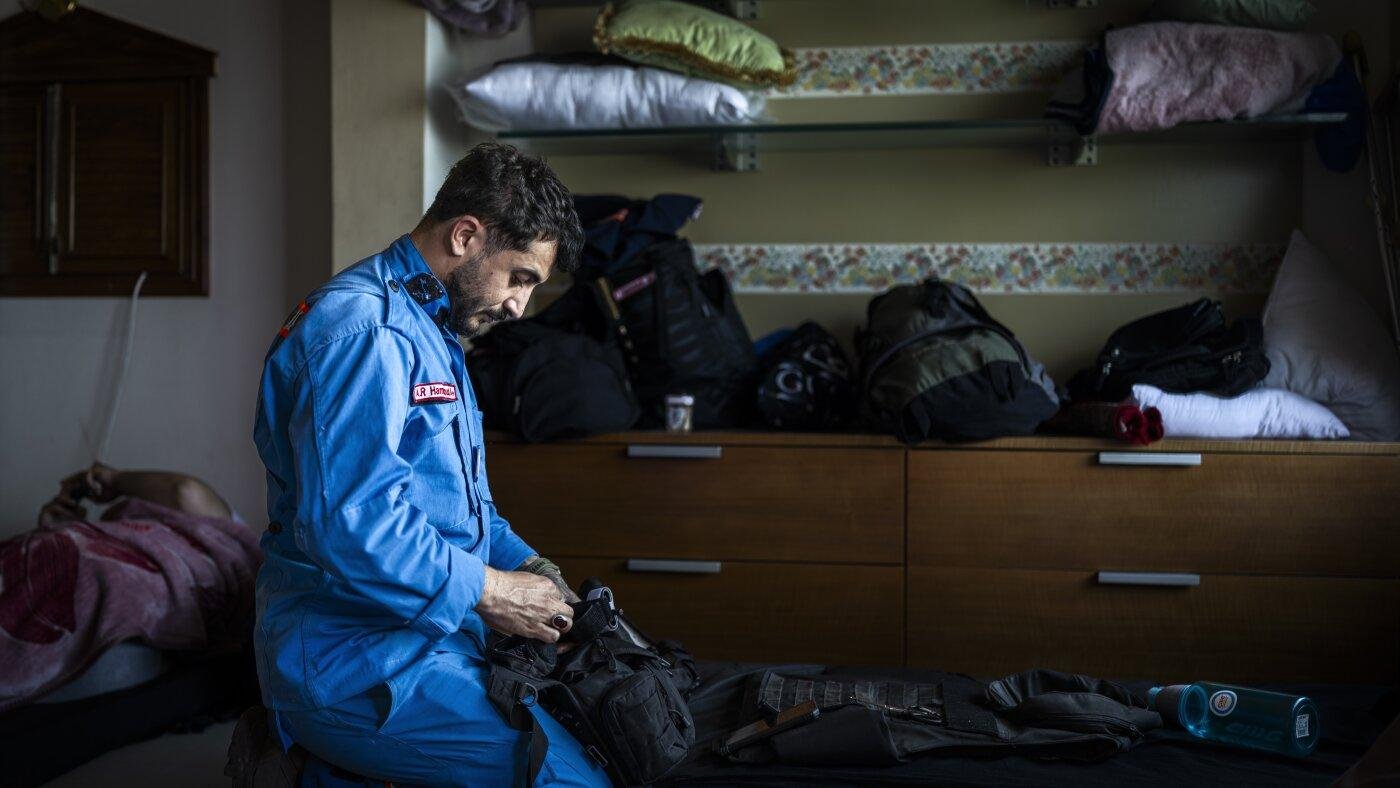
SIDON, Lebanon — In this southern Lebanese city, Nareej Ramal is weeping in the arms of her father-in-law; the civil defense uniform her husband, Hussein Jaber, wore every day is draped around her shoulders like a final embrace.
Jaber, 32, a veteran first responder with Lebanon's interior ministry, was killed along with his colleague Ahmad Noura, 45, by an Israeli drone on May 12 in Nabatieh, a city in southern Lebanon, as they tried to rescue a man wounded in another strike moments earlier. His death came just days before Ramal and Jaber's first wedding anniversary.
The two men were the latest of over 100 first responders killed in Israeli airstrikes since the war between Israel and the militant group Hezbollah began on March 2. A ceasefire between Israel and Lebanon that began in April has not slowed Israeli attacks.
Israel has repeatedly accused Hezbollah of using ambulances and medical facilities for military purposes, without providing evidence, claims Lebanon's health ministry denies.
International law protects hospitals, rescue teams and ambulance crews. "But what we see now, no, it's not that," says Mona Boud Zeid, the director of Al Najdeh al-Shaabiyeh Hospital, which treats the wounded in southern Lebanon. From the hospital's location in Nabatieh, she can see the airstrikes.
"It's like what we see now in Gaza. It's the same. ... Maybe our hospitals, our nurses, our doctors will go through the same."
Gaza's health ministry says Israeli attacks killed more than 1,700 medical personnel and first responders during the war.

Hundreds of mourners march on April 30, 2026, behind the coffins of three Lebanese Civil Defense paramedics killed by Israeli strikes in southern Lebanon. Diego Ibarra Sánchez/for NPR hide caption
toggle caption
Diego Ibarra Sánchez/for NPR

Fellow paramedics, dressed in uniform, carry their colleagues' coffins, draped with Lebanese flags, on their shoulders as mourners gather and weep in southern Lebanon on April 30, 2026. Diego Ibarra Sánchez/for NPR hide caption
toggle caption
Diego Ibarra Sánchez/for NPR

Hundreds of mourners march behind the coffins of three Lebanese Civil Defense paramedics on April 30, 2026, who were killed by Israeli strikes in southern Lebanon. Diego Ibarra Sánchez/for NPR hide caption
toggle caption
Diego Ibarra Sánchez/for NPR
According to the medical aid group Doctors Without Borders, which has personnel at the Nabatieh hospital, Jaber and Noura were killed after rushing to the scene of an earlier strike. A third medic with them was injured. The aid group called the killing of the rescue workers "part of an alarming pattern."
Outside the hospital morgue on May 13, a dozen uniformed first responders kept a somber, silent vigil, waiting to lift the bodies into a waiting ambulance. In the background, colleagues and hospital workers sobbed.
Wrapped in white shrouds and covered with flowers, the bodies were transferred from Nabatieh to a burial site in Haret Saida, near Sidon. Their burials will be temporary because it's impossible to bury them in their own villages due to ongoing attacks. For many families, the ritual means enduring the pain of burial twice.
"They were never just colleagues," says team leader Abdallah Hallal, his voice breaking. "We have been together for more than 20 years," he says, speaking about Noura. "We saw a lot together. We lived through a lot together. No words can describe what we feel."
Hallal has spent more than 20 years as a search-and-rescue team leader, responding to emergencies and pulling survivors from the rubble on the frontlines of disaster and war.

Families mourn their loved ones in Tyre, Lebanon, on April 30, 2026. Diego Ibarra Sánchez/for NPR hide caption
toggle caption
Diego Ibarra Sánchez/for NPR

Pictures of Lebanese Civil Defense members Hussein Jaber and Ahmad Noura, who were killed in an Israeli strike on the southern town of Nabatieh, are displayed on an ambulance in Nabatiyeh on May 13. Diego Ibarra Sánchez/for NPR hide caption
toggle caption
Diego Ibarra Sánchez/for NPR

Members of the Civil Defense team mourn the loss of Lebanese Civil Defense members Hussein Jaber and Ahmad Noura, who were killed in an Israeli strike on the southern town of Nabatieh on May 12. Diego Ibarra Sánchez/for NPR hide caption
toggle caption
Diego Ibarra Sánchez/for NPR
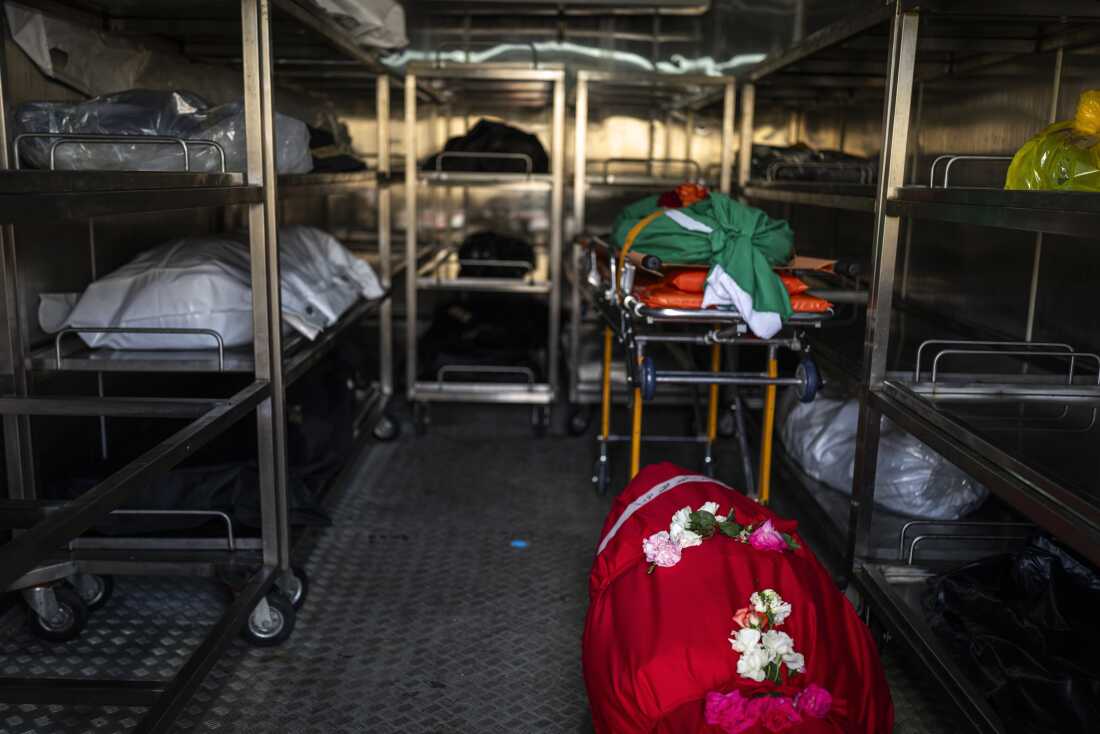
The bodies of Lebanese Civil Defense members Hussein Jaber and Ahmad Noura, who were killed in an Israeli strike on Nabatieh on May 12, lay in the morgue the next day. Diego Ibarra Sánchez/for NPR hide caption
toggle caption
Diego Ibarra Sánchez/for NPR
The same image has been repeating throughout the war, in different scenes, the same tears of first responders.
At the end of April, helmets, stretchers and rescue vehicles stood motionless at the headquarters of first responders struck in earlier attacks, transformed into silent symbols of sacrifice in Tyre, a city in southern Lebanon. They formed the backdrop to a ceremony for Hadi Daher, Hussein Al-Sati and Hussein Ghadbouni, first responders killed while responding to a strike in the town of Majdal Zoun.
Hundreds of mourners gathered to pay tribute under the Lebanese anthem, songs, fireworks and grief, a farewell marked equally by honor and loss, while shadows stretched across the soil of the temporary graveyard.
The attacks during a ceasefire are a bitter reminder of how war devours the lives of everyone caught in the crossfire. Many of the dead have been civilians.
NPR contacted the Israeli military for comment about the Lebanese medics and did not hear back,

Mourners, relatives and colleagues attend a funeral on May 13 for Lebanese Civil Defense members Hussein Jaber and Ahmad Noura, who were killed in an Israeli strike on Nabatieh the day before. Diego Ibarra Sánchez/for NPR hide caption
toggle caption
Diego Ibarra Sánchez/for NPR

Mourners attend a funeral in Baisariyah, Lebanon, on April 23, 2026, for Amal Khalil, a journalist who was killed in an Israeli attack. Diego Ibarra Sánchez/for NPR hide caption
toggle caption
Diego Ibarra Sánchez/for NPR
Commandité
Annonces
Annonces
Annonces
Catégories
Lire la suite
Best Xbox Controller for 2026: Series X and Series SWith prices going up everywhere, including Microsoft raising prices on its Xbox console and accessories, it's more important than ever to spend your money in the right place. When it comes to getting a new Xbox controller, that means finding the best one for your play style and the types of games you play the most. There are dozens of great...

Laid-off Oracle workers tried to negotiate better severance. Oracle said no. As was widely reported, Oracle axed an estimated 20,000 to 30,000 people via email on March 31. One of the employees cut that day told TechCrunch about the experience: “I had, like, this weird feeling in my stomach. I went to go sign into the VPN, and the VPN was like, ‘this user doesn’t exist anymore.’ Then I...

Israel strikes Beirut suburb days after US-brokered truce13 minutes agoJohn Sudworth and Samantha GranvilleBeirutReutersEmergency services at the scene of the Israeli strikes on SundayIsrael has hit southern Beirut in the first attack on the Lebanese capital since a truce brokered by the US last week.Two air strikes on two apartment buildings in a stronghold of Iran-backed Hezbollah killed two...
Families of USS Lincoln crew say Trump should be 'ashamed' of conditions on board President Donald Trump speaks with reporters before boarding Air Force One, Friday, Aug. 14, 2026, at Joint Base Andrews, Md. Julia Demaree...

Putin denounces Nato at scaled back Russia's Victory Day paradeKremlin.ru/Handout via ReutersVladimir Putin has used his annual Victory Day speech in Moscow's Red Square to justify his war in Ukraine and denounce Nato.Speaking in front of hundreds of military personnel and flanked by a few world leaders, the Russian president said he was fighting a "just" war and called Ukraine an "aggressive...