

The day many of us longed for during those short, dark, cold winter days is on its way. Sunday, June 21, is the longest day of the year, celebrated as the summer solstice. Technically, the solstice will arrive at 1:24 a.m. PT (4:24 a.m. ET) in the US. Here are some basic solstice facts.
What is the summer solstice?
As the Farmer's Almanac explains, the solstice occurs "when Earth arrives at the point in its orbit where the North Pole is at its maximum tilt" toward the sun, or about 23.5 degrees; this translates to "the longest day and shortest night" of the year. (By "longest day," we mean the longest period of sunlight hours.) The Farmer's Almanac explains further that "on the day of the June solstice, the Northern Hemisphere receives sunlight at the most direct angle of the year."
The solstice isn't always on the same date. In 2027, it'll be on June 21 again, but in 2028 and 2029, it'll be on June 20.
The June solstice means something different to people living in the Southern Hemisphere, where it's the shortest day of the year and marks the beginning of winter.
How much sun will you see?
The amount of sun you'll get depends on where you live.
You can figure it out for your city by going to TimeAndDate.com, typing in the name of your city under World Clock, and clicking on Sun & Moon. From there, click on Sunrise & Sunset, then scroll down for the table that shows the number of hours of daylight per day. To see the number of hours of daylight you'll receive on the solstice, be sure to select June for the month, then scroll down to the correct day.
The further north you are, the more sun you'll get: Minneapolis, you get 15 hours, 36 minutes of sun. Seattle, you land a whopping 15 hours, 59 minutes. Boston, 15 hours, 17 minutes. San Francisco, 14 hours, 46 minutes. Los Angeles, 14 hours, 25 minutes. Dallas, you get 14 hours, 18 minutes. Miami, 13 hours 44 minutes. Atlanta, 14 hours 23 minutes. Phoenix, 14 hours 22 minutes.
And let's talk about the Land of the Midnight Sun. Anchorage, Alaska, gets 19 hours, 21 minutes. But Fairbanks gets a whopping 21 hours, 49 minutes. And at the very top of the state, in Utqiaġvik, Alaska, the sun is up for 24 hours. It's worth going to their TimeAndDate.com page just to marvel at that.
Celebrating the solstice
Some countries and cultures really get into celebrating the solstice. Sweden calls it Midsummer and always celebrates on a June Friday, so the country will mark the solstice on June 19 instead of June 21. Traditional festivities there include folk dancing, wreath making and maypole raising. (And you may have seen the 2019 horror movie Midsommar, which depicts a fictional and very scary midsummer celebration.)
In Seattle, home of those luxurious 16 hours of sun, the traditional Solstice Parade and Fair occurs on Saturday, June 20, at 1 p.m. and features the event's traditional naked bicyclist ride (where cyclists wear elaborate body paint).
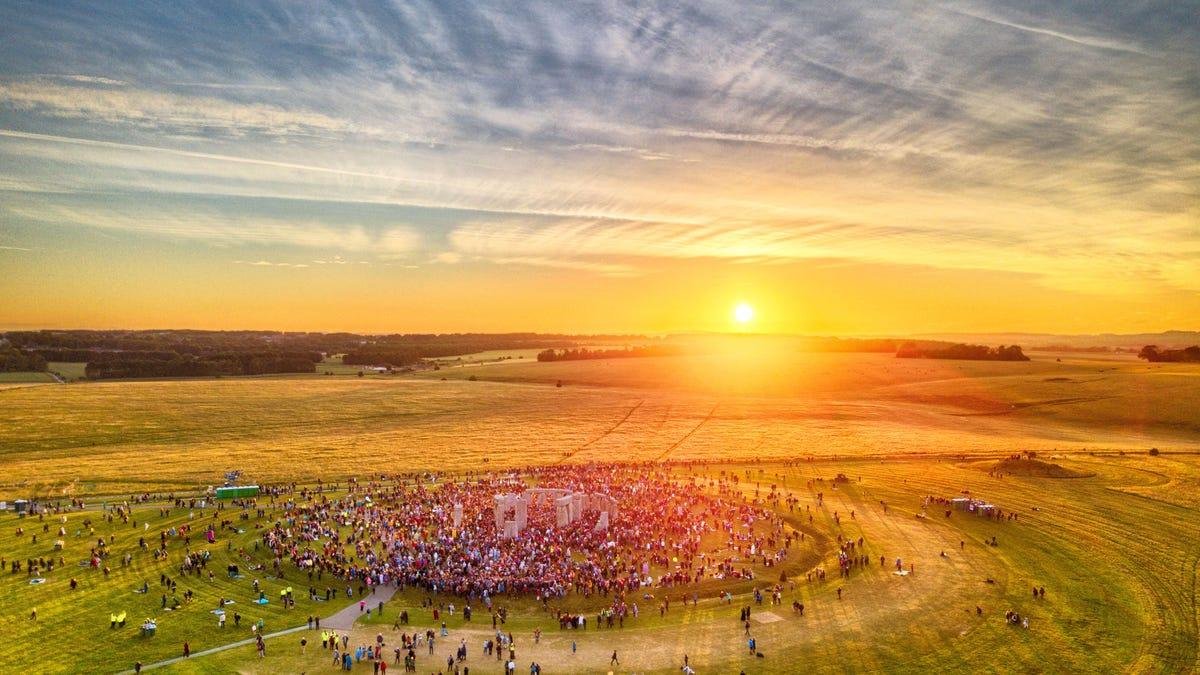
And at England's iconic Stonehenge, people gather at the famed stone structures as their predecessors did thousands of years ago. The huge stones of the monument were set up in 2500 BC to frame the sunrise at the summer solstice and the sunset at the winter solstice, the British Museum notes. Note that since we're no longer in 2500 B.C. and rely on cars, visitors are strongly encouraged to use public transit, and if you have to drive, you must book parking in advance.