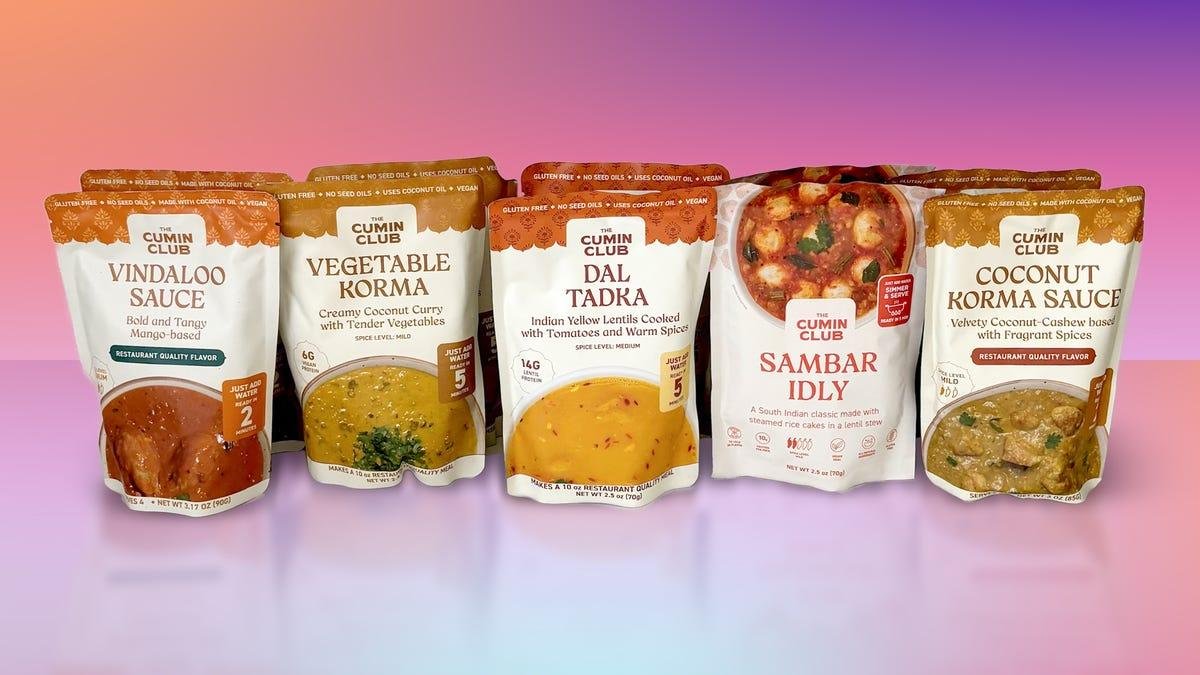
The Cumin Club flies under the radar as a meal kit service, but its dishes are delicious and take only 5 minutes to prepare.
Zain Awais/Anna Gragert/CNETFor a long time, I didn’t think I liked Indian food, but that was only because I’d never had authentic Indian food. The Cumin Club, which creates 5-minute Indian meal kits, deliciously emphasized this fact.
Co-founded by Ragoth Bala and Harish Visweswaran, who immigrated to the US from India, The Cumin Club offers over 30 vegetarian and vegan meals developed by chefs in India and approved by a panel of taste testers. Freeze-dried into pouches, the lentils, rice, curries, simmer sauces and desserts contain no preservatives, GMOs, excess sodium or seed oils.
As one of CNET’s meal kit testers and a vegetarian of 21 years who often cooks and eats vegan meals, I was curious how The Cumin Club’s freeze-dried dishes would compare to the fresh and frozen meal delivery services I’ve tested over the past few years. So I put The Cumin Club’s vegan offerings to the test.
How The Cumin Club works
The Cumin Club currently ships to the US and UK. When you go to “build your box” on its homepage, whether you’re placing a one-time order or signing up for a monthly subscription, you choose between five, 10 and 20 meals. The more meals you order, the lower the price per serving. Plus, if you opt for a subscription, servings get even more cost-effective.
The Cumin Club’s meals are also available on Amazon and at Walmart.
The Cumin Club's meals are freeze-dried in pouches, so no refrigeration or freezing is required.
Anna Gragert/CNETOfferings
There are six different categories: curries, lentils, simmer sauces, hearty grain bowls, desserts and bundles. You can also filter by spice level from very mild to hot and six different dietary needs: vegan, gluten-free, no peanuts, no tree nuts, no soy and high protein.
The most popular recipes -- like paneer tikka masala, dal tadka and palak paneer -- are mainstays on the menu, says a representative for the brand, while the rest of the selection rotates based on availability and ingredient seasonality. There will be a few new additions in the coming months, including chana masala launching in July.
If you decide to bundle, you can choose between having your cart filled with two servings of five bestsellers, two servings of five vegan offerings or two servings of four “intro to Indian food” meals. There are also bestseller and vegan gift boxes available.
Add-ons
In your cart, you can also add four sides: soy protein chunks, cumin rice, salan (a tomato-onion gravy) and sambar (a lentil-based stew).
Some of the pantry items I received, such as the coconut chutney and masala tea, can only be added to the order after checkout with mains and sides.
Out of the three Cumin Club sides I tried, the perfectly fluffy cumin basmati rice was my favorite.
Anna Gragert/CNETHow freeze-drying works
All of The Cumin Club’s meals are freeze-dried, turning them into a powdery mix. On its FAQ page, the company describes freeze-drying as a modern preservation method that involves freezing food and then drying it under low pressure, turning the ice into vapor. That means each meal retains its nutrients, flavor and texture without the use of preservatives.
Shipping and storage
For orders placed in the US, shipping takes 3-5 business days; for UK orders, 5-7 business days. Both are shipped within 1-2 business days of the order being placed or processed.
Once you receive the meals, they’re shelf-stable for at least six weeks. Each pouch has a best-before date. Since they are freeze-dried, you can store them in your pantry or a cool, dry place; no fridge or freezer necessary.
Since The Cumin Club's offerings are freeze-dried, no ice packs are needed, creating less waste when shipping.
Anna Gragert/CNETHow to edit, cancel or pause your subscription
On your Account page, you can edit your meals, skip an upcoming order and pause or cancel your subscription. Just make sure you do so before your order is processed; you should receive a reminder email two days beforehand. Once you receive the reminder email, you have until the end of that day to make changes or cancel your order.
Plus, if you’re not happy with the meals in your first order, you can email the company at hello@thecuminclub.com with your feedback, and it will issue a refund if appropriate.
How much does The Cumin Club cost?
If you choose a monthly subscription instead of a one-time order, you get 20% off your first order and 10% off all future orders.
As of May 2026, these are The Cumin Club's current prices per meal:
5 meals | 10 meals | 20 meals | |
One-time order | $9.50/meal ($4.75/serving) | $8/meal ($4/serving) | $7/meal ($3.50/serving) |
Monthly subscription | $7.60/meal ($3.80/serving) | $6.40/meal ($3.20/serving) | $5.60/meal ($2.80/serving) |
Most meals contain two servings, which I used to calculate the price per serving. Some, like the coconut korma sauce I tried, serve four. But depending on whether you add your own protein and other ingredients, as you would for the sauces, certain dishes seem more like one serving.
All sides are $4 each.
The masala tea I received is $6 for five servings, which comes out to about $1.20 per serving. This is pricey compared to other chais on the market, such as Vahdam’s masala chai, which is about $0.25 per serving at full price.
Gift boxes are $50 for eight offerings, including meals with rice or chutney, desserts, snacks such as banana chips and mango bar bites, and masala chai.
Every order includes free shipping, a welcome touch.
The pamphlet that comes with every order from The Cumin Club.
Anna Gragert/CNETAre The Cumin Club’s meals easy to prepare?
I found The Cumin Club’s meals to be among the easiest meal kits to prepare because you simply have to boil water, remove the freshness packet from your meal’s pouch, pour its contents into the water, stir or cover for a few minutes and then serve.
Some meals also have microwave instructions.
You can add your own protein, veggies or greens to The Cumin Club’s meals, and you’d have to do so for its sauces. You’d cook those separately and then add them to the dish, which would be the most time-consuming part.
What I ate and how I liked it
I taste-tested five different freeze-dried vegan dishes, along with two sides and the company’s chai. These are my thoughts:
Dal tadka: Packed with 14 grams of protein thanks to its yellow Indian lentils, this dal also contains tomatoes and spices such as cumin, ginger, green chili and red chili powder. Although it had a medium spice level, I found it less spicy than the vindaloo sauce, but just as flavorful.
The dal tadka is flavorful, not too spicy and has 14g of protein.
Anna Gragert/CNETCoconut korma sauce: To this coconut-cashew sauce made with coriander and curry leaves, green chili, star anise, cardamom and cinnamon, I added chickpeas, sweet potato, peas and cilantro. It was delicious, and I loved seeing the whole star anise in my dish.
Sambar idly: This mild lentil stew contains rice cakes, split pigeon peas, green gram (or mung bean), urad dal (an Indian lentil) and split chickpeas, which give the dish its 10g of protein. It also contains drumsticks, which are Moringa tree pods used as a vegetable in Indian cooking. This was another delicious dish, but my only critique was that the rice cakes didn’t hold up during cooking and ended up more chewy than fluffy, though still tasty.
While the rice cakes could have been more fluffy, the sambar idly was still delicious.
Anna Gragert/CNETVindaloo sauce: This green mango-based curry is made with coconut milk and aromatic spices such as ginger, Kashmiri chili powder and both dried and green chilis. It is beautifully tangy thanks to the mango, and as you can probably guess from the different types of chili, spicy. It’s labeled as “medium” spicy, but those sensitive to spice, like myself, might find it higher up on the scale. I added my own vegan chicken pieces, snap peas, spinach and the brand’s cumin rice.
Vegetable korma: This was my favorite of the vegan meals I received. It’s a creamy coconut curry with 6 grams of vegan protein and tender vegetables: carrot and green beans. I loved this meal so much that I wish others included vegetables. Cardamom, cinnamon, turmeric powder and star anise also gave it a warming, comforting flavor, and I felt that its “mild” spice rating was accurate.
I loved the added veggies in this creamy coconut curry.
Anna Gragert/CNETCumin basmati rice: This side is just four ingredients: basmati rice, cumin, coconut oil and salt, and can be made either in the microwave or on the stovetop. I went with the latter and loved it as a side to the above dishes. The rice was fluffy, and the cumin flavor was perfectly balanced, not overwhelming the dishes I paired it with.
Coconut chutney: Made of coconut, red and green chilis, curry leaves, Bengal and black gram (chickpeas and lentils) and mustard, this chutney provided a nice balance to the spicier meals. However, the amount of water suggested for mixing with the freeze-dried ingredients makes the chutney too watery, so I’d recommend adding the water slowly until you reach your desired consistency.
Though it was still a great side, the coconut chutney came out watery.
Anna Gragert/CNETMasala chai: As a fan of chai, I found this tasty and packed with flavor, thanks to Assam black tea, cardamom, saffron, ginger, cloves, cinnamon and black pepper. You simply add the tea to milk in a pot on the stovetop, add sugar, stir until the milk boils and then strain into a mug. I made mine with oat milk and added honey. I’d recommend tasting before you strain, as the tea can be a bit bitter without enough sugar.
Is The Cumin Club healthy?
Whether something is healthy depends on your specific diet, so I recommend checking the nutrition facts before ordering. You can easily find this information under each item’s description on The Cumin Club’s website and on the back of each product’s pouch.
One thing I will point out is to check the serving size for each meal, especially for saturated fat, as some of The Cumin Club’s meals are made with coconut oil and coconut milk. Coconut is a source of saturated fat and should be eaten in moderation, according to the American Heart Association.
For instance, the vegetable korma I received contained 11 grams of saturated fat, which is 55% of the recommended daily value. However, that’s for just one serving, which is half the package. To me, the entire package seemed more like one serving, but if you eat the whole dish, you'll consume 22 grams of saturated fat, which is over the daily value at 110%.
The nutrition facts are on the back of every meal from The Cumin Club.
Anna Gragert/CNETWho is The Cumin Club best for?
The Cumin Club’s meals are primarily vegetarian with a few vegan options. As of this writing, there are 28 meal options and four sides. Eight meals are vegan, and 23 are gluten-free.
Since certain meals, such as the simmer sauces, are designed for adding your own protein, veggies and more, meat eaters can also enjoy them, too. All you have to do is add your meat of choice.
As a result, I’d say that The Cumin Club is great for any type of eater, but particularly vegetarians, vegans and those avoiding gluten. However, if you’re trying to reduce saturated fat in your diet, make sure you check the nutrition facts first.
Is The Cumin Club eco-friendly?
The Cumin Club meals came in a cardboard box that can be recycled. Since the meals are freeze-dried, no ice packs are needed, so you don’t have to worry about that extra waste. The pouches that the meals are packaged in, however, can’t be recycled.
The meal pouches are categorized as #7 or "other" plastics, meaning they aren't recyclable.
Anna Gragert/CNETThe final verdict
I loved The Cumin Club and found its meals to be delicious, thoughtfully developed and perfectly balanced. The fact that they were freeze-dried, rather than fresh or frozen, didn’t affect the flavor at all and made them easy to prepare with boiling water on the stovetop.
The price isn’t bad, with a max of $9.49 per meal or $4.75 per serving, but I found that two-serving meal pouches were more like one serving, so per-meal seems more accurate than per-serving. Considering that other meal kits I’ve tested range from $6 to $18 per serving, The Cumin Club falls at the lower end of that range.
The only caveat is that you do have to add your own protein, veggies and greens to some of its meals, which will increase the cost. In that sense, recipes such as the simmer sauces are more like “meal starters” rather than “meal kits,” which traditionally come with everything you need.
If you’re looking for authentic Indian food that’s ready in five minutes and easily customizable, I’d highly recommend The Cumin Club.