The groupthink boom: what three top VCs really think about the AI frenzy
The groupthink boom: what three top VCs really think about the AI frenzy
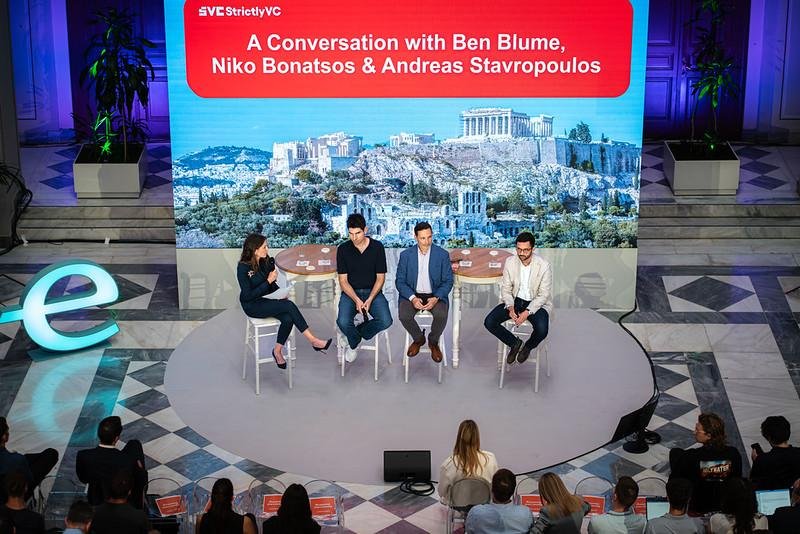
This week at TechCrunch’s StrictlyVC event in Athens — part of the Panathenea festival taking place in the city — I sat down with Niko Bonatsos of Verdict Capital, Andreas Stavropoulos of Threshold Ventures, and Ben Blume of Atomico to ask about the current state of venture investing, the wave of mega-IPOs that SpaceX is about to kick off, and where they still see an ocean of opportunity. Our conversation, following, has been edited for length and clarity. You can check out the full discussion at page bottom.
With SpaceX reportedly eyeing a $1.75 trillion valuation at IPO, and OpenAI and Anthropic potentially not far behind, what will the impacts be on the broader market?
Andreas Stavropoulos: I remember how exciting the Google IPO was, and how it ushered in a reopening of a market that had been very pessimistic about tech in the early 2000s — how it was an enabling event that brought in a whole new generation of entrepreneurs. The same thing is happening now. With every subsequent wave of paradigm shifts, the scale changes by orders of magnitude, and that’s to be expected. What business today in the information age is not a technology business?
Ben Blume: These are phenomenal companies, and with each one of these scale liquidity events, they generate wealth and returns that go back into the next generation of companies.
Niko Bonatsos: My co-founder at Verdict was the first-ever investor in what is now known as Cursor. So if Elon feels like he’s [having] a good moment, maybe Cursor [which Musk revealed recently that he has the option to acquire for $60 billion] will have some good news too. But more broadly, for the next next generation of companies, as Andreas mentioned, they could be going after much larger markets, and immigrant founders, as we know, they’re the ones who dream really big, they have nothing to lose, and they can go the distance, and Elon Musk is an immigrant founder himself. So, for those of us who come from Greece or other smaller markets, wow, you know, that’s a great example.
Some have suggested SpaceX at that valuation could soak up so much public market capital that it hurts companies going out in its wake. Is that a real concern?
Stavropoulos: You can choose to see most things as optimistic or pessimistic and make very good arguments for both. Something like a SpaceX, macro-wise, is going to end up bringing more people into the market than the short-term impact of soaking up some liquidity. Consumer involvement in markets in the last 30 years has gone from something that wasn’t really a thing to something people trade on their phones every day. Those numbers add up.
Blume: SpaceX is such a one-of-one company. For a long time, space has been a government and public sector domain. To give investors real financial access to it — I think that’s going to capture a widespread imagination. It may mentally draw from longer-tail allocations that might otherwise have gone into the next 20 or 30 software businesses, but I think the interest it generates more than compensates.
Is the current flood of capital into AI justified by future earnings, or is this a case of extreme FOMO?
Bonatsos: If you’re an AI-native founder or a company in the American dynamism space right now, you can live life in the fast lane. If you’re not in one of those two buckets, it’s really tough. In 17 years in Silicon Valley, I’ve never seen more groupthink. Three quarters of all venture capital raised over the last year went into five companies. Today, if you’re a 40-year-old tenured professor at Stanford not building something in AI, no one wants to meet you.
That said, something real is changing. Two founders with today’s AI tools can make more progress in two months with one round of funding than they could a year ago with ten people, two rounds, and a full year of work. This is changing how companies get started and how they’ll capitalize themselves — potentially going straight from pre-seed to Series B.
Stavropoulos: There will be a correction that pushes some capital back out of the market. The promise and the optimism is still significantly ahead of the short- to medium-term ability to show results. But on a long-term, macro scale, I don’t think we’re being over-optimistic. The problem is that shouldn’t be mistaken for thinking every 19-year-old with an idea is the next big thing.
How do you actually price deals when things are moving this fast?
Blume: The best founders have no shortage of capital options. You have to think about what’s a meaningful ownership stake for your fund, and walk away when you can’t get there. The interesting dynamic is that we’re a $500 million fund looking at the same opportunities as people investing from a $10 or $15 billion fund. The incremental value of a dollar to us versus them is very different. That distorts round sizes and makes it difficult for offers to stack up like-for-like.
Bonatsos: We do first-money investing — basically instead of friends and family, instead of angels. We invest in what I’d call “freaks” — individuals where, like in professional sports, a few people break all the records. One day goes by and they learn and mature and make the progress that takes the average smart founder a whole week. Most of the founders we’ve backed so far are working on markets that don’t have a name yet — which is exactly why the valuations are low. Larger asset managers can’t tell their teams to go find companies in a market that doesn’t exist yet.
There’s a lot of talk about very young founders getting term sheets almost on arrival. Is age really a proxy for anything meaningful right now?
Stavropoulos: At times of disruption, when the world seems to be changing in some fundamental way, it especially favors lack of experience. Experience can actually steer you the wrong way. That doesn’t mean it’s changed forever — we’re going through a phase where things haven’t settled down yet, and that creates fertile ground for new ideas, and typically younger entrepreneurs. But I don’t want to over-generalize.
Bonatsos: The exact same thing was happening when I arrived as a grad student at Stanford in 2009. The iPhone was two years old, the App Store was one year old, and there were days when there were more VCs on campus than students. Today is one of those singular moments again. If you’re 22 years old in San Francisco and building something in AI, there may be a seed term sheet in your inbox — but if you’re 19, oh my God, this means you’re really good [laughs]; you might already have a Series A [offer]. And look, age is all relative at this point — I was talking to a founder here in Athens this week who’s 24, and when I said he wasn’t that young, I meant it: I met the Mercor kids when they were 19, and look where they are now.

Blume: If you try to generalize just from age, I think you miss what you’re actually looking for: an extremely high level of intensity, the ability to move ahead of the pace the market is moving, and the mental dexterity to adapt in a landscape that’s changing constantly. If you have those things, it’s more important than the age on the passport.
What do you make of shady behavior happening around metrics — particularly how companies are reporting ARR [annualized recurring revenue]?
Blume: People are being relatively liberal with how they define the A and the R and the R. New pricing models — token-based billing, free tokens being counted as revenue — create a lot of ways to express these numbers. Our job as investors is to cut through that and make decisions based on the actual truths. Is it fine from a marketing perspective? Probably. Is it fine for deciding which companies get capital? No. But sophisticated investors can generally cut through it.
Bonatsos: Sometimes I’ll get an email with a very high ARR number from a portfolio company I didn’t remember doing that well, so I’ll contact the founder. The answer? It was 365 times what they made the day before because a campaign hit. I told him, can you please use a quarterly basis at least? Whenever a lot of money is chasing specific themes, some people develop a grifting mentality for short-term gain.
In venture you can only lose your money once on a bad investment, but the right one can return 100x — so you write off the bad actors and move on.
For the aspiring founders in the audience, where do you actually see white space right now?
Bonatsos: Every VC firm used to have at least half its partners doing consumer internet investing. Today, maybe they have half a person — they’ve left the field altogether. But one of the best AI companies of the last few years, OpenAI, became massive because of ChatGPT. Consumer is coming back, which is almost a crazy statement. Those founders today have maybe five investors they can pitch for their first or second round. I think there’s also a new movement emerging that’s going to help restore the American dream through new consumer fintech ideas.
Blume: The opportunity of AI interacting with the physical world is orders of magnitude larger than what we’ve seen so far in workflow automation and digital process. The physical world still shapes a large part of the economy. The bet on robotics in all its forms — not just the humanoid doing a backflip — is still one of the biggest wide-open spaces over the next 10 years.
If you’re interested in learning more about what the three think — including about whether Stanford University has grown too cozy with the venture capital industry — you can check out the full conversation below:
When you purchase through links in our articles, we may earn a small commission. This doesn’t affect our editorial independence.
Sponsorizzato
Sponsorizzato
Sponsorizzato
Sponsorizzato
Pubblicità
Categorie
Leggi tutto
After a Decade, Vitamix Is Axing One of Its Most Popular (and Affordable) Blenders. Here's Why Why You Can Trust CNET Our expert, award-winning staff selects the products we cover and rigorously researches and tests our top picks. If you buy through our links, we may get a commission. Reviews ethics statement The Explorian E310 had a good run, but after more than ten years, Vitamix...

Senegal bans ministers from foreign travel as oil price rise bitesAFP via Getty ImagesThe global increase in the price of fuel is putting pressure on the finances of the Senegalese governmentGovernment ministers in Senegal have been banned from all non-essential foreign travel following the rise in the price of oil resulting from the conflict in Iran, the prime minister has announced.Speaking...
Jo Malone sued by Estée Lauder for use of own name in Zara collaborationGetty ImagesThe Jo Malone brand is famous for fragrances and scented candlesBritish perfumier Jo Malone is being sued by US cosmetics giant Estée Lauder Companies for using her name in a collaboration with High Street retailer Zara.Estée Lauder Companies bought Malone's eponymous perfume brand, Jo Malone, including the...

250 missing as boat carrying Rohingya and Bangladeshi migrants sinks in Indian Ocean250 missing after migrant boat sinks in Indian OceanAFP via Getty ImagesMany Rohingya have been fleeing by sea, as seen in this 2024 file picture of a boat carrying Rohingya refugees in IndonesiaAbout 250 Rohingya and Bangladeshis, including children, are missing after their boat capsized last week in the...

Greetings from Nairobi, where taking a matatu is no ordinary bus ride Far-Flung Postcards is a weekly series in which NPR's international team shares moments from their lives and work around the world. The moment you board the Onyx bus, the music grabs you. Gospel, Gengetone, Afrobeats — competing at volumes that make...