Five patients recover from Ebola in DR Congo and leave hospital
Emery Makumeno,BBC Africa, Kinshasaand Hafsa Khalil

 Reuters
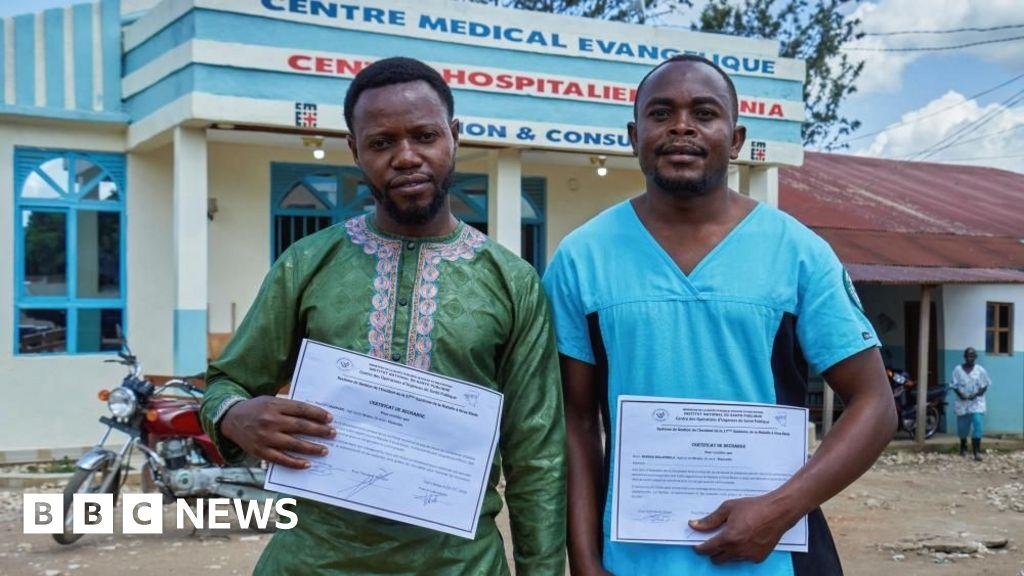
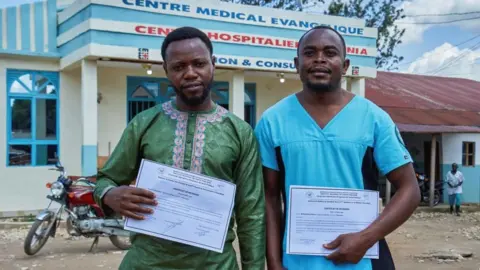
Health authorities in the Democratic Republic of Congo are celebrating after five patients, who had Ebola and now recovered, were allowed to leave hospital.
The current outbreak is suspected to have killed almost 250 people. But those infected can get better and officials stress that people should seek medical help if they believe they have contracted the virus.
On Sunday, there was a ceremony for a group of four nurses who were discharged from a hospital in Bunia, the provincial capital of Ituri, the epicentre of the outbreak.
"You are living stories that this outbreak can be stopped," World Health Organization (WHO) chief Dr Tedros Adhanom Ghebreyesus told the four on a visit to Bunia.
"We were really demoralised because we knew that at some point... we were going to die. That was it... I'm telling you, if you have never been isolated, you will not know that it's not easy," Nurse Etienne Ezo told the Reuters news agency as he reflected on his experience.
The first survivor, a laboratory worker, to have recovered left hospital last week.
Health workers are on the frontline in the battle against the spread of the virus and are often the most at risk.
You may also be interested in:
"It pains me to see health workers who have already died because of Ebola while serving others... this is the risk which comes with the profession, but your commitment and coming back again to serve means a lot," Tedros told the four nurses, three men and one woman, at Sunday's ceremony where they all received certificates recognising their recovery.
"This encouraging milestone bears witness to the effectiveness of field interventions: early detection, medical care, contact tracing and community engagement," DR Congo's Institute of Public Health wrote on social media.
Its director, Dr Mwamba Kazadi, described the recoveries as a victory worth celebrating, adding that early detection and strong care make a difference.
Tedros has called on communities to work with medical staff after some residents attacked health centres over strict burial rules. The bodies of those suspected of having died of Ebola are not allowed to be handled by grieving relatives, regulations which clash with local traditions.
In a joint statement with the Congolese government on Sunday, he said local communities are "at the heart of the solution" and that "success" in their response depends on their trust and engagement.
"Persistent challenges include early detection and isolation of cases, contact tracing, safe and dignified burials, robust infection prevention and control in health facilities, and strong community awareness.
"The Government and WHO call on all communities to continue adopting protective behaviours, including regular hand hygiene, early care seeking in health facilities, and sharing accurate information."
There are now more than 1,000 suspected Ebola cases in the DR Congo, and at least 246 deaths. Neighbouring Uganda has reported nine confirmed cases and one death.
But in some affected areas, there is a sense of normality. In Bunia, schools and markets are open as people continue to go about their daily activities.
The current outbreak - the 17th in DR Cngo's history - is caused by the Bundibugyo species of Ebola, which has no approved vaccines, though some are being worked on now.
While cases are concentrated in DR Congo's Ituri, North and South Kivu provinces, and some in Uganda's capital Kampala, people have also been tested outside of Africa.
You may also be interested in:
 Getty Images/BBC