The world’s largest privately owned laser just turned on
The world’s largest privately owned laser just turned on
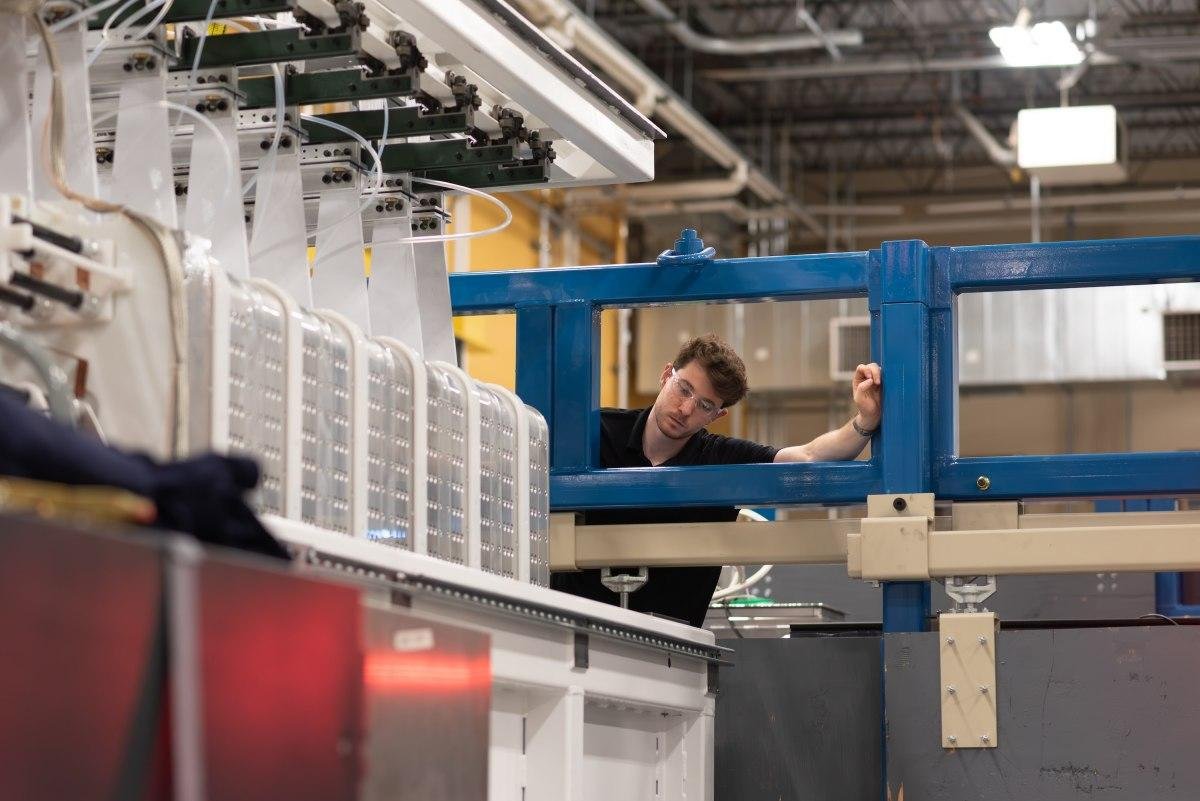
Fusion startup Xcimer Energy on Wednesday flipped the switch on its Phoenix laser system, which the company says is the largest privately owned example in the world.
Xcimer’s approach to fusion power is modeled after the National Ignition Facility (NIF), which proved in December 2022 that a controlled fusion reaction could release more power than required to ignite it.
The NIF trained 192 laser beams on a fuel target smaller than a pencil eraser. The energy from the lasers hit the gold target. As the lasers obliterate the gold target, their energy is converted into X-rays, which are focused on the fuel pellet inside, compressing it until atoms in the fuel fuse and release energy.
The company is betting that more powerful, less complex lasers will help turn NIF’s concept for fusion power into something more profitable.
Xcimer’s plans for a fusion power plant call for two lasers capable of firing in microsecond-long pulses. Light from those pulses will be fed through a compression system, of sorts, which will delivers the lasers’ energy to the fuel target in nanoseconds. The quicker the fuel is compressed, the more likely it is to generate usable fusion reactions.
Phoenix is a step toward an eventual power plant. The system uses excimer amplification, similar to those used in semiconductor manufacturing but significantly more powerful. At full strength, the krypton-fluoride laser generates over 1 kilojoule of energy, Xcimer told TechCrunch, and its core is 38 meters long.
While that may be the most powerful privately owned laser, it’s still a fraction of what the company says it will need for a commercial power plant, which could exceed 12 megajoules.
Xcimer hopes to complete a prototype in 2028 before working on a larger system that it hopes will produce at least as much power as it consumes. Sometime in the mid-2030s, it is planning to build its first commercial scale power plant.
When you purchase through links in our articles, we may earn a small commission. This doesn’t affect our editorial independence.
Tim De Chant is a senior climate reporter at TechCrunch. He has written for a wide range of publications, including Wired magazine, the Chicago Tribune, Ars Technica, The Wire China, and NOVA Next, where he was founding editor.
De Chant is also a lecturer in MIT’s Graduate Program in Science Writing, and he was awarded a Knight Science Journalism Fellowship at MIT in 2018, during which time he studied climate technologies and explored new business models for journalism. He received his PhD in environmental science, policy, and management from the University of California, Berkeley, and his BA degree in environmental studies, English, and biology from St. Olaf College.
You can contact or verify outreach from Tim by emailing tim.dechant@techcrunch.com.
Sponsor
Sponsor
Sponsor
Sponsor
Zoekertjes
Categorieën
Read More
Instagram is alerting users who were targeted by hackers during AI chatbot attacks The widespread hacking campaign that relied on simply asking Meta AI’s chatbot to take over a victim’s Instagram account appears to have continued even after the company said the issue had been resolved. Meanwhile, the company has been scrambling to secure the targeted accounts and alert victims. Over the...

Instagram now alerts parents if their teen searches for suicide or self-harm content Instagram will start alerting parents if their teen repeatedly tries to search for terms related to suicide or self-harm within a short period of time, the company announced on Thursday. The alerts are launching in the coming weeks to parents who are enrolled in parental supervision on Instagram. The...

Starbucks Comeback? Execs Are Betting More Merch Will Make Up for Stingier Rewards Money may earn a commission when you click on the products and services below. Opinions are our own, but compensation and in-depth research determine where and how they appear. Learn more about how we make money. There was a buzz around Starbucks’ investor day...

Nobel laureate reflects on the anniversary of Russia's invasion of Ukraine Nobel laureate reflects on the anniversary of Russia's invasion of Ukraine Audio will be available later today. Nobel Peace Prize laureate Oleksandra Matviichuk reflects on Russia's full-scale invasion of Ukraine and whether the U.S. can do more to end the...
Afghanistan: Girls' education ban leaves few options for womenShe was told to marry in a country which bans girls' education. So she got in a taxi and fled58 minutes agoYogita LimayeSouth Asia and Afghanistan correspondent, in KabulAlia travelled to the Afghan capital to escape the prospect of marriage as her only optionAlia - whose name we have changed for her safety - travelled hundreds of...