
 Reuters
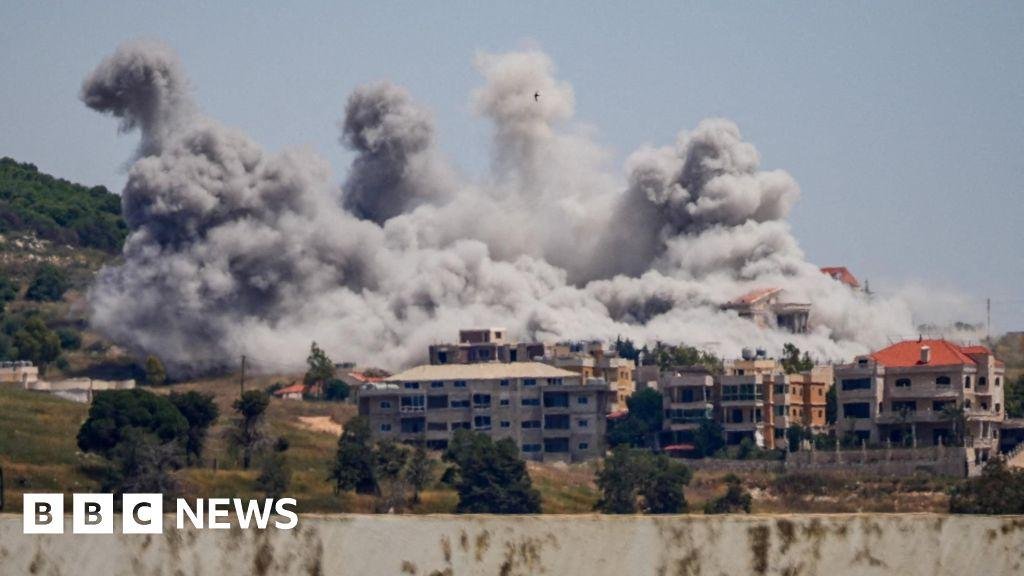
Israeli strikes killed at least nine people in southern Lebanon on Wednesday, authorities said, as the Iran-backed armed group Hezbollah said it fired rockets into northern Israel.
Lebanon's health ministry said the dead included two paramedics whose ambulance was hit in a strike in the southern Chehour area. A car was also struck just south of Beirut.
Meanwhile, Israel's military said it intercepted a drone and two projectiles that crossed the border. Hezbollah said it targeted a gathering of Israeli troops.
The incidents tested a partial ceasefire agreed on Monday, which Lebanon said would see Israel refrain from bombing the capital, Beirut, in exchange for Hezbollah not attacking Israel.
Israeli and Lebanese diplomats held a second day of talks in Washington on Wednesday to discuss ways to shore up the deal.
US Secretary of State Marco Rubio told reporters that he hoped they would produce "an action plan on a track for security in [Lebanon], independent from Hezbollah".
Lebanon was drawn into the war between the US, Israel and Iran on 2 March, when Hezbollah launched rockets into Israel in retaliation for an Israeli strike that killed Iran's supreme leader. Israel responded with an air campaign across Lebanon and a ground invasion in the south.
A US-brokered ceasefire between Israel and Lebanon on 16 April failed to stop the fighting, and last week Prime Minister Benjamin Netanyahu ordered the Israeli military to intensify its strikes on Hezbollah and advance deeper into Lebanon in response to drone and rocket attacks on communities in northern Israel.
At least 3,516 people have been killed in Lebanon since the start of the war, according to the country's health ministry. Its figures do not distinguish between combatants and civilians.
The UN says more than one million people have also registered themselves as displaced in Lebanon, where Israeli evacuation orders cover more than an eighth of the country.
Israel says 26 of its soldiers and four Israeli civilians have been killed on both sides of the border during the war.
 Reuters
Lebanese media reported Israeli strikes across the south of the country on Wednesday.
The health ministry said four Syrians and two Palestinians were killed in a strike in the al-Housh area, which is just south of the coastal city of Tyre.
The ministry also said that two paramedics were killed and a third was seriously wounded when Israeli forces "directly targeted an ambulance" in the Chehour area, which is about 14km (9 miles) to the east. The ambulance belonged to the Risala Scouts Association, which is affiliated with the Amal movement, an ally of Hezbollah.
The ministry accused the Israeli military of "demonstrating contempt for international humanitarian law", which specifically protects medical personnel.
At least 128 paramedics and healthcare workers have been killed in Israeli attacks on ambulances and medical facilities over the past three months, according to the ministry.
There was no immediate comment from the Israeli military. In the past, it has claimed that ambulances are being used for military purposes, without providing any evidence.
The Lebanese army, meanwhile, said that one of its soldiers was killed in an Israeli air strike on the road between Nabatieh and Kfar Tebnit, about 27km north-east of Tyre. Lebanon's state-run National News Agency (NNA) reported that his motorbike was targeted by a drone.
The army said another two Lebanese soldiers were injured in a separate Israeli strike on their vehicle on the road between Deir Zahrani and Nabatieh.
It denounced what it called "a pattern of deliberate strikes targeting army personnel, vehicles and positions" by Israeli forces.
NNA also reported an Israeli strike on a car on the busy coastal highway in the Khaldeh area, just south of Beirut. It did not mention any casualties, but security sources told Reuters news agency that two people were injured.
It was the closest strike to the capital since the partial ceasefire was announced.
Also on Wednesday, the Israeli military said it intercepted a "hostile aircraft" that crossed the border near the Manara and Kiryat Shmona areas, about 15km south of Nabatieh, as well as two projectiles that crossed in the nearby Misgav Am area.
The military did not immediately blame Hezbollah, but the group later said that "in response to the Israeli enemy army's violation of the ceasefire" its fighters targeted "a gathering of Israeli enemy army soldiers" in northern Israel with a rocket barrage.
Earlier, the group said it had carried out drone attacks on Israeli troops operating in the Odaisseh, Zawtar al-Sharqiya and Yahmar al-Shaqif areas of southern Lebanon.
Israel's leaders have warned that its military would resume strikes on the Hezbollah stronghold of Beirut's southern suburbs, known as Dahieh, if the group launched cross-border attacks on northern Israeli communities.
According to the Lebanese government, the partial ceasefire agreed on Monday states that "Israel will not launch a broad offensive on Beirut in exchange for Hezbollah refraining from launching attacks against Israel".
The ceasefire agreement was announced by US President Donald Trump, who on Wednesday appeared to confirm a report that it was brokered after he had called Netanyahu "crazy" in an expletive-laden call prompted by the prime minister's order to bomb the Lebanese capital.
"I was a little bit perturbed at his constantly fighting with Lebanon," Trump told the New York Post's Pod Force One podcast. "At some point, I said: 'Bibi [Netanyahu], we've got to stop this.'"
Netanyahu subsequently agreed to hold off from striking Beirut, but he stressed that the Israeli military would continue operating in southern Lebanon.
When asked about the call in an interview with CNBC, Netanyahu said: "Sometimes, like the best families, we have these tactical disagreements. We always find a way to resolve them."
Trump is said to be concerned that further escalation in Lebanon could jeopardise a wider deal to end the war between the US, Israel and Iran.
Iran has warned the US that any regional ceasefire must include Lebanon.