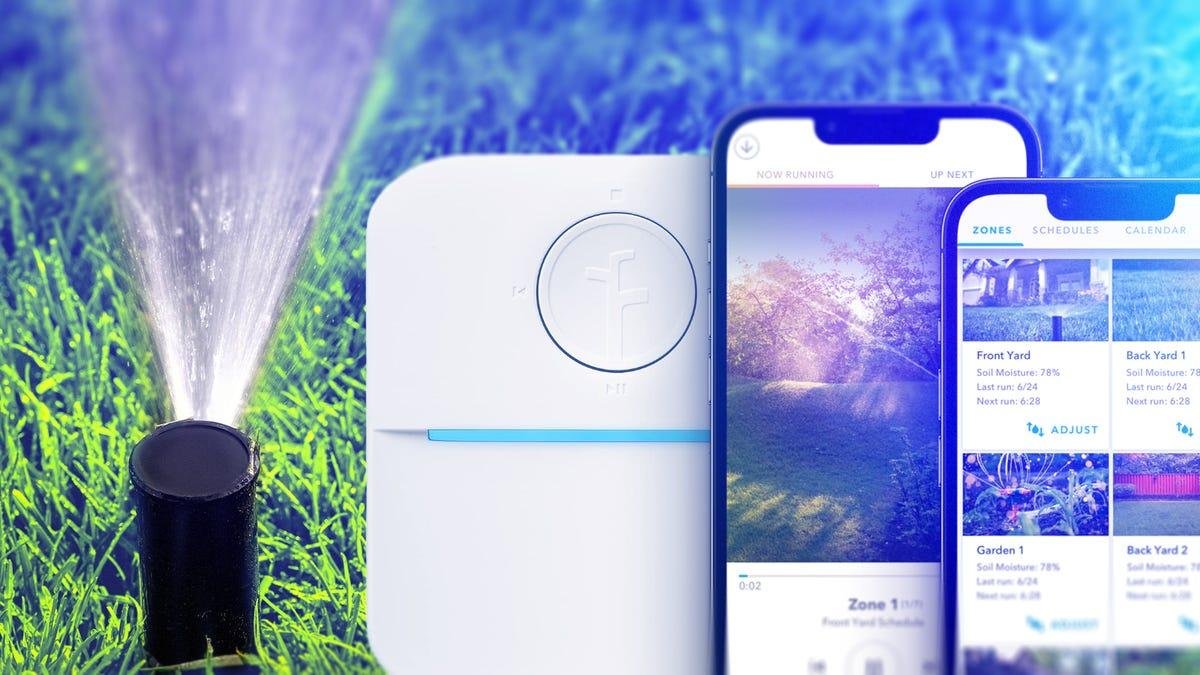


It may not be your first thought, but your sprinkler system is an excellent subject for a smart home upgrade. You won’t believe how useful it is to have irrigation that you can control by app no matter where you are, not to mention a controller that shuts itself off when rain is predicted.
Rachio’s controller proved relatively easy to DIY install, and has the most complete app I’ve seen for smart irrigation. You can even list the slope of your lawn and how much sun it gets for customized recommendations, but I stick with weather automation and zone scheduling for the most part. Quick runs, heat/drought boosts and similar extra round this controller off nicely.
Pros
- Excellent mix of functions with complete app controls
- Weather sensing and heat wave boosts, among other tricks
- Modern, stylish design
- Can dig into numerous details about your lawn if you want.
Cons
- Rachio’s app can be overwhelming if you don’t narrow your focus
- Requires a separate enclosure for outdoor installation
Unlike Rachio’s ultra-smart controller, Orbit’s is ready for outdoor use right out of the box, imbued with IPX-5 waterproofing and tamper-proofing with an optional stealth mode so you don’t have to worry about vandalism or unintended use.
Pros
- Waterproof for exterior installation
- Tamper proofing and stealth mode
- Weather detection and drought warnings
- Upgraded design with more handy on-board information
Cons
- No water boost option, only drought warnings to cut back on irrigation when required
Rain Bird’s compact model is one of the most affordable on my list while also provided excellent smart home support, compatible with Alexa, Google and Apple devices and their respective voice assistants.
Pros
- Compact and affordable
- Can share access with others
- Weather automation based on postal code for privacy
- Smart home compatible for Alexa, Google and Apple
Cons
- Hinged design is a bit flimsy in comparison with other models
What if you don’t have built-in sprinklers? I haven’t forgotten about you, and neither has Aiper with its standalone IrriSense 2 irrigation system, which only needs a water and power connection, plus the right placement to overlook your lawn.
Pros
- Can set up without underground sprinklers
- Irrigation mapping and highly customizable schedules
- Can reach up to 40 feet
- Rain and weather sensing
Cons
- Very expensive at over $500
- You’ll need a power source when installing this model in the right place
At CNET, we’ve tried these smart sprinkler systems, and we’re ready to recommend what impressed us the most, from controllers that can fit right where your old hub is to standalone smart sprinklers that you can install without any underground work.
What is the best smart sprinkler?
Rachio is an expert in smart sprinklers, and its 3rd-gen model is one of the best I’ve tried, a step up in every way from past controllers and a good fit for nearly any home. In addition to Rachio’s incredibly thorough app controls, automation and programming, you can also add water sensors and other components if you prefer to build your system out – but this controller is a great upgrade either way. It's also WaterSense certified via the EPA, which means it's water-saving promises really carry some weight.
Best smart sprinklers and irrigation
Pros
- Excellent mix of functions with complete app controls
- Weather sensing and heat wave boosts, among other tricks
- Modern, stylish design
- Can dig into numerous details about your lawn if you want.
Cons
- Rachio’s app can be overwhelming if you don’t narrow your focus
- Requires a separate enclosure for outdoor installation
Rachio’s controller proved relatively easy to DIY install, and has the most complete app I’ve seen for smart irrigation. You can even list the slope of your lawn and how much sun it gets for customized recommendations, but I stick with weather automation and zone scheduling for the most part. Quick runs, heat/drought boosts and similar extra round this controller off nicely.
With app controls and adaptive scheduling, there’s not much need to use onboard buttons for the Rachio 3rd-gen controller, which is good because it only has a few aside from the glowing LED light that shows when zones are active.
Keep in mind, if your controller is outdoors you will need a protective enclosure for this hub, a relatively cheap add-on that shouldn’t interfere with functionality.
Pros
- Waterproof for exterior installation
- Tamper proofing and stealth mode
- Weather detection and drought warnings
- Upgraded design with more handy on-board information
Cons
- No water boost option, only drought warnings to cut back on irrigation when required
Unlike Rachio’s ultra-smart controller, Orbit’s is ready for outdoor use right out of the box, imbued with IPX-5 waterproofing and tamper-proofing with an optional stealth mode so you don’t have to worry about vandalism or unintended use.
The B-Hyve XR also taps into weather reports for automation, as well as drought warnings, although it doesn’t have the boosting feature that Rachio offers. However, it’s a bit more affordable, making this a good choice if you want to minimize your initial costs, too. Also I like the updated design, which provides more useful on-board info than older modes.
Pros
- Compact and affordable
- Can share access with others
- Weather automation based on postal code for privacy
- Smart home compatible for Alexa, Google and Apple
Cons
- Hinged design is a bit flimsy in comparison with other models
Rain Bird’s compact model is one of the most affordable on my list while also provided excellent smart home support, compatible with Alexa, Google and Apple devices and their respective voice assistants.
The Rain Bird app offers full scheduling, plus the ability to share passes with friends or landscape professionals so they can control irrigation to. It also has weather automation based on your general postal code. I’m not a huge fan of the somewhat less durable design compared to my other picks, but at least it’s outdoor-ready and includes familiar controls if you don't want to use the app.
Pros
- Can set up without underground sprinklers
- Irrigation mapping and highly customizable schedules
- Can reach up to 40 feet
- Rain and weather sensing
Cons
- Very expensive at over $500
- You’ll need a power source when installing this model in the right place
What if you don’t have built-in sprinklers? I haven’t forgotten about you, and neither has Aiper with its standalone IrriSense 2 irrigation system, which only needs a water and power connection, plus the right placement to overlook your lawn.
When ready, you can create your own irrigation maps to control the sprinkler’s behavior, set up multiple schedules and make sure that certain areas like flower beds get extra attention if needed. The water pressure, rated at about 45 psi according to Aiper tests, can reach up to 40 feet, enough for most small to medium yards. The sprinkler system can also sense rain and provide weather predictions.
For all these features, you’ll have to pay -- this is by far the most expensive pick on my list. But it’s a highly capable solution if you don’t have any built-in sprinklers but still want smart irrigation. Just make sure you have a nearby outdoor plug or are willing to install one when choosing the right place.
Best smart sprinklers compared
| Best smart sprinklers | Rachio 3rd-gen Smart Sprinkler Controller | Orbit B-Hyve XR Sprinkler Controller | Rain Bird ARC8 | Aiper IrriSense 2 Smart Irrigation System |
|---|---|---|---|---|
| Cost | $200 | $170 | $140 | $600 |
| Zones | 8 | 8-16 | 8 | N/A |
| Voice Assistant | Amazon Alexa, Google Home | Amazon Alexa, Google Home | Amazon Alexa, Google Home, Apple | N/A |
| Weather detection and automation | Yes | Yes | Yes | Yes |
| WaterSense certification | Yes | Yes | Yes | No |
| Outdoor-ready | With optional enclosure | Yes | Yes | Yes |
| Revew score | 7.5/10 | N/A | N/A | N/A |
Smart sprinkler systems are helpful, but know your hard and irrigation needs before buying.
Rain BirdInitial cost
Smart sprinklers can save you money over time, when used wisely. But you also have to factor in initial costs and how long it will take to pay off a smart upgrade when you buy it. These sprinklers and controls can cost anywhere from $150 to $500 or more, depending on the type you get, so it’s important to think about your budget.
Zone controls
Zone controls won’t be a problem for most homes, since these smart sprinklers typically support over 8 zones with their wiring, more than enough for almost any residential property. But if you have specific needs for lots of irrigation zones, it’s worthwhile to take a look at what wiring the controllers support.
Voice assistants
I’m not going to rate voice assistants as a particularly high priority for smart sprinklers, but if you like using voice commands, check to see if the sprinkler controller offers the version you like. Many of my picks work with at least Alexa, which tends to have the most smart home support.
Rachio's app is packed with features and automations, like a very cool weather tie in.
Tyler Lacoma/CNETAutomation with weather and more
Today’s smart sprinklers can often tap into local weather reports if you provide them with your address. The value of this feature can vary according to your location (my high desert town is notoriously unpredictable even for official weather forecasts), but it’s often very useful for saving money and time by pausing irrigation when it’s raining. Look for this feature when you’re buying.
Extra features for new grass and more
Smart irrigation controls may also come with guides for watering new grass patches, recommendations for watering depending on season or grass species and other little tricks that you may find useful -- or prefer to ignore. If you’re doing a lot of new landscaping, you may want to watch for features like this that could make irrigation easier.
Wi-Fi range
Depending on your home, your sprinkler controller may not be near enough to your Wi-Fi router for a stable connection. In that case, you may need a Wi-Fi extended or similar option to help things work out.
Rain skips and weather detection can be valuable features in a smart controller.
RachioThey can, but it will depend how much water they use. You’ll want to enable systems like weather detection and schedule only the water use you need to see the biggest impact. Smart irrigation companies say these devices can save 30% to 40% of previous water use. My tests didn’t show that much of an impact, but savings are definitely possible.
Yes, in almost every case, this is a DIY setup. You’ll want to take a picture of your old wiring so you know which wires go to which zones. Also, choose a sunny day with the garage open if you’re installing indoors, since the power will be off when you hook up the new controller. You may have to test your zones and switch some wiring, based on how your old system was set up.
Yes. I’ve never encountered any safety issues with using these devices, aside from the possibility of accidentally leaving sprinklers on for too long. The apps will need some information from you, including your address or general postal area to track weather. But with such a tight focus, there’s not much activity the apps can track aside from your watering habits, so it’s not a major privacy concern. If you use a voice assistant for irrigation, that voice assistant will also be able to track the commands you give.
WaterSense is a program made available through the EPA. Brands that qualify get a blue label for their products that means the product is very efficient at using water. It's a good sign in a smart sprinkler.
Yes, in general smart sprinklers will always need Wi-Fi connections to enable their apps, automation features like getting weather, and more. The controllers will still work with their onboard controls if a Wi-Fi connection is lost. Some can also connect via Bluetooth over shorter ranges.