A sari for Mars: Outfit worn by Indian 'rocket woman' at US museum

 Smithsonian’s National Air and Space Museum
Geeta PandeyBBC Correspondent
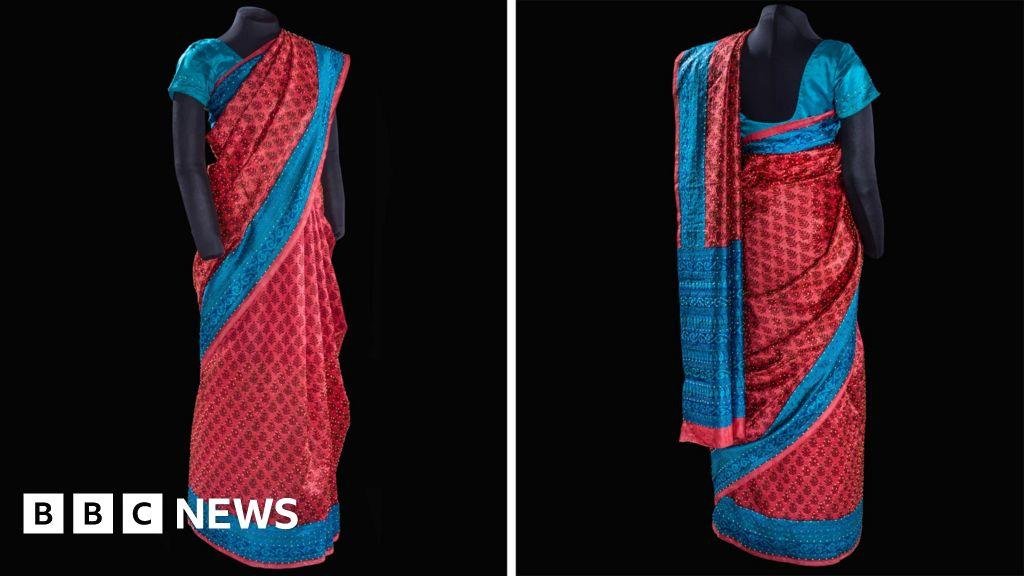
On a day that Nandini Harinath describes as the most important of her life, the Indian space scientist turned up to the office in a vibrant red and blue silk sari.
That sari is now in pride of place in the Smithsonian's National Air and Space Museum in Washington.
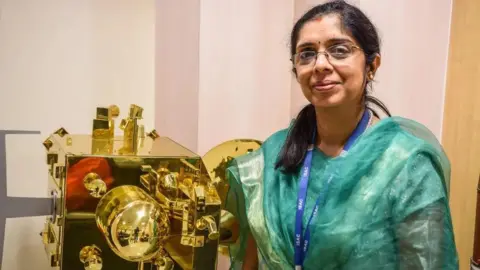
Nandini, who was the deputy operations director for Mangalyaan, India's maiden Mars Orbiter Mission, wore the outfit on 1 December 2013.
For Nandini, saris - especially those gifted by her father – have been a go-to outfit for big days at work or whenever she represents India's space agency.
So it was an obvious choice for what she says was the "single most critical day" for the project. Nandini and other scientists from the Indian Space Research Organisation (Isro) were in the control room to push the spacecraft out of Earth's orbit and send it on its 300-day journey towards Martian orbit.
"It was a do-or-die moment, the most critical operation in the mission," Nandini told me when I interviewed her in 2016. "We had to decide where the spacecraft goes, how it goes and when it goes. The success of the mission depended on what we did that day."
Mangalyaan was successfully placed in the Martian orbit on 24 September 2014, making India only the fourth country or geo-bloc to do so.
Nandini and other female space scientists burst into the global spotlight on that day after a photograph of sari-clad women celebrating at Isro went viral on social media, challenging the stereotype that rocket science in India was a male preserve.
Isro later clarified that the celebrating women were administrative staff - but added that several female scientists had worked on the mission and they were in the control room at the time.
Matt Shindell, space history curator at Smithsonian museum, told the BBC on the phone from the US that he found that image "very compelling".
"I felt it would be a great story to tell, the story of these 'Rocket Women' who were at the front and centre of this important mission."
Shindell reached out to Nandini in 2020 over email and the two began discussing what object could best represent India's Mars mission and her role in it.
"I asked her what object she'd be willing to part with. We agreed on the sari that she was wearing on the day Mangalyaan left Earth's orbit," Shindell said.
Once the sari and the matching blue blouse reached the museum, textiles conservator Beth Knight watched YouTube videos to learn how to drape it on the mannequin.
Shindell says the sari has "a family resemblance" to a lot of clothing in their collection that was worn during an important mission at ground control, such as Gene Kranz's vest the Nasa Flight Control Chief wore in 1970 to steer Apollo 13's crew back to safety.
 Smithsonian’s National Air and Space Museum
Smithsonian, which is visited by tens of thousands of people every week, also has several objects from India in their collections - but most are from the Air Force and airline companies.
It also has a commemorative silver tray Isro presented to the science fiction author Arthur C Clarke in 2007 on his 90th birthday.
"But Nandini's sari is the first object I have collected from India for our interplanetary science collection and it's our very first sari," Shindell says.
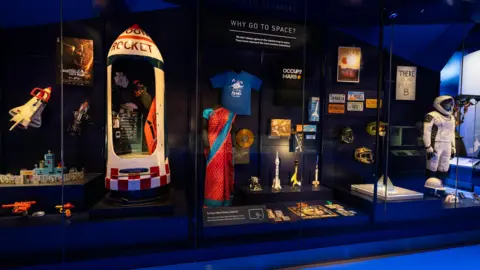
The garment is on display in the Air and Space Museum's "Futures in Space" gallery, alongside different objects, including toys, games and movie posters. It's placed right next to the iconic blue t-shirt worn by Sally Ride on the 1983 Shuttle mission when she became the first American woman in space.
The idea behind this display, Shindell says, "is to engage visitors to recent things that happened in space and what could happen next".
"We have lots of questions when it comes to space and the installation invites visitors to consider some of today's biggest questions: Who decides who goes to space? Why do we go? And what will we do when we get there?"
This exhibition, he says, deals with the question of why and the display of objects speaks to the motivations behind going to space.
Nandini's sari speaks to two motivations, he adds. "One, it's a symbol of India's national pride in its first Mars mission and the country's successful space programme. The second is her personal story which is inspiring as her success could encourage more women to pursue careers in science."
The sari, he says, was chosen also because it has cultural value and that it's visibly easy to identify. The display invites museum visitors to use the touchscreen to find out more about the exhibits.
"I'm overjoyed that visitors are watching the sari and wanting to find out more about it. It's a fantastic addition to our collection," Shindell says.