It's one of the world's most isolated islands. Here come the bulldozers
It's one of the world's most isolated islands. Here come the bulldozers

Apart from the indigenous people, the Great Nicobar island's population consists mainly of a few thousand settlers, who live in sleepy villages alongside dense forests. A major development project would dramatically alter the scene. Omkar Khandekar/NPR hide caption
toggle caption
Omkar Khandekar/NPR
THE GREAT NICOBAR ISLAND, India — Fireflies illuminate the edge of a forest on the Great Nicobar Island as field biologist Sumit Kumar tries to find a particularly shy creature.
A soft hoot wafts through the thicket. Kumar scans the trees with his flashlight: Sitting on a branch is a rare, wide-eyed, fat Nicobarese Scops owl. It narrows its eyes into what feels like a death-glare. Kumar smiles: "When you spot them, they look at you as if to say, 'You don't belong here.'"
And he says, they're not wrong.
The Great Nicobar Island is part of an archipelago that lies deep in the Indian Ocean. Until mainland Indians started settling here a few decades ago, its humans consisted of around a thousand indigenous folks.
It's governed by India but is so distant that it takes a flight from the mainland and a 30-hour ferry ride to arrive.
The Indian government hopes to change all that.

Great Nicobar Islanders clean vessels near Campbell Bay. R. Satish Babu/AFP/via Getty Images hide caption
toggle caption
R. Satish Babu/AFP/via Getty Images
The upcoming Great Nicobar Project is set to transform this sleepy island into a bustling township over the next three decades.
Once complete, the island will have a civilian and military airport, a transshipment port that caters to container ships, a power plant and a new town equipped to host a million tourists a year — nearly 100 times its current population.
The project will cover an area twice the size of Manhattan, and potentially feature high rises, discos, even Disneyland-like theme parks.
Environmentalists and critics have a list of concerns. They say farms, beaches and hills will be swallowed up and a million trees will be felled. They worry about the impact on endangered animals, like leatherback turtles, largest of all sea turtles, and the Nicobarese pigeon, the closest living relative of the dodo, with its distinctive fluorescent green and orange plume.
The Great Nicobar Project "sounds like an open invitation to disaster," says Manish Chandi, a scholar who has studied the Andaman and Nicobar archipelago for over two decades. "It poses a threat to a huge amount of natural resources, its biological diversity and its indigenous communities."
Chandi argues the purported benefits of the Great Nicobar Infrastructure project reflect a flawed understanding of "development." Residents are not the primary beneficiaries, he says. "It's a model that sees money-generation as the only way forward." He says the price of that extraction isn't taken into account.
It's a tussle mirrored in many state-backed infrastructure projects across India, from a coastal road underway in the Arabian Sea that cuts through mangrove trees to an upcoming dam in the Himalayas that will decimate chunks of forests. The clamor to protect nature has grown sharper as India sees a rise in heatwaves, glacial floods and extreme rainfall in recent years.

In a photograph from March 26, 2026, construction workers operating a tarmac mixer to build a road cutting through the island's forest land. R. Satish Babu/AFP/via Getty Images hide caption
toggle caption
R. Satish Babu/AFP/via Getty Images
After some public criticism last year, the environment minister Bhupendra Yadav insisted that the project "poses no threat to the island's tribal groups, does not come in the way of any species and does not jeopardize the eco-sensitivity of the region."
Indian ministers and departments overseeing this project did not respond to NPR's emails with a list of questions about the potential negative impacts of the project.
Why this project?
The global presence of China looms over the project.
In a press release in May, the Indian government said the goal is "to enhance India's national security, strategic and defense presence, strengthen the islands' economic position, and accelerate holistic development in the region."
And more plainly, the Hindu nationalist Bharatiya Janata Party that governs India has described the project as a "strategic gateway to crush China" in a series of social media posts.
It says the project can also help "challenge the dominance" of China in the Indian Ocean. Analysts say the shipping blockade in the Strait of Hormuz stemming from the Iran war has lent an air of urgency.
"If we think about global choke points today, especially in light of conflict in the Strait of Hormuz, India is one of many countries that are looking to secure their own supply lines," says Nitya Labh, a maritime researcher from the think-tank Chatham House.
"The project here is a great opportunity to do that because it sits along such a major international shipping route," she says, referring to the Strait of Malacca, a narrow maritime pathway that lies between Malaysia, Indonesia and Singapore.
In a 2023 press release, the Indian government said nearly 75% of India's maritime cargo today is handled at ports outside India. With a new project, it said, "Indian ports can save $200-220 million each year on transshipment cargo" and grab a share of the regional goods traffic.
There's been a massive outcry against this project for years — from former bureaucrats, the political opposition Indian National Congress party, academics and indigenous communities. They accuse the government of downplaying its ecological impact and overstating its economic and security benefits. Some have also filed lawsuits.
Others, like Abhijit Singh, a former Indian naval officer and expert on maritime affairs, have questioned the government's claims.
"This strategic and commercial gain that we are talking about seems to me a bit notional," says Singh. "But the damage to the environment is going to be very real."
Singh says India already has military infrastructure in the region to counter Chinese threats. He adds, a transshipment port only makes sense if it can lure shipping companies from their current stopovers in Singapore and Sri Lanka.
"A transshipment port does not just come up in a vacuum. It requires a logistical network. The big problem with Nicobar is that it is over 700 miles away from the Indian mainland. That means the markets and cargo production centers are quite far off from the transshipment port."
India's ruling party has bristled at criticism of the project.
In April, the country's political opposition leader Rahul Gandhi described it as the "biggest scam and gravest crime" against nature and "indigenous communities" during a visit to the island.
Days later, the ruling party accused him of sabotaging the project on behalf of China and George Soros, echoing widespread antisemitic conspiracy theories that the billionaire Jewish philanthropist seeks to subvert popular rule.
And many fear reprisals from the government for speaking out.
Nearly a dozen environmentalists, think tanks, public officials and residents declined to comment when NPR reached out, or they requested anonymity. Some said they worried about their ability to obtain funding for their projects or obtain access to the island if they publicly criticize the project.
But India's ruling party has promised the project would bring new roads, power, internet and more than 50,000 jobs to the island. The interior minister Amit Shah promised in a speech earlier this year that "in a decade, this region will draw the most tourists in the world."
For many islanders, that is a major incentive.
Two populations: Settlers and islanders
On a recent spring afternoon, around two hundred men and women sit in neat rows at the community hall in Gandhi Nagar, a settlement built by mainland Indians when they migrated to the island five decades ago. A dozen bureaucrats had flown down for the public hearing scheduled this afternoon. They sit behind a small table, looking somber.
At the five-hour public hearing, residents ask for guarantees: jobs, houses, farmland and a hefty payout, not the pittance they say they're being offered and that the government confirms: a dollar-and-a-half per square meter of their land.
"We're no ordinary people," says an elderly man with a long white beard, who did not give his name during the public hearing. From the 1970s, he says, the government shipped hundreds of Indian citizens from the mainland to build roads and tend to farms, and to act as India's eyes and ears against Burmese poachers and foreign powers. They lived through earthquakes and diseases, staying put even when the deadly tsunami of 2004 devastated the island. "Had we run away, the Chinese flag would've fluttered on Great Nicobar," the man says. The crowd cheers.
But for the indigenous communities, the threat is existential.
Around a hundred members of the hunter-gatherer Shompen tribe live in the Great Nicobar's rainforests. The Indian government forbids outsiders from most contact with the tribe because their bodies aren't immune to modern day diseases. In the past, thousands of the indigenous Great Andamanese people living in the region died after contact with British colonizers led to an epidemic of measles and syphilis. The nonprofit conservation group Survival International, which focuses on the rights of indigenous people, says massive tourism risks contact between the island's indigenous tribe and outside visitors.
The Indian government insists that the safeguards are in place, and the rights of the Shompen will "not be affected adversely." But anthropologist Vishvajit Pandya, who interacted with the Shompen people as part of an official study in 2019, told NPR that the project's official maps he has studied include areas they're known to inhabit.
To prevent interactions with outsiders, the government's environmental impact report proposed using barbed wire to fence off areas Shompen communities are known to inhabit.
The island's other indigenous folk — the Nicobarese — are also worried. They do have contact with outsiders and have spoken to reporters, including NPR.
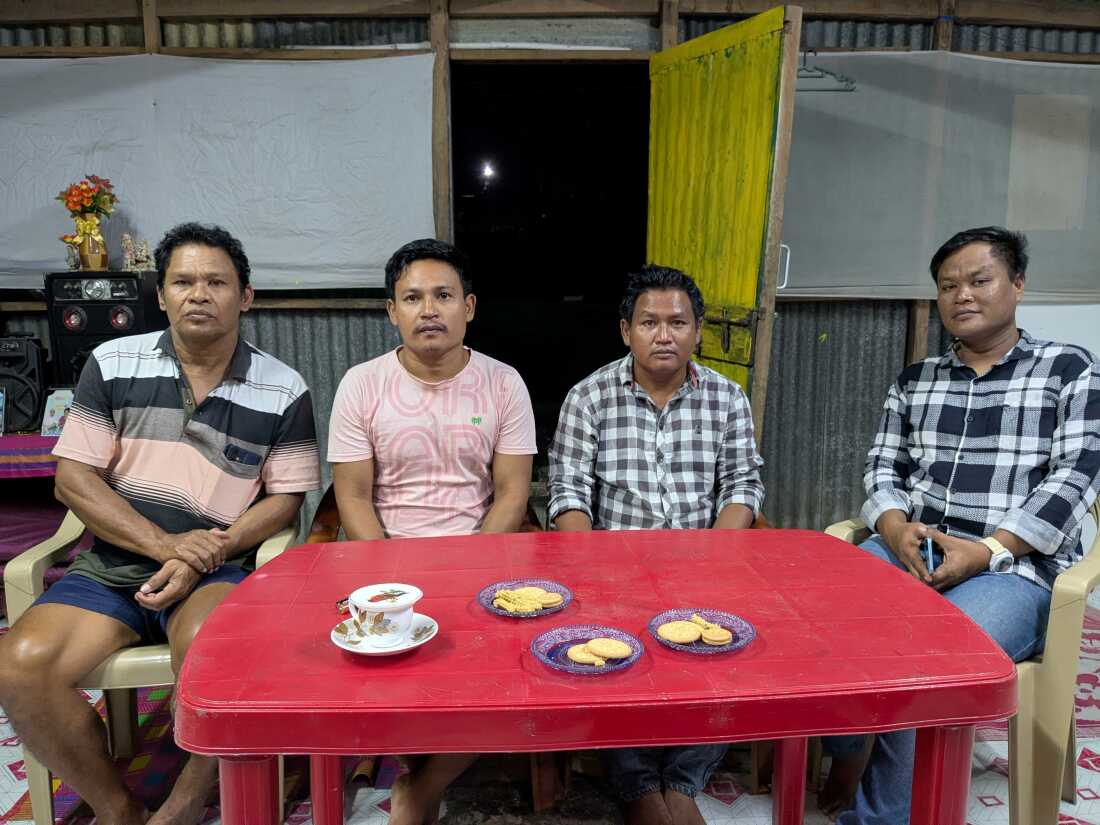
Barnabas Manju (left) and his team from the Great Nicobar Tribal Council say parts of the upcoming Great Nicobar Infrastructure project encroaches on their ancestral land, even though Indian officials had promised that wouldn't happen. Omkar Khandekar/NPR hide caption
toggle caption
Omkar Khandekar/NPR
For generations, around a thousand Nicobarese people have lived in coastal villages. It was a simple life, says chief Barnabas Manju. "We fished in the sea, got honey from forests, squeezed oil from coconuts."
The 2004 tsunami wrecked their thatched-roof homes near the coast and forced them to relief camps in the island's administrative center. Manju says Indian officials had promised to help them return when things got better. That never happened.
Over syrupy tea and biscuits, Manju and his three deputies recalled how the lives of his community members have fundamentally changed. They now labor on building sites for money and sleep in tin sheds instead of the thatched-roof homes in their village. Their diet includes processed food. They buy fish and coconuts from the market instead of doing their own hunting and gathering for free.
Four years ago, Manju says, officials told him about the Great Nicobar project. "They had brought with them a consent letter. They didn't even give me time to read it — and just asked me to sign."
Manju says they promised him the project wouldn't impact their ancestral lands. When he saw the project's maps later, he realized part of the port would be built over his community's ancestral lands.
But Manju says what keeps them going is faith.
Every Sunday, they pray at their church, then ask for blessings for everyone: friends and family, island officials and India's prime minister.

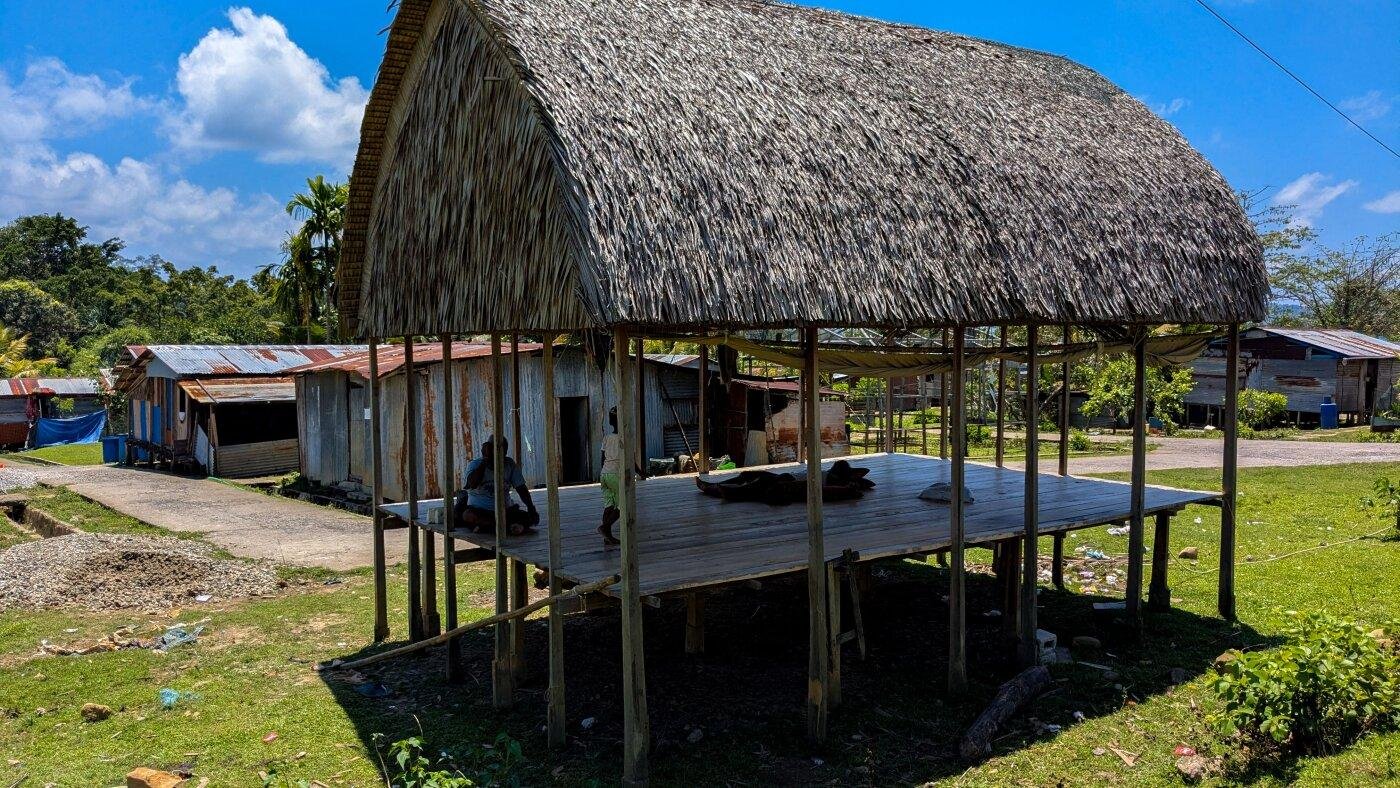
Before the 2004 tsunami destroyed their villages, the indigenous Nicobarese lived in thatched-roof shelters like these, which have been erected in a relief camp near the coast. hide caption
toggle caption
Manju says he will lead his people back to their thatched-roof homes in their villages one day. And when that happens, he hopes officials understand why it was so important to them: "Because a country's development shouldn't come at the cost of its people's identity."
Leesha K Nair is a freelance journalist from the Andaman and Nicobar Islands, focusing on intersecting themes of environment, climate, mental health and Indigenous issues.
Sponsorizzato
Sponsorizzato
Sponsorizzato
Sponsorizzato
Pubblicità
Categorie
Leggi tutto
FBI director James Comey indicted for a second timeGetty ImagesFormer FBI Director James Comey has been indicted for a second time and will face charges brought by the US Department of Justice, multiple sources told the BBC's US partner CBS News.The specific charges are not known, but the sources said they relate to an image Comey briefly shared on Instagram last year that showed seashells...

CPI(M), CPI: India's communists once ruled millions. What happened to them?11 hours agoSoutik BiswasIndia correspondentAFP via Getty ImagesThe communists have been reduced to a single seat in the 294-member assembly in West BengalFor the first time since 1957, India no longer has a single communist-led state government.The defeat of the Communist Party of India (Marxist)-led Left Democratic...
Netflix plans to add a vertical video feed, use AI for recommendations Netflix is going to launch a TikTok-like vertical video feed within its apps this month, and plans to use AI broadly for content creation and recommendations, the company said on Thursday. Netflix has been testing a vertical video feed since last year. The short video feature could aid users with discovering video podcasts,...

Court overturns Alex Murdaugh's murder convictionsCourt overturns Alex Murdaugh's murder convictions and orders new trialBBCA South Carolina court has overturned the 2023 murder convictions of Alex Murdaugh, a disgraced lawyer who was convicted of killing his wife and son.The state's supreme court on Wednesday ordered a new trial for Murdaugh over the June 2021 killings.Murdaugh has been in...

Champions League Soccer: Stream PSG vs. Liverpool Live Why You Can Trust CNET Our expert, award-winning staff selects the products we cover and rigorously researches and tests our top picks. If you buy through our links, we may get a commission. Reviews ethics statement The defending champs host Arne Slot's Reds in Paris. Kevin Lynch is a London-born, Dublin-based writer...