To be a pedestrian in London is to have the power. Tube strikes? Bus delays? No fear -- you can probably walk there faster anyway. And traffic? Make it stop for you. There are no jaywalking laws here.
It's against this backdrop of people stepping out into the road whenever they damn well please that Waymo plans to launch its fully autonomous robotaxis this year.
"We're treating London with the appropriate amount of humility and respect," Saswat Panigrahi, Waymo's chief product officer, told the audience at SXSW London.
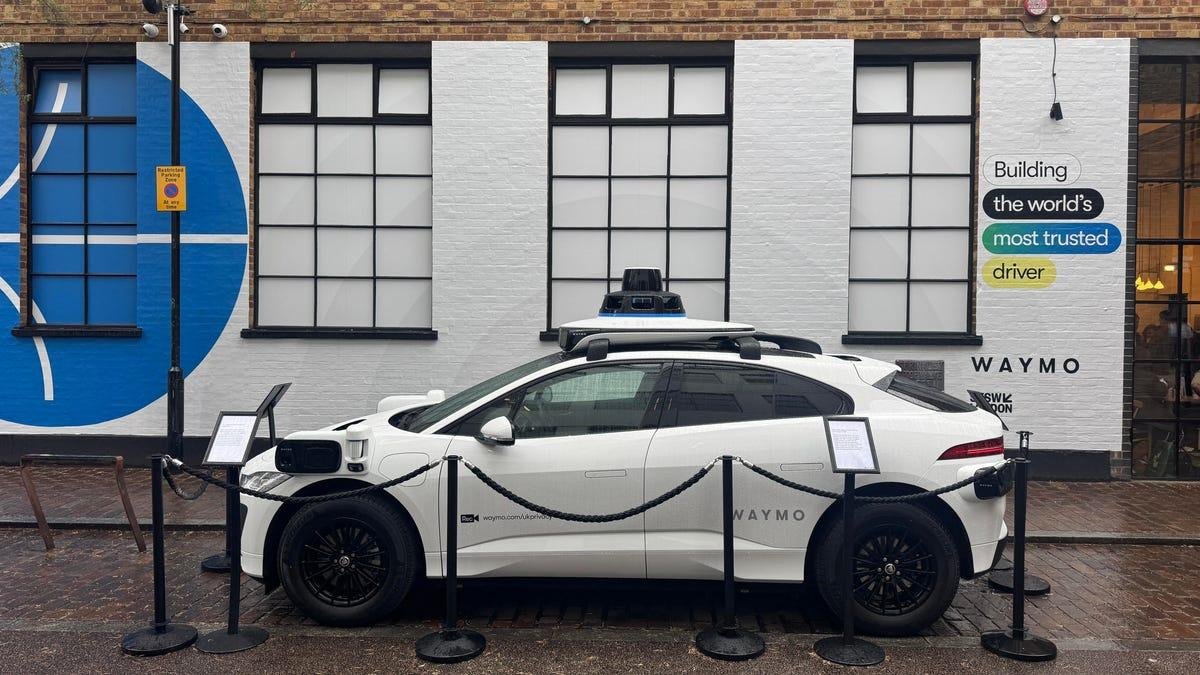
On a couple of occasions throughout the tech festival, I caught a glimpse of one of the company's Jaguar I-Pace vehicles rolling slowly along the street. Waymo employees have started traveling around the city in Waymo vehicles, of which there are 100 -- all still under the watchful eye of a human driver for now.
The testing in the British capital comes ahead of Waymo opening up to the public by the end of 2026. And it's not alone. Wayve, one of the UK's most valuable AI startups, has also been trialing its tech on London roads. It plans to launch its autonomous ride-hailing service in London this year in partnership with Uber before expanding to Tokyo and the US.
The two companies rely on different technologies: Waymo uses a classic robotics approach based on 3D mapping combined with sensors and lidar, while Wayve uses an AI driver that taps into end-to-end neural networks trained on extensive data. But for Londoners, both options will introduce a brand new experience into the city's well-established transport network. Both companies will also have to contend with many of the same unique-to-London challenges.
London roads: "The hardest edge cases"
When I finally get to try Waymo in London, it won't exactly be my first time. I have been in one of the cars before on a mission to go for tacos in San Francisco's Mission district. On that occasion, struggling to find somewhere to pull over, the Waymo circled the block several times before it would let me out.
London isn't a grid-based city but instead packs complex one-way systems into its labyrinthine medieval streets. If a car misses its chance to stop, it could be much harder to remedy. It's like driving around San Francisco's Chinatown but all the time, Waymo spokesperson Ethan Teicher told me in an interview at the company's SXSW London booth.
The Waymos are ready for rain.
Katie Collins/CNETOperating in the city means "solving for the hardest edge cases," said Wayve's vice president of commercial and operations, Kaity Fischer, speaking at SXSW London. It has 20 times the amount of construction going on in San Francisco, and 10 times the number of vulnerable pedestrians, she added -- and that's not just the jaywalkers.
Unlike Waymo, which is already available in cities across the US, London is Wayve's first market for autonomous taxis, so it's learning all its lessons here before it goes elsewhere. But it has been testing its vehicles on British roads since 2019.
Waymo, meanwhile, has only been testing in London since the end of last year, but it will use the experience it's gained over more than 20 million rides to inform its expansion to London. These, in turn, will provide learnings to help the company venture elsewhere.
London (mostly) welcomes its robotaxi overlords
To the point where any autonomous vehicle company can operate in any given city, it needs policymakers and regulators on its side. In the US, most states and even cities have their own operating standards, which explains the phased rollout.
The same isn't true in the UK. "The government has been an incredible support for us launching and deploying our technology right now," said Fischer. The UK is the first country to have a nationwide strategy for getting autonomous vehicles on the road, which makes it easier for companies like Wayve, she added.
London was a natural first choice for Waymo in Europe, said Teicher. It's a global city with a huge potential customer base of both residents and visitors who come from other countries and might experience Waymo in the British capital for the first time. Plus, he added, "the city has some very clear goals around safety and transit, and we think this technology helps accomplish a lot of those goals."
Waymo had a booth at this year's SXSW London to introduce the vehicles to the city.
Katie Collins/CNETLondon also wants to help people find last-mile solutions, which Waymo is ideal for, said Teicher. "We already know that Londoners think about transportation in sort of a step-by-step manner," he said, adding that the company was happy to contribute another safe, accessible, clean and comfortable option to London's established transport ecosystem.
That ecosystem includes iconic modes of transportation, which includes the Tube underground system, red Routemaster buses and black cabs. The latter may prove less welcoming to Waymo and Wayve than local politicians have been.
When Uber first arrived in the city, London's black cab drivers -- who must pass a test known as the Knowledge, in which they prove their encyclopedic understanding of London's streets -- protested extensively. Last year, the Guardian reported that there's been a drop in the number of black cab drivers registered with Transport for London from 22,810 in 2013-14 to 14,470 in 2023-24.
I ask Teicher whether Waymo is prepared for the potential backlash from the city's registered cabbies. "They are skilled professionals," he said. "We have tremendous respect for what they do, what they mean to the city, and we don't see ourselves replacing them anytime soon."
The company will be part of an ecosystem of hailable vehicles when it launches, he added. "We're not going to be the whole ecosystem."
He also welcomes the competition from Uber and Wayve. "It pushes all of us to do what we can to be better, to learn from each other, and ultimately it's a win for Londoners," he said.