Why Apple’s slow-and-steady AI bet is starting to look pretty smart
Why Apple’s slow-and-steady AI bet is starting to look pretty smart
For years, Apple has been accused of being one of the biggest stragglers in the AI arms race. Doubters have argued that Apple’s lack of a clear AI strategy have cost it its edge, and Wall Street analysts have worried that the gap could start hurting iPhone sales.
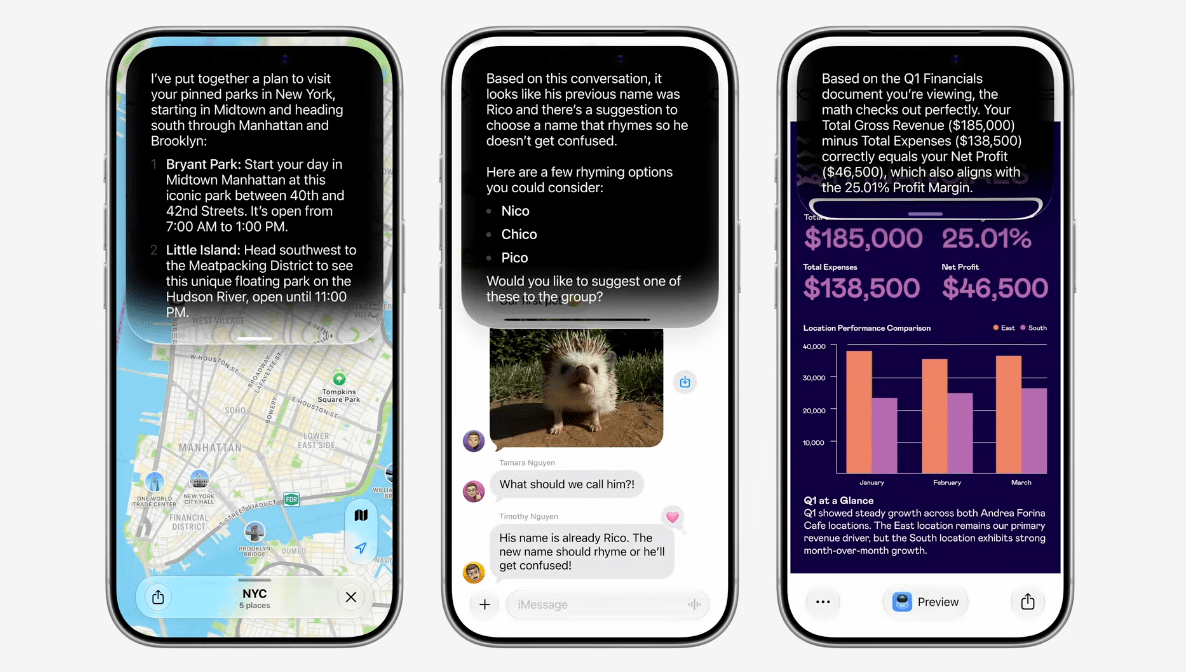
Now, the company has unveiled what it is billing as its biggest AI launch to date: Siri AI, which embeds new automated capabilities (fueled by a partnership with Google Gemini) into the very spine of its software.
Is it enough to get people to stop saying that Apple is “losing” the AI race?
To be honest, nobody really knows. But the question itself may be the wrong one. A better one might be: are Apple customers actually going to use these features and, if they do, will it help Apple’s business?
Before we address that question, we should note that Monday’s announcements also came with an interesting comment from Craig Federighi, Apple’s senior vice president of software engineering.
“Some appear to be racing forward, seemingly pursuing AI for the sake of AI, without clear regard for the people — all of us — that it’s ultimately meant to serve,” Federighi said during his remarks. “At Apple, our mission has always been to turn the potential of advanced technology into helpful and intuitive products for everyone.”
The not-so-veiled defiance on display here seems like both a response to Apple’s “behind-on-AI” criticism and an effort to acknowledge the deeply ambivalent — and, according to some polls, increasingly negative — sentiments that many consumers have about the AI industry. It’s also a shrewd message at a moment when Americans are worried that AI will take their jobs and rot their brains. Apple is positioning itself as the AI company that’s actually on your side.
Judging by Monday’s demos, that positioning has some substance behind it. Siri can now surface information buried deep in your inbox or text history and surface helpful information and offer helpful suggestions based on it. It can use what Apple calls onscreen awareness to give you context about what you’re looking at. And — using Gemini — it can pull near-instantaneous up-to-date information from the web and deliver it right to your device.
Siri is also designed to work seamlessly across Apple devices, giving users increased flexibility and, like other AI chatbots, it stores chat histories so users can revisit past conversations.
By building AI functionalities into its disembodied, ethereal assistant, Apple also has the potential to eat into the advantages of competitors whose apps can only reach users through its own App Store. For those competitors, having Apple’s AI embedded at the operating system level is a meaningful threat to their distribution advantage.
The keyword here is “potential” since this version of Siri won’t be available to consumers until later this year, as a beta.
A final verdict will have to wait, but what’s already clear is that Apple is doing its best to court its audience — whether they end up going for it or not. Apple is obviously a hardware company, and these updates are designed to make that hardware incrementally more user-friendly and convenient, keeping users glued to their devices a little while longer.
The contrast with its competitors is instructive and maybe the most important signal in Monday’s announcements for anyone watching where the AI industry is actually headed. Take OpenAI, which, despite shipping updates at a relentless pace, has struggled to define who it’s actually selling to, oscillating between consumers and enterprises. Or Meta, which is pouring gargantuan sums into AI without a clear explanation of how it connects to the company’s core advertising business.
Apple’s more measured approach is starting to look optimal by comparison — and more financially sound. For the most part, Apple hasn’t needed a gangbusters AI strategy. It posted historic iPhone sales last quarter. And as questions mount over AI’s profitability and real-world utility, Apple is spending significantly less than its competitors — roughly $14 billion in capex planned this year, against a cumulative $900 billion being committed by other tech giants — while still earning huge amounts of revenue. That revenue has come from the AI industry itself via taxes on AI companies that use its App Store to platform their apps.
In short, Apple is spending less, making more, and now launched a suite of AI features that — for many iPhone users — will feel indistinguishable from the other AI applications already available to them through the App Store. If that doesn’t exactly count as “winning the AI race,” it may be the smartest way to run it.
When you purchase through links in our articles, we may earn a small commission. This doesn’t affect our editorial independence.
Lucas is a senior writer at TechCrunch, where he covers artificial intelligence, consumer tech, and startups. He previously covered AI and cybersecurity at Gizmodo. You can contact Lucas by emailing lucas.ropek@techcrunch.com.
Προωθημένο
Προωθημένο
Προωθημένο
Προωθημένο
Διαφημίσεις
Κατηγορίες
Διαβάζω περισσότερα
Baltimore Key Bridge collapse: Criminal charges filed against Dali cargo ship operatorDali ship operator charged over deadly Baltimore bridge collapseGetty ImagesFederal prosecutors have filed criminal charges against the owner of the cargo ship Dali, two years after the vessel struck Baltimore's Key Bridge, causing its collapse and killing six people. Synergy Marine, the company that operated...

Linfield University Sign up for a Money account and start creating a richer life. By clicking "Continue" I agree to...

This New Health-Tracking Pet Collar Is Like a Smartwatch for Dogs and CatsOur pets can't speak up and tell us how they're feeling, or why and where they are hiding. Tractive, an Austria- and Seattle-based tech company that creates GPS tracking devices for pets, announced on Wednesday two new smart collars that, according to the press release, "will redefine pet care for millions of...

Experts say exploiting Anthropic’s Fable isn’t how Kimi K3 got so good White House science advisor Michael Kratsios said that Moonshot, the Chinese company behind the Kimi K3, the largest available open-weight LLM, built its model by copying Anthropic’s Fable LLM while using chips that aren’t cleared for export to China. “Large-scale, covert industrial distillation aimed at stealing...
Israel's Lebanon incursion raises pressure on West over Iran-backed Hezbollah Israel's Lebanon incursion raises pressure on West over Iran-backed Hezbollah Western countries fear Israel's ground offensive in Lebanon aims to force them to act on disarming Iran-backed militant group Hezbollah, increasing tensions and urgency for a diplomatic solution.