
 Getty Images
Four days of extreme rain and landslides in the Indonesian island of Sumatra have pushed the world's most endangered great apes even closer to extinction, says a study.
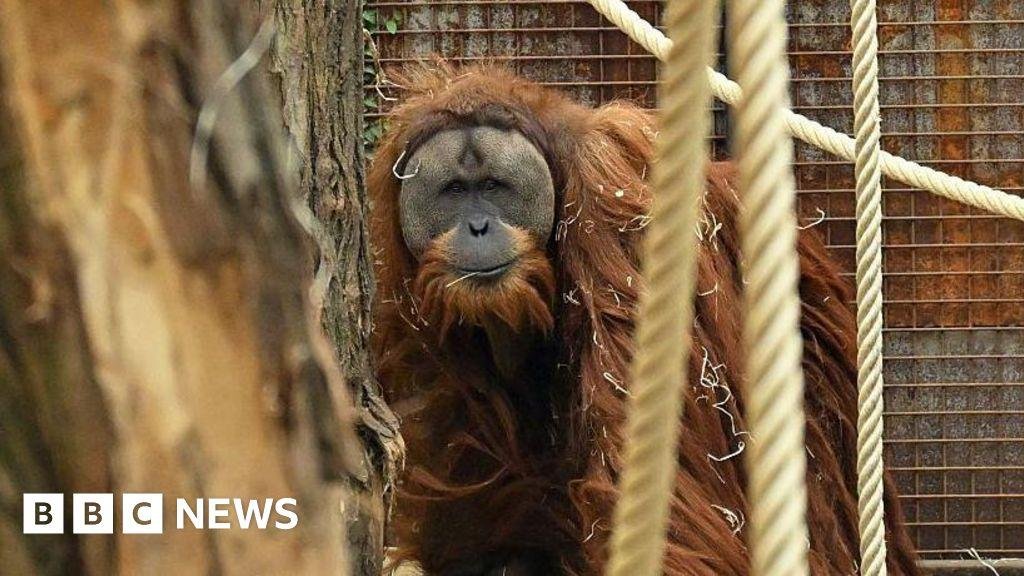
Research suggests that 58 of less than 800 critically endangered Tapanuli orangutans, or around 7% of the total species, were killed as a result of the extreme weather event last November.
Those are conservative figures, and do not take into account rain-induced canopy damage or reduced food availability, said the authors of the study published on Wednesday.
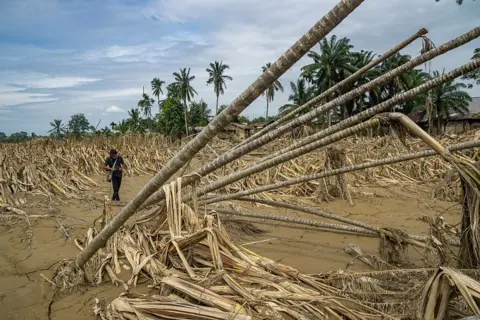
Cyclone Senyar ravaged Sumatra in late November, killing more than 1,000 people in Southeast Asia's deadliest natural disaster for 2025.
The study's findings, said the authors, show that extreme rainfall events can directly threaten the survival of great ape populations.
The damage to the island's wildlife, however, has been harder to quantify.
Wildlife experts and conservationists had previously observed that, in the wake of the storm, Tapanuli orangutan sightings had dissipated - fuelling speculation that the great apes may have been swept away by floods and landslides.
Professor Erik Meijaard, managing director of Borneo Futures in Brunei and an author of the study published on Wednesday, had told the BBC in December that Cyclone Senyar had likely killed about 35 orangutans – a loss which he said would constitute "a major blow to the population".
His more recent estimate of 58 deaths marks a significant uptick on that figure.
Weeks after the cyclone, humanitarian workers told the BBC they found the carcass of what they believed to be a Tapanuli orangutan semi-buried amid debris of mud and logs in Pulo Pakkat village in central Tapanuli district.
"I have seen several dead bodies of humans in the past few days but this was the first dead wildlife," said Deckey Chandra, who was working with a humanitarian team in the area. "They used to come to this place to eat fruits. But now it seems to have become their graveyard."
Meijaard said he had seen photos of the dead orangutan, shared by Chandra.
"What struck me is that all the flesh had been ripped off the face," he said. "If a few hectares of forest comes down in massive landslides, even powerful orangutans are helpless and just get mangled."
"It must have been hellish in the forest at the time."
 Getty Images
Researchers noted that Cyclone Senyar was an anomalous event, but that human-induced climate change played a significant role.
They also noted that the frequency and intensity of extreme rainfall in the area is likely to continue in the future, posing a threat to the survival of Tapanuli orangutans and their habitat.
Studies indicate that the species - which was only discovered in 2017 - will go extinct if it continues to lose more than 1% of its population annually.
The Indonesian government has temporarily halted major developments in the Batang Toru area - a protected forest in Sumatra - including mining, oil palm, and hydropower expansion, giving researchers a rare opportunity to further assess the ecological risks faced by these great apes.
The authors of Wednesday's report point out that the devastation inflicted by Cyclone Senyar proves how vulnerable the species is.
"The crisis facing the Tapanuli orangutan illustrates the convergence of climate instability, biodiversity loss, and vulnerability, calling for a coordinated response matching the scale of the threat," they report wrote.
To protect the remaining orangutans, they added, sustained international support will be required.
"Through strengthened domestic protection, climate-responsive planning, and global financial and technical assistance, we can still prevent the first modern extinction of a great ape species."