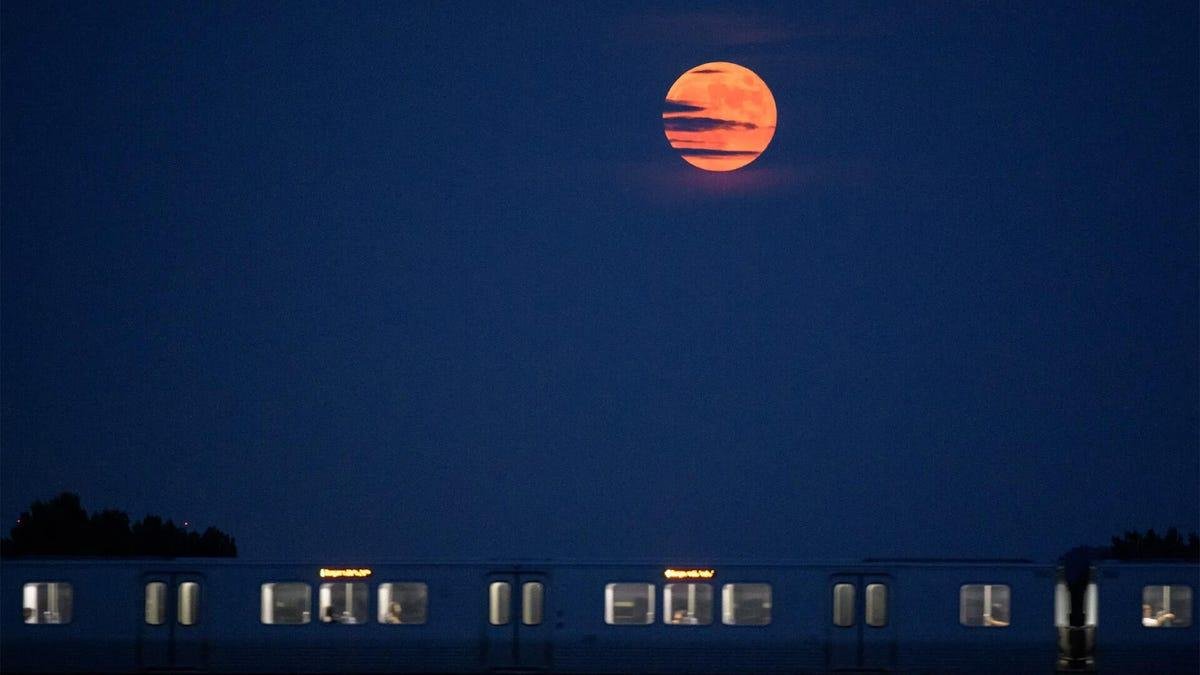
The full moon is usually the brightest object in the night sky, but not all full moons are the same. June's Strawberry Moon is a great example of this variation. It's the third and final micro moon of 2026, and you can see it on June 29. A micro moon occurs when a full Moon or a new Moon happens at the same time the Moon is at apogee, its farthest point in orbit from Earth.
The Strawberry Moon reaches peak illumination at 7:56 p.m. ET that day, which is still during daylight hours for everyone in North America. That means the best time to see the full moon is that same evening once the sun has set. The moon is set to rise out of the southeastern sky just after sunset and streak across the southern horizon until it sets in the southwest just before sunrise.
The sun won't rise too far above the horizon in June thanks to the summer solstice.
StellariumOne of the least friendly moons to watch
You may notice that the Strawberry Moon isn't terribly high in the sky this month, and that's normal. June's full moon is the lowest full moon of any given year, due to the same mechanics that give us the summer solstice. The Earth is tilted on its axis, and during the summer solstice, the Northern Hemisphere is tilted toward the sun. That means the sun is higher in the sky than it is at other times of the year.
This also works with the moon, albeit in reverse, since the moon is always opposite the sun. The Northern Hemisphere is tilted away from the moon, so the moon appears lower in the sky than it normally does. It's not quite as low as last year's Strawberry Moon, which was the lowest full moon in decades, but if you're somewhere with a lot of trees, you may have some trouble finding it.
A micro moon is noticeably smaller and less bright than a supermoon or even a regular full moon.
NASA/JPL-CaltechJune's full moon is also the final micro moon of the year, and so in addition to being low on the horizon, it's also smaller than usual. The moon's orbit around Earth is elliptical instead of circular, which means the moon is sometimes closer to Earth, a phenomenon known as perigee, and sometimes farther away, a phenomenon known as apogee.
Since the moon is in apogee, it's approximately 7% smaller than it would normally appear during a typical full moon and about 14% smaller than a supermoon. The full moon is still easy to find and the brightest thing in the night sky, but you may have to walk around the block to see it behind the trees in your neighborhood.