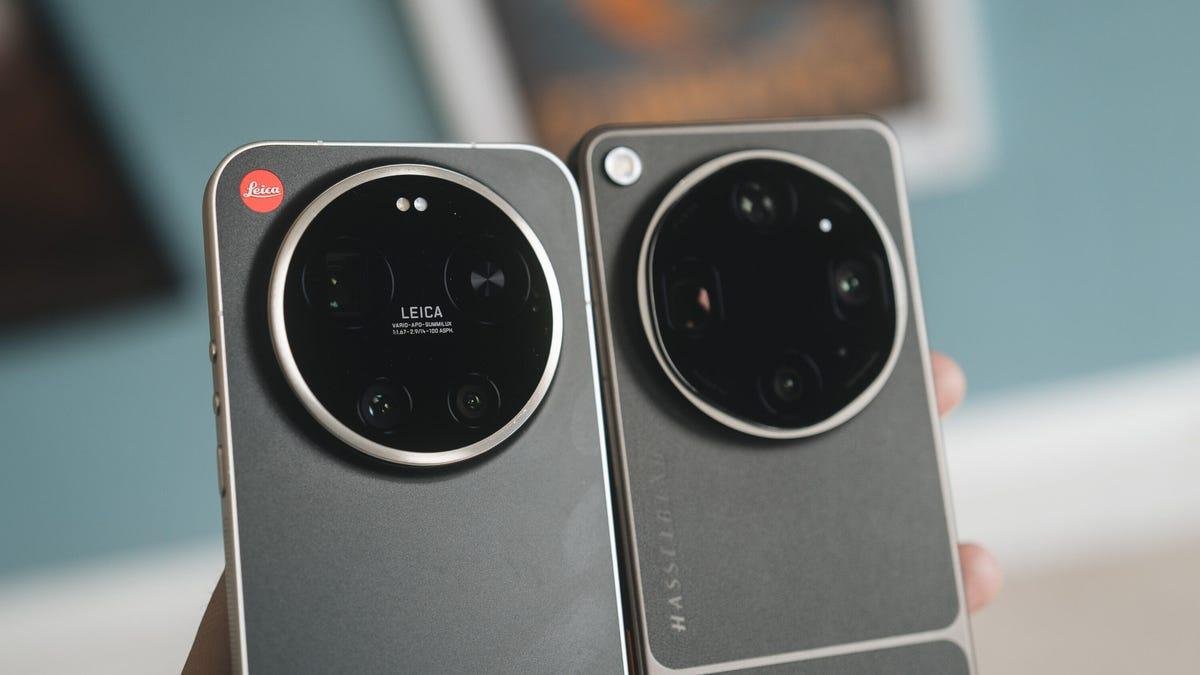
I called Xiaomi and Leica's Leitzphone "the best camera phone I have ever used" when I reviewed it in March, and I meant it. This phone has some astonishing chops when it comes to taking images that arguably make it more of a camera than a phone. But it's not the only phone I've said that about recently.
Oppo partnered with Hasselblad for its Find X9 Ultra, equipping the phone with a similarly potent lineup of specs that also makes it an absolute photography powerhouse. With both phones claiming to be basically the best around, I wanted to put them to the test in a side-by-side shootout to see which one impresses me more.
I've been a phone reviewer at CNET for 15 years, but I'm also a professional photographer and photography YouTube creator. That means I have exceptionally high standards for phone cameras. Especially when they both have sky-high price tags.
Starting at £1,449 ($1,915), the Oppo Find X9 Ultra is unquestionably pricey, but it undercuts the £1,700 ($2,245) Leitzphone by quite a bit (neither phone is officially offered in the US). They're by no means cheap, with both more expensive than the iPhone 17 Pro, so those of you looking toward these phones are right to expect pristine performance in every respect.
With huge price tags on both phones, they need to impress.
Andrew Lanxon/CNETThat means I won't be pulling my punches here, but instead nitpicking at every little difference I can see. But it's important to keep in mind that some of what I'll conclude comes down to personal preference. Photography is an art form, and some aspects -- like how vibrant colors appear -- can be a matter of taste, rather than a subjective flaw in an image. While I'll be passing judgment, keep in mind that your experience may vary slightly.
At the end of the day, though, both these phones are exceptionally good at what they do, so it's going to be an interesting fight. Let's get going.
Oppo Find X9 Ultra vs. Leitzphone: Big hardware differences
Before we even get into photo comparisons, there are notable differences in the hardware of each phone. The Find X9 Ultra has an impressive setup of rear cameras, including a 200-megapixel main camera, a 50-megapixel ultrawide, a 200-megapixel telephoto camera with 3x optical zoom and an additional 50-megapixel telephoto camera with 10x optical zoom.
Lots of big numbers, for sure, but the Leitzphone has some advanced trickery on its side. Its main image sensor is a physically larger 1-inch-type chip that employs a technology called LOFIC. I won't bore you with what that really means, but it essentially boils down to the sensor being able to capture high dynamic range images in a single shot, rather than combining multiple frames into a single photo, as is the more typical approach -- and the one used by Oppo's phone.
The physical control ring around the camera is one of my favorite features of the Leitzphone. The Oppo, right, doesn't have this feature.
Andrew Lanxon/CNETIt's a cutting-edge piece of tech that's rumored to debut in the next iPhone 18 Pro and Samsung's Galaxy S27, and will likely become the norm for all high-end camera phones next year. Oppo's phone uses the typical method of combining frames, and it's a bit of a shame that Oppo hasn't pushed for this in its own phone. The company says its image processing is still competitive, however.
The Leitzphone has more tricks, though. First, it has a physical settings wheel positioned around the whole camera module on the phone's rear. Give it a twist, and it can control your focus, zoom or even exposure compensation (depending on what you set it to control) and basically allows you to hold and control the phone in much the same way you would with a real camera. It's a really nice touch, and I love using it.
It's also one of the first camera phones to employ a continuous telephoto zoom unit that uses real moving lens elements to zoom in without loss of quality, rather than only jumping between set zoom levels. Again, I think this works extremely well, although Oppo's zoom skills are still something to behold -- especially with the optional lens attachment, which I'll come to.
The Find X9 Ultra has a shutter button on its edge. It's bright orange, to match the shutter buttons on Hasselblad's pro cameras.
Andrew Lanxon/CNETOn a purely hardware level, I do think the Leitzphone is pushing its camera tech further, which explains why the phone has a higher price tag -- it's packing brand-new tech not seen in other phones.
But at the end of the day, camera hardware is meaningless without impressive image quality, so let's take a look at some photos. Note that all shots shown here have been imported into Adobe Lightroom for comparison and exported at a lower quality for better web viewing. No other edits have been made, unless otherwise stated.
Oppo Find X9 Ultra vs. Leitzphone: Image quality tests
Enlarge Image
Oppo Find X9 Ultra, main camera.
Andrew Lanxon/CNETEnlarge Image
Xiaomi Leica Leitzphone, main camera.
Andrew Lanxon/CNETLet's start with this outdoor scene from the main cameras of each phone. The images look great with accurate colors and solid overall exposures. But there are differences to note. The Leitzphone has slightly punchier highlights in some areas, which gives a bit of extra pop to the clouds, without looking like it's overexposed and blown out the details. Interestingly, it's got more controlled highlights elsewhere in the scene.
Enlarge Image
Oppo Find X9 Ultra (left) Xiaomi Leica Leitzphone (right) main camera, detail crop.
Andrew Lanxon/CNETIf we zoom in on the details of this building, it's clear that Oppo's shot shows a much brighter building, which looks a bit blown out, resulting in lost detail -- or its image processing has smoothed out those details unnecessarily. Either way, the result is that the Leitzphone has maintained a more organic look to this building with controlled highlights, sharper details around the windows and maintained much more of the natural textures.
Enlarge Image
Oppo Find X9 Ultra main camera (left), Xiaomi Leica Leitzphone main camera (right).
Andrew Lanxon/CNETIn this scene, the Leitzphone again produced a shot with better-looking contrast on the clouds -- the whites actually look white in its image, giving them an almost 3D depth. I think Oppo's image processing has spoiled things here. It appears that the phone has tried to tone down those highlights too much, resulting in whites that are actually more gray, giving the scene less pop overall. It's also lightened the shadows quite a bit, especially in the foreground, where the chain fencing casts shadows.
Enlarge Image
Oppo Find X9 Ultra, main camera.
Andrew Lanxon/CNETEnlarge Image
Xiaomi Leica Leitzphone, main camera.
Andrew Lanxon/CNETI actually found that the Find X9 Ultra can be quite aggressive with its shadow processing. In this image, the exposure in the shadowy areas on the left side is really lifted, creating what, to my eye, looks like a quite processed HDR image. It makes the shot look almost like a cliché "phone photo," while the Leitzphone's less heavy-handed approach results in a more "professional"-looking shot with natural shadows.
Enlarge Image
Oppo Find X9 Ultra, main camera.
Andrew Lanxon/CNETEnlarge Image
Xiaomi Leica Leitzphone, main camera.
Andrew Lanxon/CNETAnd it's the same story when I used these trees as a framing device; more natural-looking tones from the Leitzphone and better fine details when you zoom in.
Enlarge Image
Oppo Find X9 Ultra, main camera.
Andrew Lanxon/CNETEnlarge Image
Xiaomi Leica Leitzphone, main camera.
Andrew Lanxon/CNETAnd again. I just find that the Leitzphone delivers realistic-looking tones more consistently straight out of the camera. Sometimes it doesn't work in the Leitzphone's favor, however.
Enlarge Image
Oppo Find X9 Ultra, main camera.
Andrew Lanxon/CNETEnlarge Image
Xiaomi Leica Leitzphone, main camera.
Andrew Lanxon/CNETHere, for example, the X9 Ultra's processing has resulted in an image with a lot more vibrance, with those red chairs looking a lot more vivid, especially against the quite dull-looking shot taken on the Leitzphone.
Enlarge Image
Oppo Find X9 Ultra, ultrawide camera.
Andrew Lanxon/CNETEnlarge Image
Xiaomi Leica Leitzphone, ultrawide camera.
Andrew Lanxon/CNETFrom the ultrawide cameras, the X9 Ultra's shot does start to look a bit overcooked -- those reds are almost shockingly vibrant -- but I think it's generally a better look than the muted aesthetic of the Leitzphone's shot.
Enlarge Image
Oppo Find X9 Ultra, ultrawide camera.
Andrew Lanxon/CNETEnlarge Image
Xiaomi Leica Leitzphone, ultrawide camera.
Andrew Lanxon/CNETAlthough in this ultrawide example, I think I prefer the Leitzphone's effort. By not oversaturating the tones (especially the yellow paint circle and the rich blue skies), it maintains a more natural look that suits the scene well. Both phones have 50-megapixel ultrawide cameras, so it's little surprise that there's almost nothing to choose between them in terms of overall quality here.
Enlarge Image
Oppo Find X9 Ultra main camera (left), Xiaomi Leica Leitzphone main camera (right).
Andrew Lanxon/CNETAnother example of each phone's approach -- the X9 Ultra has gone hard on the saturation here, especially in those red seats. While the Leitzphone's shot is a little more restrained. I'm happy to chalk this one down to personal taste.
Enlarge Image
Oppo Find X9 Ultra, main camera.
Andrew Lanxon/CNETEnlarge Image
Xiaomi Leica Leitzphone main camera.
Andrew Lanxon/CNETAnd here with this close-up on a lovely summer flower. The Leitzphone is arguably a little muted, but I still prefer it to the heavily processed shot from the Oppo, with its artificial-looking shadows and overly vibrant greens.
Enlarge Image
Oppo Find X9 Ultra, main camera, default mode JPEG.
Andrew Lanxon/CNETEnlarge Image
Xiaomi Leica Leitzphone, main camera, default mode JPEG.
Andrew Lanxon/CNETThis is probably the most obvious difference I've seen in how each phone uses image processing. It's a complicated scene for any camera to capture, with a huge contrast between the deep shadows in the building and the bright sky above. While the Leitzphone has slightly blown out the brightest highlight on the cloud, the Find X9 Ultra has gone way overboard with its processing, creating a very unnatural-looking sky by artificially pulling that brightness back, while simultaneously raising the shadows on the lower right of the scene to an unrealistic extent.
Enlarge Image
Oppo Find X9 Ultra, main camera, Master mode, edited DNG raw file.
Andrew Lanxon/CNETEnlarge Image
Xiaomi Leica Leitzphone, Pro mode, edited DNG raw file.
Andrew Lanxon/CNETBut everything changes if you take a more manual approach, using the Pro modes of each camera (called Master mode on the Oppo) and shooting in DNG raw. These raw files have captured a lot more tonal information, allowing the highlights to be perfectly rescued in both images. It's also bypassed all of the phone's image processing in the Oppo's camera, allowing it to capture deeper shadows that look like they actually did in the moment.
I found this to be the case for most of the time I spent taking photos with the Find X9 Ultra, especially during a photo expedition to Madeira. In the default camera mode, its images can look too processed -- at least in my opinion -- but by taking full control in Master mode, you can unleash everything that this camera is capable of.
Oppo Find X9 Ultra vs. Leitzphone: Zoom
With two separate optical zoom lenses on the back (one 3x and one 10x), the Oppo Find X9 Ultra may have a natural advantage in zoom, though the Leitzphone offers its own continuous telephoto zoom from 3.2x to 4.3x with no loss in quality. It's not as big a zoom, but I generally find the roughly 70-100mm equivalent zoom on the Leitzphone to be more broadly usable than the 230mm equivalent zoom of the Oppo.
Enlarge Image
Oppo Find X9 Ultra, 3x optical zoom.
Andrew Lanxon/CNETEnlarge Image
Xiaomi Leica Leitzphone, 3.2x optical zoom.
Andrew Lanxon/CNETAt 3.2x on the Leitzphone and 3x on the Oppo, I expected more from the Oppo's 200-megapixel telephoto zoom here. While the Leitzphone looks a little oversharpened, it's preferable to the quite mushy details offered by Oppo's camera.
Enlarge Image
Oppo Find X9 Ultra, 6x hybrid zoom.
Andrew Lanxon/CNETEnlarge Image
Xiaomi Leica Leitzphone, 4.3x optical zoom.
Andrew Lanxon/CNETWhile the Leitzphone maintains its quality at 4.3x zoom, the Oppo digitally crops at its 6x zoom range, further reducing that quality. Looking close up, there's a lot of detail smoothing going on, which has really reduced the definition on some of the brickwork in the buildings.
Enlarge Image
Oppo Find X9 Ultra, 10x optical zoom.
Andrew Lanxon/CNETBut at 10x, the Oppo really comes out swinging. Suddenly, all those details pop back into glorious view with a stunning shot that's pin-sharp yet somehow also doesn't look oversharpened. It's a great balance, and I'm really impressed with what this 10x zoom lens can do.
But the Oppo has another trick up its sleeve: its detachable telephoto zoom lens. It's a physical unit (and quite a hefty one at that) that takes that zoom up to an optical 300mm and all the way up to a wild 1,380mm equivalent with digital cropping. It's an accessory the Leitzphone doesn't offer, and I've taken some zoomed shots using it on my travels that have left me utterly blown away.