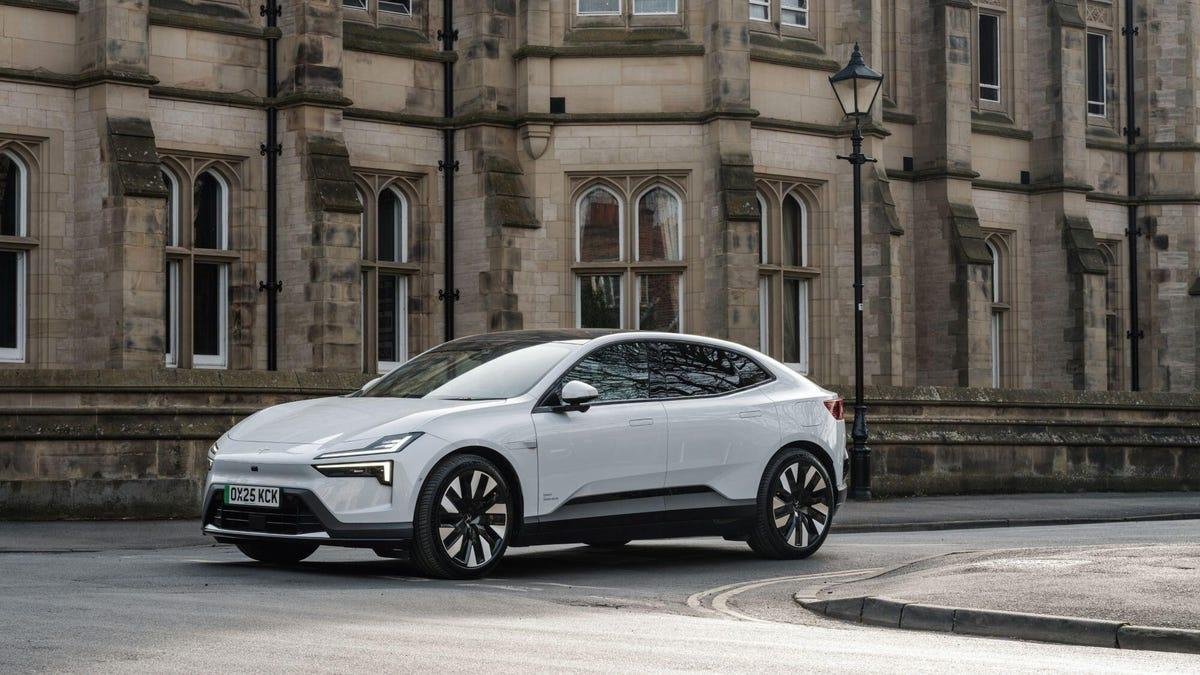


Automaker Polestar will not be allowed to sell its 2027 models and beyond in the US after the US Department of Commerce's Bureau of Industry and Security banned those sales over concerns about Chinese-made connected technology. And the company has no plans to return.
The crux of the issue is Polestar's ownership by Volvo and Volvo's own parent company, China-based Geely.
The Swedish manufacturer of electric vehicles, which became a distinct brand in 2017, revealed the ban in an SEC filing, which it paired with a press release this week announcing that it's shifting manufacturing to Europe.
It said in the release that it will continue to sell existing stock of its Polestar 3 and Polestar 4 vehicles in the US and to support customers through its service network.
A representative for Polestar told CNET in an email that, because of the Commerce Department's decision, the company has no plans to sell new cars in the US from model year 2027 onward, including the planned Polestar 7.
The company has marketed the Polestar 7 as a premium compact SUV. It's due out in 2028.
This decision isn't surprising: A 2024 letter from Polestar (PDF) to the Bureau of Industry and Security foreshadowed what would eventually happen. It said at the time that the agency's prohibitions could eventually lead the company to stop selling vehicles in the US, even ones it manufactures in South Carolina.
The US ban has not been posted on the Commerce Department's website or social media, but it's in line with the agency's directive to police technology from China that the government considers a potential security threat. This month, the department issued a $36 million penalty against Bosch for exporting sensors and auto software to Huawei.
In May, however, the Bureau of Industry and Security granted Volvo special authorization to sell its vehicles in the US after the auto company said it discussed its connected technology with the department.
A representative of the Bureau of Industry and Security did not immediately respond to a request for comment.
US agencies aren't just looking at the auto industry. The Federal Communications Commission has targeted consumer products including routers and drones that have technology made in China.
Considering EVs in the US
Polestar is not one of the top 10 EV manufacturers, lagging behind larger companies including Tesla, BYD and Volkswagen.
Electric vehicles only account for about 6.5 percent of the US auto market, according to industry watcher Edmunds. In the US, EVs are typically priced higher, and federal rebates to purchase these types of vehicles have been phased out.
With gas prices high this summer, consumers may be giving EVs another look, but concerns remain about pricing and range.
Some automakers are trying to boost the appeal of electric vehicles through lower-cost models. Slate is taking preorders for a basic, modular EV truck that costs $24,950 before delivery fees. Other EV models, such as the Chevrolet Bolt, can be found for about $30,000.