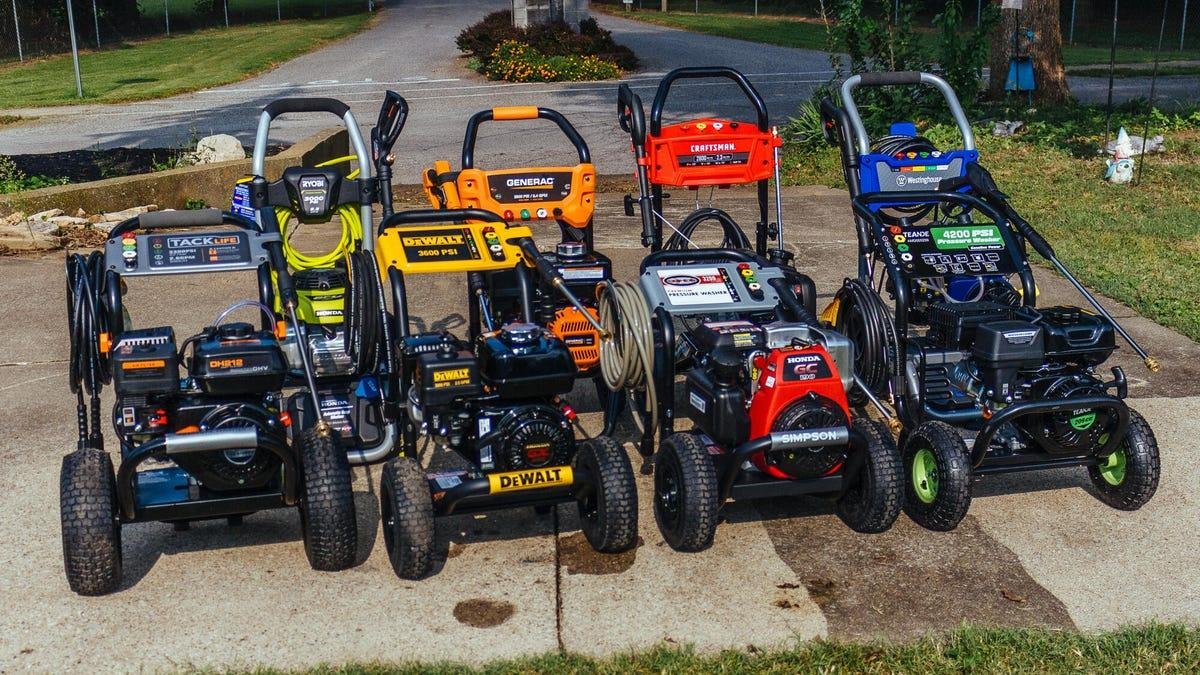
Pressure washers can be a force multiplier for cleaning around your home or tackling stubborn messes, particularly outdoors. However, buyers tend to stumble into a number of pitfalls when choosing a model, whether it’s overestimating the power they need or missing key setup details that lead to damaged surfaces. Before you spend your hard-earned cash on a power washer, read about these five common mistakes and save yourself some time, money and potential damage to your property.
1. Buying for pressure instead of for cleaning
Power is important, but it's not everything. A common mistake first-time purchasers make is over-prioritizing pressure per square inch (PSI), when in reality, real-world cleaning performance depends on a careful balance between PSI and gallons per minute (GPM). An oversize machine can be overkill, depending on what you plan to use it for, and it can even be dangerous for cleaning siding, decks or vehicles.
Before you buy, carefully consider what you're going to be cleaning the most often and whether you'll be using your pressure washer on any surfaces that could be damaged or degraded by too much PSI. A small electric unit like our top pick for best pressure washer, the Karcher K1800PS Cube, will likely be enough for cleaning patios, furniture and light grime, while heavier-duty jobs may justify more output.
For that kind of work, look for a unit that balances 1,500–2,000 PSI with around 1.2–1.8 GPM. On the opposite end of the spectrum, if you're looking for serious, heavy-duty cleaning for stubborn grime, look for a model with 2,800–3,500 PSI and 2.3–3.0 GPM, something like the DeWalt DWPW3000.
2. Always using the maximum power setting or misjudging distance
Invest a little time in learning the proper tips, angles and distances when operating a pressure washer for different uses.
Steve Conaway/CNETThe temptation may always be to crank your washer up to maximum to save time cleaning and make sure you blast off every bit of grime, but as mentioned above, sometimes maximum power is overkill. The same is true for range: The closer you are to the surface you're cleaning, the more power you'll be delivering. In both instances, you risk stripping paint or damaging detailing on sensitive exteriors.
The best approach is actually the opposite. Start with your washer set to the lowest possible setting and begin at close to its maximum range, usually around 20 feet or so for consumer models. You can then steadily increase the power setting and, if necessary, get closer to your target until you're effectively cleaning without damaging the surface. Again, model selection is key. If you're just cleaning some light grime off a deck, a smaller unit like the Sun Joe SPX3000 packs plenty of oomph without risking damage to your property.
3. Ignoring water supply limits
This one's vital to ensure you get right before you commit to a purchase. The last thing you want is to get your shiny new pressure washer home and realize that your house’s hose flow can't support the washer’s water demand. To perform properly, the water supply has to be able to keep up with the pump’s minimum flow requirement.
To determine if your supply rate is up to snuff, we spoke to Caleb John, director of Exceed Plumbing & Air Conditioning. He recommends a simple bucket test. Just grab a bucket with a known volume, like 5 gallons, and a stopwatch (or phone with a timer app). Fully open the outdoor faucet or hose bib, place the hose into the bucket and time how long it takes to fill. The GPM is the number of gallons in your bucket times 60, divided by the seconds it takes to fill. So if a 5-gallon bucket fills in 75 seconds, that's 300÷75=4 GPM.
If your home isn't delivering enough GPM for the washer you want, you don't necessarily have to abandon your purchase.
"What you need to do is start by checking if your isolation valve is opening fully," John says. "If not, you might also need to upgrade your water supply hose to a 3/4-inch diameter. An undersize or restricted hose starves the pump and wears it out well before its time."
The type of pump is also a factor, John said. "Gas-powered pumps require more flow and require a separate supply line. If they are operated when other fixtures are running, pressure drops during the job and the pump has to work harder to make up for it, thus reducing its lifespan significantly."
John told us that for most scenarios, a single washer with a rating between 1,600 and 2,000 PSI should be enough to manage most jobs.
"Units in that range only need 5–6 liters of water per minute, which most standard taps can handle comfortably. The Kärcher K5 fits into this and does not require any special modifications or demands from the existing supply line, which is exactly why I'd point most homeowners toward it first."
4. Picking the wrong nozzle
Using the turbo nozzle during our testing tore wood away at a depth of nearly half an inch.
Richard Baguley/CNETChoosing the right nozzle for the job is as important as choosing the right machine for your home. Using the wrong one with an incorrect spray pattern can concentrate too much force in a small area or spread it unevenly, which in turn can affect cleaning quality or surface safety.
A nozzle tip that's too small can strip paint, gouge splinters out of wood, or even etch softer materials, which is fine if that's your intent, but it can be a costly mistake if done by accident. A wider fan is a better choice for general cleaning. Choosing a pressure washer with a wide array of nozzle tips means you'll have more versatility in your cleaning options, so you’ll be able to adjust if your machine ends up being more or less powerful than a specific task requires. A versatile washer like the DeWalt 20V MAX 550 PSI Cordless Power Cleaner Kit comes with a number of nozzle options so you can approach each job with the right kit.
Choose a pressure washer that comes with multiple tips to give you more flexibility in how you use it.
Steve Conaway/CNET5. Skipping safety and accessories
A good pressure washer package will include some safety gear and some essential accessories, not just the machine itself. You should include that factor as part of your price calculations. If you end up having to buy a bunch of additional gear after the primary purchase, that cheaper unit may suddenly not feel like such a great value.
Protective eyewear, closed-toe shoes and hearing protection are smart basics, especially with louder gas units. You should also factor in detergent compatibility, hose length, wand comfort and storage. A machine that’s awkward to use is often used incorrectly, leading to poor results or even avoidable damage.
Many pressure washer manufacturers also produce detergents or solutions that are designed for specific surfaces/materials. There are detergents specifically designed for cleaning stone, for instance, or formulated so as not to damage softer or finished wood surfaces. Using the right solution can not only produce better results, it can also mean avoiding costly repairs.
For more on using your new pressure washer properly, read our beginner’s guide to pressure washing for expert advice on cleaning all kinds of surfaces around your home.