


NASA’s Psyche Spacecraft Sent Back Some Awesome Photos of Mars
NASA’s Psyche Spacecraft Sent Back Some Awesome Photos of Mars
A common road trip activity is stopping at a roadside attraction to see something really cool. It turns out that NASA spacecraft do this from time to time as well. The Psyche spacecraft, on its way to the asteroid belt to study its namesake asteroid, made a stop by Mars and, among other things, took some pretty epic pictures of the planet as it flew by.
The flyby occurred on May 15, with the idea that Psyche would use Mars as a gravitational slingshot to change the spacecraft’s direction and send it on its merry way. However, NASA rarely lets opportunities like this slip through its fingers, so while Psyche was flying by Mars, NASA had the spacecraft measure the red planet with every tool that Psyche had onboard, capturing all sorts of data and several breathtaking images.
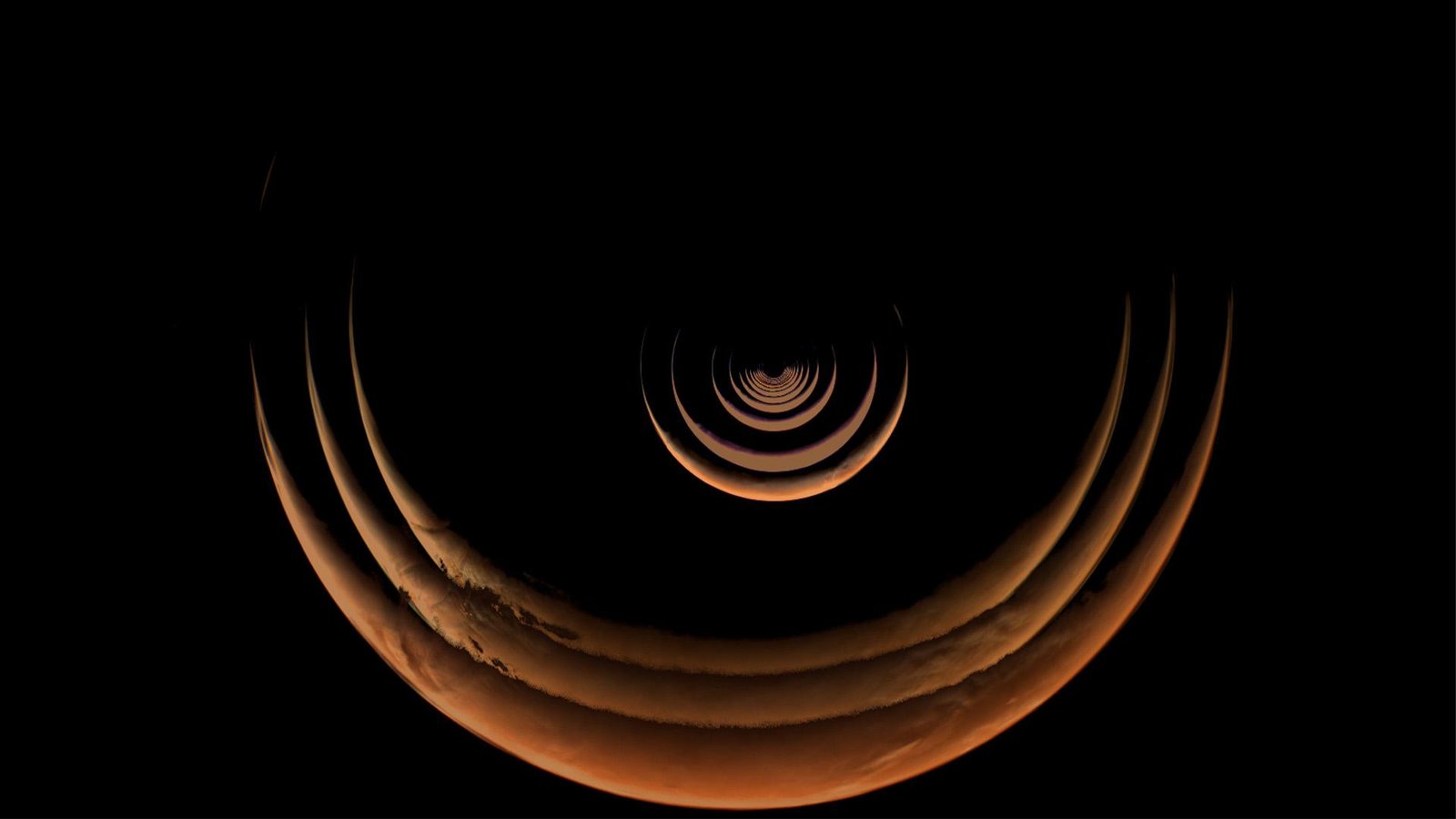
The big winner is a series of time-lapse images taken daily by the spacecraft as it approached Mars, which were then stitched together. The final image forms an eye-like shape, making it unique thanks to the angle at which Pscyhe approached Mars. The spacecraft didn’t stop there and took a month-long time-lapse of the planet as it flew by.
“Coming in at such a high phase crescent, only about 4% of Mars was illuminated, and with that, we could see the atmosphere around it glowing,” said Hannah Zigo of Psyche’s multispectral imager operations team at Arizona State University in a YouTube video.
Psyche’s imaging team captured a time-lapse of Psyche passing by Mars, from May 2 to May 31, when the planet was no longer visible. They also released a time-lapse video that condenses this month-long flyby into 1 minute and 15 seconds of some of the best imagery you’ll ever see of our red neighbor from space.

Other science happened, too
NASA’s spacecraft took as much data as it could during its brief flyby, and measured everything from Mars’ atmosphere reacting to solar winds to neutrons bombarding the red planet’s surface, thanks to its thin atmosphere. Psyche’s instruments weren’t necessarily tuned for measuring a planet, but Mars made for an excellent test bed for the spacecraft’s various tools.
“The mission’s imager, magnetometer and gamma-ray and neutron spectrometer teams worked overtime to make full use of this planetary encounter, and all instruments delivered great results,” said Lindy Elkins-Tanton, principal investigator for Psyche at the University of California, Berkeley, in a statement.

The team didn’t anticipate making any real discoveries, since the planet’s surface has been intensively studied for decades, but the data gathered certainly helps researchers study Mars more accurately. The instruments did their best, but the imager was definitely the MVP of the flyby.
“The imager performed brilliantly, delivering some rarely seen views of the Red Planet,” said Jim Bell, Psyche’s imager instrument lead at Arizona State University. “Besides the obvious beauty of the photos, we were also able to fully test its calibration and sensitivity to scattered light, including picking out the Martian moons Phobos and Deimos from very far away as a part of a practice for the satellite search that we’ll use at the asteroid Psyche to look for any moonlets there.”
For those of us here on Earth who aren’t a part of the Psyche team, our reward for everyone’s hard work is some truly excellent desktop background candidates and yet another excellent glimpse of our red neighbor. Psyche is expected to reach the Psyche meteor in August 2029.
Προωθημένο
Προωθημένο
Προωθημένο
Προωθημένο
Διαφημίσεις
Κατηγορίες
Διαβάζω περισσότερα
Record-breaking DHS shutdown ends. And, May Day protests to draw crowds nationwide Stalemate In The Strait Of Hormuz, DHS Shutdown Ends, Trump's Surgeon General Nominee Good morning. You're reading the Up First newsletter. Subscribe here to get it delivered to your inbox, and listen to the Up First podcast for all the news you need to...

Jair Bolsonaro granted temporary house arrest in Brazil for poor healthVanessa BuschschlüterLatin America online editorReutersJair Bolsonaro, who governed from January 2019 to December 2022, was jailed last yearA judge in Brazil has ruled that jailed former President Jair Bolsonaro can be placed under house arrest for the next three months because of poor health.Bolsonaro, 71, was taken two...

Di time electronic digital yang serba cepat ini, para penggemar Toto Macau tentu mendambakan akses informasi yang mudah, akurat, john dapat diandalkan. RAJABANDOT hadir sebagai solusi utama bagi Anda yang ingin mendapatkan info Macau terlengkap dengan up-date harian. Dengan mengusung konsep sebagai situs Toto Macau terpercaya, RAJABANDOT berkomitmen untuk memberikan pengalaman terbaik bagi...

The company behind ClassPass and Mindbody just got a lot bigger with a $7.5B merger The fitness industry is consolidating fast — and the latest deal is one of the biggest yet. Playlist, the parent company behind fitness brands Booker, ClassPass, and Mindbody, has officially merged with EGYM, a startup known for its smart gym equipment, AI-driven workout plans, and corporate wellness marketplace...

If you have spent any time chasing stronger gear in Path of Exile 2, you will already know that the real power often sits in the small details. That is where POE 2 Items like Masterwork Rune start to matter, because they are not about raw stats on their own. They are about making every other rune you have worked for do a bit more. That is why players who plan ahead tend to hold onto them...
