


Regional Deep Dive: Asia Pacific Leads, Middle East & Africa Emerges as Fastest-Growing Market for Leather Goods

A comprehensive regional analysis of the Global Leather Goods Market reveals distinct dynamics across major markets, with Asia Pacific leading in revenue and the Middle East & Africa region emerging as the fastest-growing market. According to the Global Leather Goods Market report, regional dynamics are shaped by manufacturing capabilities, consumer spending, and economic factors. The market is witnessing growth in both mature and developing economies.
Market Dynamics
Asia Pacific
Asia Pacific commands 36.9% of the global leather goods market revenue, driven by China's export dominance and India's growing domestic consumption . China's Guangdong and Zhejiang provinces manufacture approximately 40% of global leather goods by volume, while domestic spending on luxury leather products grew 14% in 2024 . India's Council for Leather Exports targets USD 10 billion in leather product exports by 2027, backed by the PLI scheme that subsidizes machinery upgrades . Japan's quality-conscious consumer culture and South Korea's K-fashion leather integration are also significant.
Europe
Europe holds the second-largest share at 27.2%, anchored by Italian and French heritage brands . The Tuscany tanning district processes 65% of Europe's bovine hides and supplies raw material to over 5,000 artisan workshops . EU sustainability directives are creating both compliance costs and competitive advantages for producers who adopt green chemistry tanning methods early. Germany and the UK are also significant markets.
North America
North America accounts for 22.1% of global revenue, benefiting from a mature retail infrastructure and a digitally savvy consumer base . The US alone accounts for roughly USD 83.0 billion in leather goods spending, driven by heritage brands like Coach, Michael Kors, and Kate Spade that continue to expand outlet and e-commerce channels.
Middle East & Africa
The Middle East & Africa region is the fastest-growing, with a projected CAGR of 8.7%, fueled by luxury retail expansion in the UAE and Saudi Arabia's Vision 2030 spending . Dubai Mall alone drew in 105 million visitors in 2024, while retail growth initiatives inside Riyadh and Abu Dhabi will bring in an excess of 500,000 square meters of premium retail space by 2028 . Saudi Arabia's entertainment and tourism mega-projects are opening up new luxury retail corridors.
Competitive Landscape
The competitive landscape is regionally specific. In Asia Pacific, a mix of global manufacturers and domestic brands compete. In Europe, heritage luxury houses dominate. In the Middle East & Africa, luxury retailers and international brands are expanding.
Conclusion
The Leather Goods Market displays a clear regional structure, with Asia Pacific leading and the Middle East & Africa driving the fastest growth. The global expansion of luxury consumption creates opportunities for manufacturers and retailers in all regions.
FAQs
1. Which region is the largest market for leather goods?
Asia Pacific commands 36.9% of global revenue, driven by China's export dominance and India's growing domestic consumption.
2. Why is the Middle East & Africa a key growth region for the Leather Goods Market?
The Middle East & Africa is a key growth region due to luxury retail expansion in the UAE and Saudi Arabia, with a projected CAGR of 8.7%.
Sponsored
Ads
Ads
Ads
Categories
Read More
ChatGPT Health Will See You Now, and It’s a Big Step Forward for Medical Queries I unexpectedly spent a lot of time sick in hospitals and doctors’ offices this summer, so, as a reporter covering AI, I was well-prepared to stress-test the new version of ChatGPT Health. ChatGPT Health is a specialized experience inside the chatbot, designed with solid privacy restrictions and safety...

Chappell Roan leaves talent agency led by Casey Wasserman after Epstein falloutGetty ImagesSinger Chappell Roan says she has left the talent agency led by Casey Wasserman, whose name appears in the Epstein files.Announcing her split with the agency, Roan said she has a "duty to protect her team" and her decision reflected her belief that "meaningful change in our industry requires...

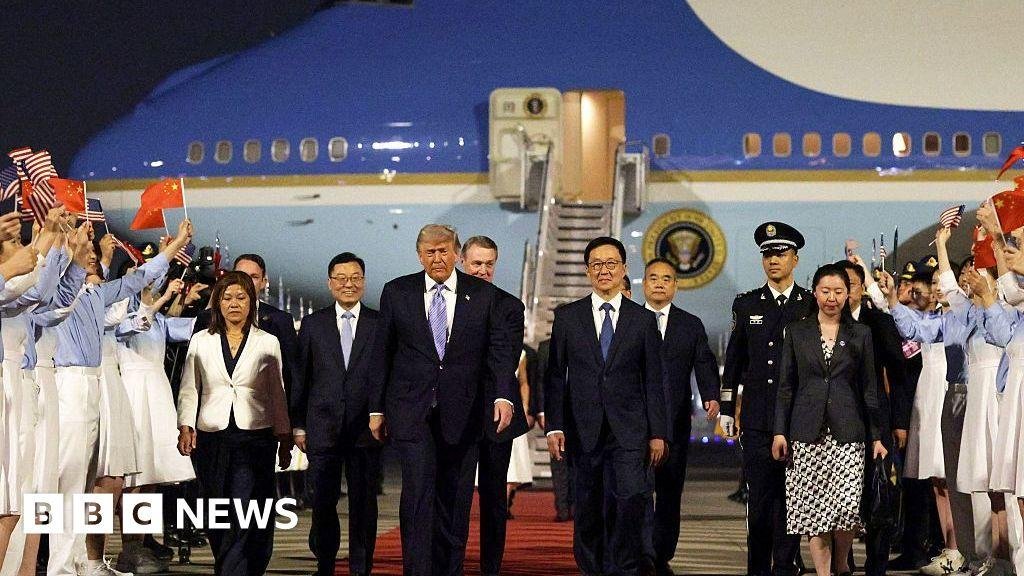
Trump arrives in China for high-stakes meeting with Xi JinpingGetty ImagesDonald Trump is joined by Vice-President of China Han Zheng and other Chinese officials as he arrives in Beijing on 13 MayUS President Donald Trump descended the steps of Air Force One in Beijing on Wednesday evening, greeted with pomp and pageantry ahead of a high-stakes meeting with his Chinese counterpart, Xi...
Jailers and officials at Russia's 'torture prisons' in Ukraine exposed by BBCImage caption, "I have never heard such terrible screams before," says Liudmyla, recalling her first days in the Izolyatsia detention centreByBy Tania Kharchenko and Samuel HortiBBC Eye InvestigationsThis article contains accounts of torture and sexual violenceEarly one October morning in 2019, a group of men jumped...

Artificial intelligence is changing how companies across the UAE operate. From customer service chatbots to automated marketing campaigns and predictive analytics, AI helps businesses improve efficiency and make smarter decisions. However, AI is only as effective as the data it receives. Poor-quality data leads to inaccurate predictions, flawed automation, and wasted...

