How Austin’s Hardware Boom is Reshaping Mobile App Development
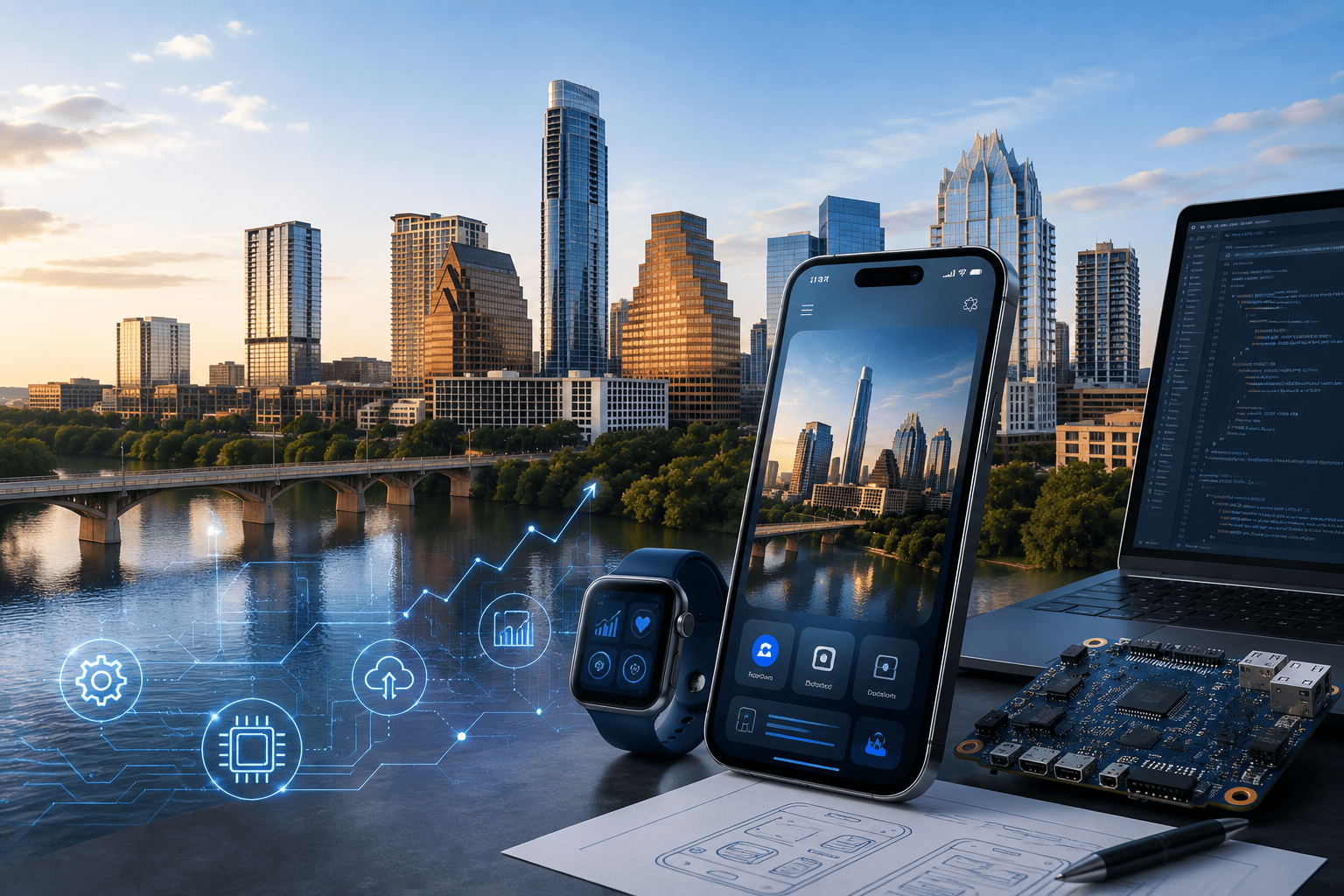
For decades, Austin’s "Silicon Hills" moniker was largely defined by its thriving software, enterprise SaaS, and digital services sectors. However, over the past few years, the city has undergone a profound industrial transformation. With the rapid expansion of semiconductor manufacturing facilities, the continued growth of electric vehicle production, and a surging robotics sector, Austin has firmly established itself as a global hub for advanced manufacturing and hard tech.
As physical machines, sensors, and intelligent hardware become the new focal points of the Austin tech ecosystem, an inevitable digital parallel is emerging. Every piece of smart hardware whether it is a connected thermostat, an industrial sensor, or a humanoid robot requires a sophisticated software interface to control, monitor, and configure it. Consequently, this boom in advanced manufacturing is fundamentally reshaping the demands placed on software creators, driving an unprecedented need for specialized mobile app development tailored for hardware-integrated applications.
The Rise of Cyber-Physical Systems in the Capital City
Austin’s hard-tech renaissance is not just a passing trend; it is backed by monumental infrastructure investments. The region is home to massive semiconductor operations, cementing its status in the microchip supply chain. Simultaneously, the area has become a breeding ground for next-generation industrial technology, from autonomous vehicles to cutting-edge robotics.
This shift toward tangible, connected products means that the traditional boundaries between hardware and software are dissolving. Today’s devices are cyber-physical systems physical mechanisms controlled by intelligent, often cloud-connected, software. For business owners, investors, and tech stakeholders, this represents a major pivot. Producing world-class hardware is no longer enough; the user experience is entirely dictated by the digital interface that accompanies it.
As a result, the region is seeing a massive surge in demand for highly capable smart device app developers. These specialists are tasked with building the digital remote controls, diagnostic dashboards, and data visualization tools that allow human operators to interact with complex hardware seamlessly from their smartphones or tablets.
Why Hardware-Integrated Applications Demand Specialized Expertise
Building a mobile application that controls a physical device is fundamentally different from building a standard social networking or e-commerce app. When software interfaces with the physical world, the complexity multiplies.
First, there are the connectivity protocols. Developers must be fluent in Bluetooth Low Energy (BLE), Wi-Fi Direct, Zigbee, and ultra-wideband communication to ensure devices pair smoothly and maintain a stable connection. Second, latency becomes a critical safety issue. If a user presses a "stop" button on their mobile app to halt an industrial machine, that command must execute in milliseconds, requiring sophisticated edge computing architectures.
Furthermore, these applications must handle Over-The-Air (OTA) firmware updates, ensuring that the hardware can receive critical security patches and feature upgrades without "bricking" the device. This highly technical environment has given rise to a specialized niche: IoT app development Austin. Developers in this space must understand hardware constraints, battery optimization, and low-level communication protocols just as well as they understand modern mobile UI/UX design. They must anticipate edge cases where physical environments interfere with digital signals, ensuring the application remains robust even when connectivity is intermittent.
Local Innovation in Action: Robotics and Mobile Teleoperation
To understand how this hard-tech boom directly impacts software development, one only needs to look at Austin’s pioneering robotics sector. A prime example is Apptronik, an Austin-based robotics company that has recently drawn global attention for its AI-powered humanoid robots designed to work alongside humans in logistics and manufacturing.
In mid-2026, Apptronik announced the opening of a newly expanded, nearly 90,000-square-foot facility in Austin called Robot Park. This facility serves as a massive data collection and training ground where hundreds of their Apollo 2 humanoid robots perform real-world tasks in simulated warehouse environments.
While the mechatronics and AI models behind these robots are highly advanced, managing a fleet of humanoid machines requires intuitive, powerful control software. Human operators must be able to monitor diagnostics, teleoperate the robots when necessary, and analyze massive streams of performance data. This is where mobile and tablet applications become indispensable. A complex humanoid robot is only as useful as the interface that allows a warehouse manager to direct it. The development of these teleoperation and fleet management apps requires tight, iterative collaboration between hardware engineers and mobile developers, proving that the future of robotics relies heavily on the quality of mobile software engineering.
The Strategic Advantage of Local Development Partners
For companies building connected hardware, offshoring software development often introduces insurmountable friction. When building an app that must interface with a proprietary piece of hardware, developers need the physical prototype on their desks. They need to test how the app behaves when the device’s battery dies, when the Bluetooth signal drops due to physical interference, or when a mechanical sensor misfires.
This necessity for physical proximity makes partnering with a local mobile app development company in Austin a strategic imperative for the region’s hardware innovators. Having hardware engineers and software developers operating in the same city and often in the same room accelerates prototyping, streamlines debugging, and ensures that the final product offers a cohesive user experience.
Local developers also benefit from an innate understanding of the regional business ecosystem. They are plugged into the same talent pools, attend the same industry consortiums, and understand the regulatory and technological standards that govern Austin’s thriving tech landscape. By keeping development local, hardware companies mitigate the risks associated with distributed teams and protect their sensitive intellectual property during the crucial early stages of product development.
Looking Forward: A Synergistic Future
Austin’s evolution from a software haven into a comprehensive hard-tech capital represents a monumental opportunity for the entire technology sector. As advanced manufacturing, semiconductor production, and robotics continue to scale across the region, the reliance on sophisticated mobile applications will only grow.
For local business owners and tech stakeholders, recognizing this synergy is vital. The success of Austin’s hardware boom is inexorably linked to the capabilities of its software developers. By investing in and partnering with local engineering talent capable of bridging the cyber-physical divide, Austin can ensure that its next generation of intelligent hardware is paired with world-class digital experiences. The city is no longer just writing code or just bending metal it is doing both, and in the process, it is setting a new standard for global technological innovation.
Sponsorizzato
Pubblicità
Pubblicità
Pubblicità
Categorie
Leggi tutto
Crunchyroll confirms data breach after hacker claims unauthorized access Anime streaming service Crunchyroll has confirmed a data breach involving customer service ticket information following an incident with a third-party vendor, after a hacker claimed to have accessed user data and internal systems. The streaming site, which Sony acquired from AT&T in 2020 for $1.18 billion, operates as...

Is Dubai's glossy image under threat? Not everyone thinks soAFPDubai has built an appeal for being a stable oasis in a turbulent regionStephanie Baker had been celebrating her birthday with friends at a bar on Palm Jumeirah - Dubai's iconic man-made palm-shaped island lined with luxury hotels and beach clubs.But as the group stepped outside to head to another nearby venue, something unusual...

Control Resonant is a sequel — and also a starting pointChronologically, Control Resonant is a sequel to 2019’s Control. But in most other ways, the games aren’t directly connected. To developer Remedy, they’re more like two sides of the same coin.When Resonant was first revealed last year, creative director Mikael Kasurinen said you can play the games in any order. The world of Control is...

Saleh Mamman: Nigeria arrests former minister in hiding after conviction for corruption39 minutes agoMakuochi OkaforBBC Africa, LagosEFCC/XAuthorities said they wanted to ensure Mamman served his sentenceNigeria's anti-corruption agency says it has arrested former Power Minister Saleh Mamman a week after he was sentenced to 75 years in jail on corruption charges.The Economic and Financial...

Eufy's Newest Robot Vacuum Has the Longest Roller Mop We've Seen for the Price Why You Can Trust CNET Our expert, award-winning staff selects the products we cover and rigorously researches and tests our top picks. If you buy through our links, we may get a commission. How we test vacuums Eufy's new Omni C28 robot vacuum comes with an extra-long roller mop and some premium features...