3D Rendering Market Forecast Points to 19.8% CAGR as Architecture and Gaming Applications Expand | Autodesk, NVIDIA, Adobe
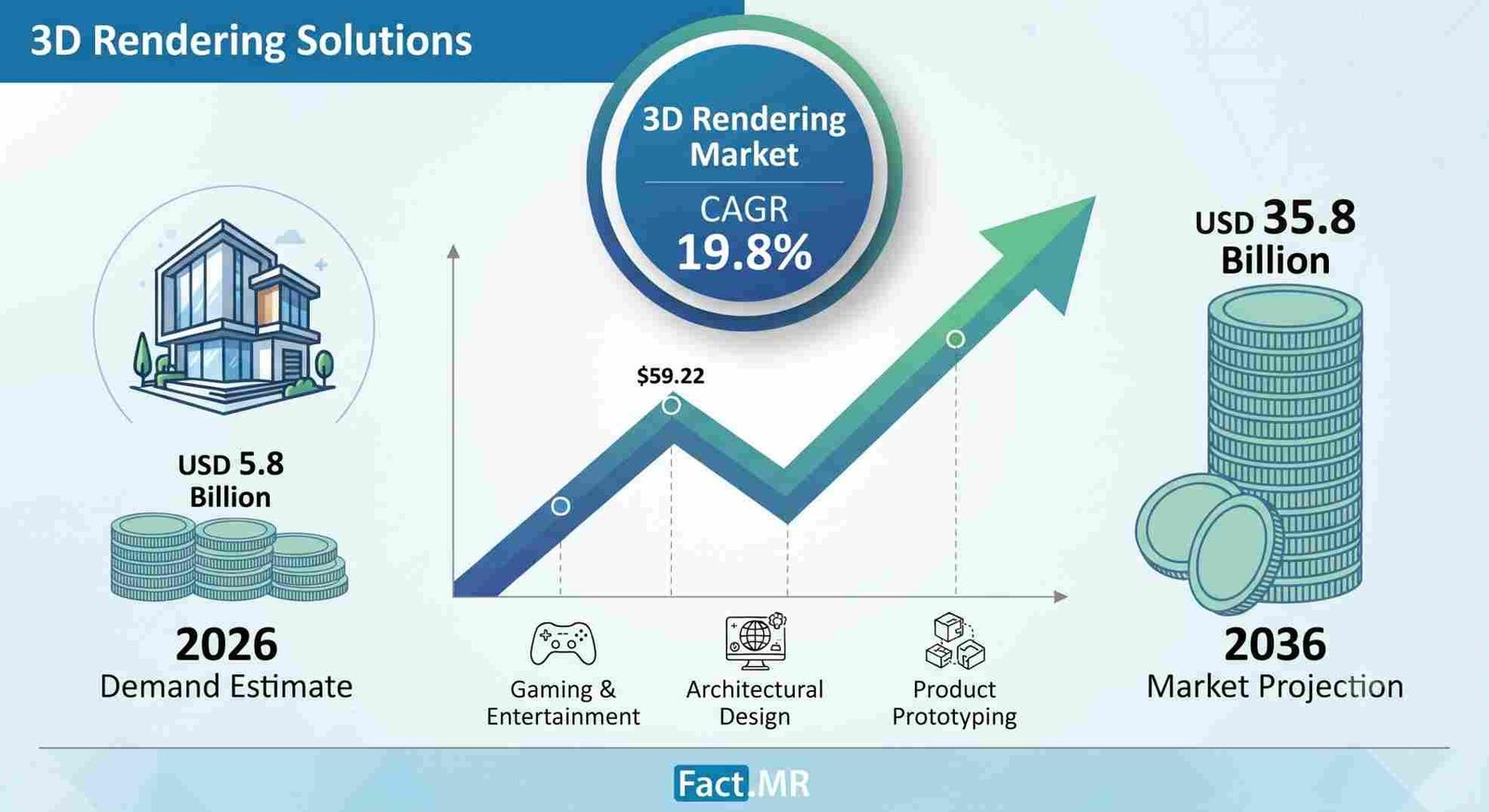
The global 3D Rendering Market is forecast to expand from USD 5.8 billion in 2026 to USD 35.8 billion by 2036, registering a 19.8% CAGR throughout the forecast period, according to Fact.MR. The market was valued at USD 5.0 billion in 2025, with demand increasingly shifting toward real-time visualization, cloud rendering, photorealistic design, and integrated digital workflows.
The market is expected to generate approximately USD 30.0 billion in additional revenue between 2026 and 2036. Growth is being supported by wider use of visualization across architecture, engineering, product development, gaming, animation, marketing, and other design-intensive applications.
Get Detailed Market Forecasts, Competitive Benchmarking, and Pricing Trends: https://www.factmr.com/connectus/sample?flag=S&rep_id=15100
3D Rendering Moves from Design Tool to Business Decision Platform
Rendering technology is no longer limited to producing polished images at the end of a design process. Organizations are increasingly using three-dimensional visualization earlier in development to compare alternatives, communicate concepts, and identify potential design issues before physical work begins.
Architecture firms can present proposed buildings before construction. Product teams can evaluate digital prototypes before manufacturing. Marketing departments can create realistic product environments without building physical sets.
This broader role is helping transform rendering software from a specialist creative application into a strategic visualization platform.
Fact.MR identifies this shift toward a “visualization-first” development phase, in which rendering becomes integrated into product design and project planning workflows.
Real-Time Rendering Changes the User Experience
One of the most important developments in the market is the growing emphasis on real-time rendering.
Traditional rendering workflows can require substantial processing time before users see a final result. Real-time technologies allow designers to make changes and receive visual feedback much faster.
This can accelerate design reviews and reduce the time needed to evaluate multiple concepts.
The benefit is particularly relevant in architecture, engineering, gaming, interactive media, and virtual environments where users need to manipulate scenes dynamically.
Rendering vendors are therefore focusing on faster processing, GPU utilization, advanced lighting, and increasingly sophisticated visual effects.
Cloud Rendering Opens Access to More Computing Power
Complex 3D scenes can require significant computing resources. High-resolution assets, realistic lighting, simulations, animations, and large environments can place substantial demands on local workstations.
Cloud rendering offers another approach by allowing workloads to use remote computing resources.
This can give organizations access to additional processing capacity without requiring every employee to operate a high-end rendering workstation.
For smaller studios, design agencies, and distributed teams, cloud-based rendering can also provide greater flexibility. Users can scale computing resources according to project requirements rather than maintaining maximum hardware capacity at all times.
Fact.MR identifies cloud deployment as an important market opportunity while noting that computing requirements and software costs can still restrict adoption among smaller organizations.
Architecture and Interior Design Represent a Major Application
Architectural and interior design is projected to account for 24.7% of application demand in 2026, making it the leading application category.
Rendering allows architects and interior designers to communicate spatial concepts before construction or renovation begins. Materials, lighting, furniture arrangements, exterior finishes, and other design elements can be represented in realistic digital environments.
For property developers, visualization can also support project marketing by giving potential buyers or investors a clearer understanding of a proposed development.
As construction projects become more digitally coordinated, rendering can serve as a bridge between technical design information and visual communication.
Software Dominates the Component Landscape
The software segment is expected to hold 70% of the market in 2026.
Rendering software provides the core environment for transforming three-dimensional models into images, animations, simulations, and interactive visual content.
Subscription-based licensing is also changing the commercial structure of the industry. Instead of relying only on one-time software purchases, vendors can generate recurring revenue through ongoing access, cloud services, upgrades, and additional capabilities.
Integration with broader design applications is another important factor. Rendering tools that work smoothly with modeling, animation, engineering, and architectural workflows can reduce the need for users to move data between disconnected applications.
Windows Maintains a Strong Platform Position
Windows is projected to account for 75% of the operating-system segment in 2026.
Its established presence across enterprise workstations and professional design environments supports continued demand for Windows-compatible rendering platforms.
Hardware availability also plays a role. Professional workstations designed for graphics-intensive workloads remain widely available within Windows-based ecosystems.
At the same time, rendering vendors are developing capabilities that leverage advanced graphics processors and AI-assisted workflows.
For example, Fact.MR highlights 2026 updates to Autodesk's Maya and 3ds Max that include AI-powered animation and generative 3D modeling capabilities, alongside enhanced rendering functions.
Large Enterprises Account for the Majority of Demand
Large enterprises are estimated to capture 60% of the market in 2026.
Large organizations often manage numerous visualization projects simultaneously across design, engineering, product development, marketing, and other departments. Their larger technology budgets also allow them to invest in advanced rendering infrastructure and cloud resources.
Enterprise users are increasingly interested in centralized workflows that allow teams to collaborate around common digital assets.
The growing availability of powerful graphics hardware and cloud computing is further expanding what large organizations can accomplish with real-time visualization.
Graphics Professionals Remain the Leading End Users
Graphics professionals are expected to account for 30% of the end-user segment in 2026.
Professional artists, designers, animators, and visualization specialists rely on rendering technologies to produce digital content for commercial and creative applications.
The entertainment industry is an important demand center, with animation, visual effects, gaming, and motion graphics requiring increasingly detailed environments and realistic imagery.
However, the market is broadening beyond traditional creative professionals. Engineers, product designers, marketers, educators, and business users are increasingly adopting visualization tools for communication and decision-making.
This expansion of the user base provides rendering providers with opportunities beyond established media and design markets.
AI Is Adding New Capabilities to Rendering Workflows
Artificial intelligence is beginning to influence how 3D content is created, enhanced, and rendered.
AI-assisted tools can automate portions of material creation, scene enhancement, animation, and image generation. These capabilities can reduce repetitive work and allow professionals to spend more time on creative or technical decisions.
Fact.MR points to recent industry developments including AI-enabled capabilities from Autodesk and Chaos, as well as neural rendering innovations from NVIDIA.
The integration of AI does not eliminate the need for rendering expertise. Instead, it is changing how professionals interact with rendering software and how quickly they can produce high-quality results.
India Emerges as the Fastest-Growing Country Market
India is projected to record a 21.9% CAGR through 2036, the fastest growth among the countries assessed by Fact.MR.
The country's expanding digital design services industry and engineering visualization activity are supporting adoption. Architecture firms and engineering service providers are increasingly incorporating advanced visualization into their workflows.
India's growing role in digital design outsourcing and engineering services also creates opportunities for rendering software providers serving international projects.
Other high-growth markets include:
- China: 21.1% CAGR from 2026 to 2036.
- South Korea: 20.2% CAGR.
- United States: 18.4% CAGR.
- Germany: 17.8% CAGR.
China's growth is linked to digital content production and industrial design, while South Korea benefits from gaming and animation activity. The United States is supported by enterprise visualization spending, and Germany benefits from industrial design and engineering applications.
Read Full Research Report on 3D Rendering Market
Competition Centers on Speed, Integration, and Complete Workflows
The competitive environment includes major technology and rendering companies such as Adobe Inc., Advanced Micro Devices, Inc., Autodesk, Inc., Chaos Software EOOD, and NVIDIA Corporation.
The market is increasingly rewarding vendors that can provide more than standalone rendering engines.
Integration with design software, cloud infrastructure, collaboration tools, and real-time workflows can strengthen customer retention. Rendering speed and output quality remain important, but customers are also evaluating how effectively platforms fit into their existing production pipelines.
Fact.MR Principal Consultant Shambhu Nath Jha notes that competitive advantage is increasingly connected to workflow integration and rendering speed, with providers capable of reducing project turnaround times positioned to strengthen their market presence.
High Computing Requirements Remain a Market Constraint
Despite rapid growth, rendering-intensive workloads can require substantial processing capacity.
High-performance hardware, graphics processors, software subscriptions, and cloud computing resources can increase the total cost of deployment. These requirements may be particularly challenging for smaller organizations with limited technology budgets.
Vendors are addressing this issue through cloud rendering, GPU acceleration, optimized rendering engines, and AI-assisted workflows.
The ability to deliver higher visual quality with lower processing requirements will remain an important area of technology development.
The Road Ahead for 3D Rendering
The 3D Rendering Market is projected to grow from USD 5.8 billion in 2026 to USD 35.8 billion by 2036, representing a 19.8% CAGR.
The next stage of market development will be defined by the convergence of real-time graphics, cloud computing, artificial intelligence, GPU acceleration, collaborative design, and photorealistic visualization.
Rendering is increasingly becoming part of the decision-making process rather than simply an output-generation step. Organizations can visualize products, buildings, environments, and concepts before committing significant resources to physical development.
As this approach spreads across industries, providers that combine speed, interoperability, cloud accessibility, and intelligent automation are likely to capture the strongest opportunities.
Other Related Report:
Fab DataOps Platforms Market- https://sites.google.com/view/foodbeveragesinsights/reports/fab-dataops-platformsmarket
Software Distribution Market- https://sites.google.com/view/foodbeveragesinsights/reports/software-distribution-market
PCB Chemistry Control Market- https://sites.google.com/view/foodbeveragesinsights/reports/pcb-chemistry-control-market
About Fact.MR
Fact.MR is a global market research and consulting firm, trusted by Fortune 500 companies and emerging businesses for reliable insights and strategic intelligence. With a presence across the U.S., UK, India, and Dubai, we deliver data-driven research and tailored consulting solutions across 30+ industries and 1,000+ markets. Backed by deep expertise and advanced analytics, Fact.MR helps organizations uncover opportunities, reduce risks, and make informed decisions for sustainable growth.
Patrocinados
Publicaciones
Publicaciones
Publicaciones
Categorías
Read More
K666 Game A Complete Guide to Online Gaming and Entertainment Online gaming has become a popular way for people to relax, compete, and enjoy interactive entertainment from their mobile devices. Among the many platforms available today, K666 Game is gaining attention for its variety of gaming options and simple user experience. Players looking for a convenient platform can...

Google bets on Gemini to reinvent the smart home speaker After years of incremental updates, Google is betting that its Gemini AI can reinvent its smart speaker. On Wednesday, the company introduced its first audio device built specifically for Gemini with the $99.99 Google Home Speaker. The new Google Home device is the first standalone smart speaker from the tech giant since the Nest Audio...

Season 14 makes the early grind feel a bit different, and if you play it right, you can move from a fresh start to endgame-ready much faster than most people expect. A lot of that speed comes from leaning into seasonal systems instead of trying to force the same old dungeon loop. That means using Helltides, War Plans, and the new event flow to stack experience while picking up...

China's new challenge as natural disasters strike - fake AI videosAs China deals with the fallout of Typhoon Noul that made landfall over the weekend, officials will be painfully aware that they will likely have an additional challenge to deal with: dangerously misleading videos created with Artificial Intelligence (AI).Powerful storms and flooding incidents over the last few months have seen...

Anthropic is having a moment in the private markets; SpaceX could spoil the party Glen Anderson has been brokering trades in private company shares since 2010, back when the number of institutional investors focused on the late-stage private market could be counted on two hands. Today, he says, there are thousands. As president of the investment bank Rainmaker Securities, which focuses solely...