Our Robot Pool Vacuum Tests Show Why Suction Power Matters Less Than You Think
Our Robot Pool Vacuum Tests Show Why Suction Power Matters Less Than You Think
If you use a robotic pool cleaner every day as I do, you know what matters. Getting as much debris out of the pool as possible is the goal, but pure suction power — quantified as gallons of pool water sucked through the machine per hour — takes a back seat to efficiency.
An efficient robot pool vacuum doesn’t just pick up debris with stronger suction; it does so strategically, so your pool is cleaned faster and you use less battery. When you’re ready to cool off in the pool — like, now — you want the fastest possible cleaning.

This is the first year we’ve tested robots with high-functioning AI, giving them the ability to detect debris using cameras and sensors, change course and suck it up into the basket. These advanced features have upended the traditional formula for robot pool cleaner proficiency (suction power plus battery life).
Key takeaways
- Efficiency over power: Pure suction power (measured in gallons per hour) is less critical than the robot’s cleaning efficiency.
- Impact of AI: Robotic pool cleaners equipped with AI debris detection (using cameras and sensors) clean more efficiently than those without such features.
- Corded vs. cordless: In general, corded robotic pool cleaners are more efficient than cordless models because they have a consistent power supply and can perform back-to-back cleaning cycles.
- The corded Dolphin Nautilus CC Plus (Lab Award winner) was the most efficient of all the recommended models we tested.
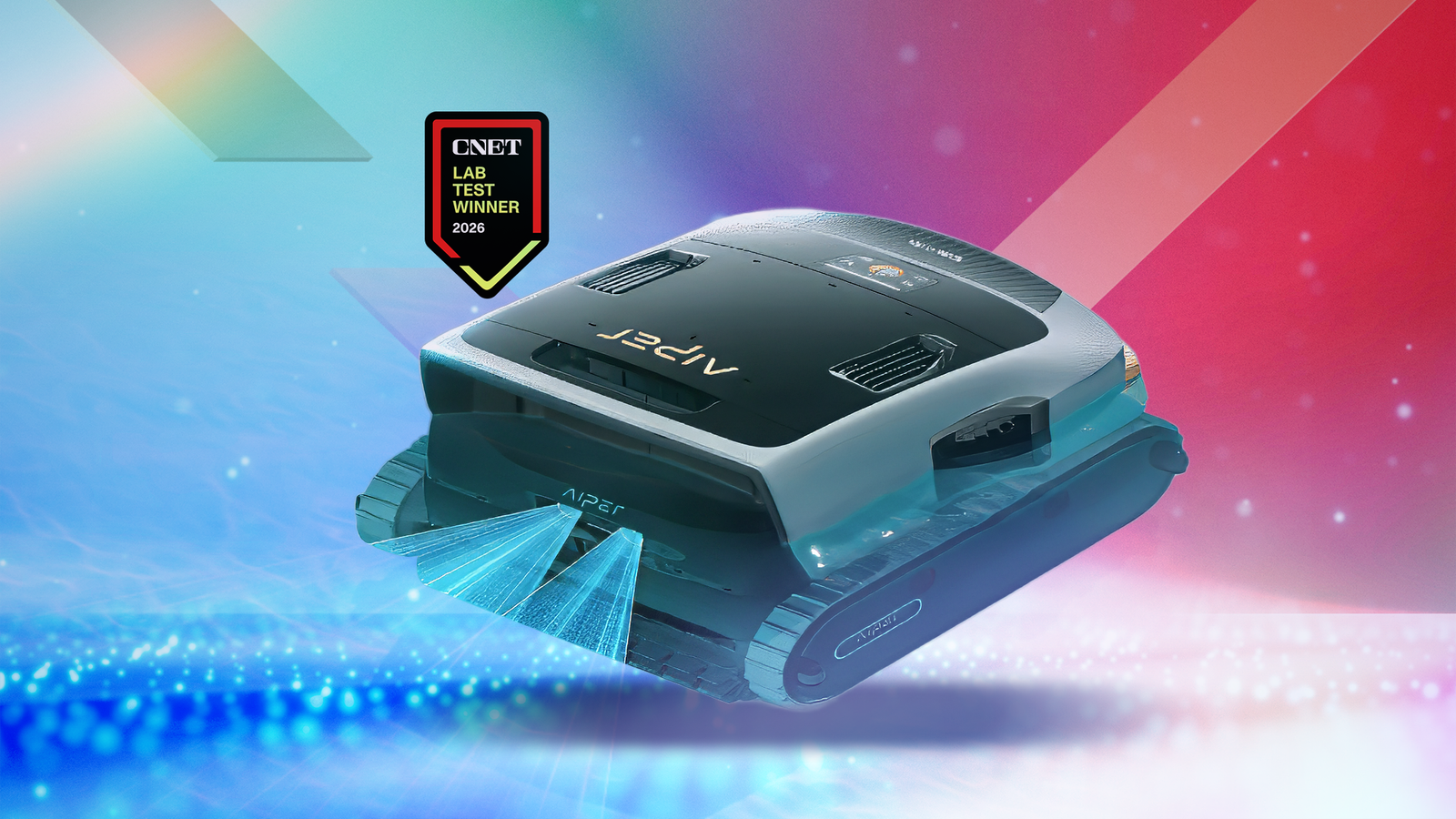
- The Aiper Scuba V3 (Lab Award winner) was the most efficient cordless robotic pool cleaner tested, picking up more debris in less time than more powerful and expensive models.

CNET Lab Awards
- Most Efficient (Corded): Dolphin Nautilus CC Plus (Efficiency Score: 58 items picked up per hour)
- Most Efficient (Cordless): Aiper Scuba V3 (Efficiency Score: 44.64 items picked up per hour)
Pure power isn’t the end-all, be-all for pool robot cleaners

When shopping for a robot pool cleaner, you might assume more suction power means better overall performance. Suction rates range anywhere from around 4,000 to 8,000 gallons per hour in robots intended for residential use.
In truth, most top pool robot cleaners have enough suction to lift the debris that’s likely to end up in your pool. Leaves, twigs and even small stones are light enough that even robot pool vacuums on the lower end of the GPH spectrum have no trouble clearing them.

The Best Robot Pool Cleaners Out of More Than 20 tested
I’ve seen plenty of robot pool cleaners with massive 8,500 GPH suction take on a pile of pebbles and leaves, with success rates similar to those of models with half that power. That got me thinking about efficiency, and so we devised a testing methodology and formula to determine the most efficient robotic pool cleaners.
How we performed the lab tests

We ran all the cordless vacuums at once with a pool full of pebbles.
David Watsky/CNETTo measure the efficiency of each robot pool cleaner, we ran it on a full charge in a 14,000-gallon test pool with 100 pebbles and 30 leaves — more debris than you’re ever likely to have in your pool — scattered about the bottom.
(We’d given each robot the repetitions it needed to map the pool using its cameras and ultrasonic sonar or acoustic sensors, if such a feature existed. Not all pool robot vacuums have it.)
We timed how long the robot operated for on a full charge. When it was finished cleaning, we counted how much debris was captured in the basket, aka how much it picked up from the floor and how much was left behind. We then prorated the pickup performance with the time the robot spent cleaning. This efficiency score indicates how many pieces of debris a robotic pool cleaner collects per hour.
Cordless robot pool cleaner efficiency winners
Many of the pool vacuums performed well, but three were in a league of their own in terms of total pickup performance, leaving fewer than 5 total objects, so we separated those from the rest. After the top three, there was a notable drop-off, and the next best model left 12 pieces of debris in the pool.
Among the three elite performers in pickup, the most efficient robot pool cleaner was the Aiper Scuba V3 with AI detection. It left just five pebbles and cleared every leaf from the pool bottom. The Scuba V3 achieved this in an astonishing 2 hours and 48 minutes – nearly 2 hours faster than the larger, more powerful robots. Its efficiency score was 44.64 items spiked up per hour.

The robot vacuum that cleared the most total debris was the Aiper Scuba X1 Pro Max. It left zero pebbles or leaves but required more than 4 hours, resulting in a lower efficiency score of 28.36 items picked up per hour. I noted that at the 3.5-hour mark of cleaning, there were still a few scattered pebbles, though it eventually picked them up.
The Beatbot Aquasense Pro, another powerful pool cleaner with a massive battery, also performed well, clearing all the leaves and leaving only three stones, but it needed 4 hours and 40 minutes to do so, giving it an efficiency score of 27.21 items picked up per hour.
The second most efficient robot pool cleaner was the Polaris Freedom. It picked up a respectable 107 items in its 2 hours and 25 minutes of cleaning, giving it a healthy efficiency score of 44.28 items picked up per hour. But because it left 23 items, including 10 leaves and 13 pebbles, it represented a noticeable dip in performance from the top of the pack.
The Aiper Scuba S1 Pro had a similar result. High efficiency, but left more total debris than we’d like to see in a top performer.
Suction power didn’t matter much, but AI smarts did

Among the cordless test group, three robot pool cleaners stood out by picking up all 30 leaves and at least 95 pebbles. We considered this a perfect or near-perfect performance. (Remember, we littered the pool with far more debris than you’re likely to have at any given time if you use your robot cleaner somewhat regularly).
Of the top three performers in total pickup, the Aiper Scuba V3 trounced the others in its efficiency rating, despite having significantly lower GPH and battery life. It picked up 125 of the 130 pieces of debris in 2 hours and 48 minutes.
What accounted for Aiper Scuba’s dominant efficiency was its ability to detect debris with cameras, sensors, and AI for targeted cleaning. It was fascinating to watch the Scuba V3 move through the pool, stop and turn toward debris when it encountered a leaf or pebble.
Other robots we tested roam the pool either based on their mapping or aimlessly like a screensaver, hoping to run over leaves, bugs and sticks rather than seeking them out.
Robots with big power and battery life deliver, but there’s a price to pay

The most expensive robot pool cleaners are typically those with the largest motors and batteries. That also makes them the heaviest, with a large lithium-ion battery accounting for most of the weight.
The two robot pool vacuums that beat the Aiper Scuba V3 in overall performance weigh 7 and 16 pounds more, respectively. When you’re pulling a cordless robot from the pool each day for charging, emptying and cleaning, that extra weight matters.
They’re also significantly more expensive, clocking in at $1,800 and $2,199, whereas the Aiper Scuba V3 retails for around $850.
Corded models: Efficiency over convenience
In general, corded models are more efficient than their cordless counterparts. Because they are fed consistent power through an electrical cord, suction never drops or wanes mid-cycle, ensuring heavy debris, sand and leaves are vacuumed. They also run endlessly, so you can trigger back-to-back cycles until your pool is clean.
On the flip side, you can’t swim while a corded robot pool cleaner is working due to the risk of electrical shock. You’ll also need an outlet nearby and manage an unsightly cord running across the deck during operation.
Because of these structural differences, we put corded robot pool cleaners in their own category but used a similar equation to calculate efficiency. Corded robot cleaners often have set runtimes ranging from two to three hours.
Of the three corded models we tested, the Dolphin Nautilus CC with Wi-Fi performed the best, clearing all leaves and all but 14 pebbles during its 2-hour run time, giving it an impressive efficiency score of 58 items picked up per hour. That’s better than the Polaris ERA could manage in its longer cycle of 2 hours and 30 minutes (45 efficiency score). The Dolphin E10 picked up only 108 of the 130 items in 2 hours of cleaning, but managed a solid 54 efficiency score.
My expert buying advice on robotic pool cleaners

We’ve tested nearly two dozen robotic pool cleaners.
David Watsky/CNETIf you’re in the market for a robotic pool cleaner, prioritize efficiency and smart debris detection over raw suction power specs, especially for an average-size pool. Our lab data shows that models like the Aiper Scuba V3, which use AI-driven navigation to target debris, deliver more efficient cleaning than more powerful robots, which are often both expensive and heavy.
If you want the fastest cleanup and an easier daily lifting experience, focus on cordless models with advanced sensors. If you have the patience to manage a cord and require continuous cleaning power, a corded model remains the most reliable, high-efficiency workhorse.
The best time to buy is during seasonal shifts or major retail holidays like Prime Day and Black Friday, when you can often find significant discounts on these premium units. Given the rapid advancement in AI-enhanced pool cleaning technology, check for sales or brand-specific promotions, as older models are frequently marked down to make way for new releases with improved navigation and sensor suites.

David Watsky
Managing Editor / Home and Kitchen
David lives in Brooklyn where he's spent more than a decade covering all things edible, including meal kit services, food subscriptions, kitchen tools and cooking tips. David earned his BA from Northeastern and has toiled in nearly every aspect of the food business, including as a line cook in Rhode Island where he once made a steak sandwich for Lamar Odom. Right now he's likely somewhere stress-testing a blender or tinkering with a toaster. Anything with sesame is his all-time favorite food this week. See full bio
Sponsorizzato
Pubblicità
Pubblicità
Pubblicità
Categorie
Leggi tutto
Israel is building a buffer zone inside Lebanon Israel is creating a large buffer zone in southern Lebanon for a prolonged military occupation, with low expectations that direct talks with Lebanon will lead to quick action on disarming Hezbollah. MARY LOUISE KELLY, HOST: Israel and Lebanon held historic talks today in Washington. They're seeking a diplomatic resolution to...

Spotify will let you edit your Taste Profile to control your recommendations At the SXSW conference on Friday, Spotify co-CEO Gustav Söderström announced a new feature, launching in beta, that will allow listeners for the first time to review and edit their Taste Profile, the algorithmically generated model of their music preferences. This Taste Profile is key to Spotify’s recommendations,...

I went to the so-called ‘steroid Olympics,’ to understand why Silicon Valley is obsessed with peptides I am sitting in the sweltering Nevada heat watching a man struggle to lift a bar over his head. If the man manages to do it, he will win $250,000. The man is Boady Santavy — a two-time Olympic weight-lifting contestant from Canada — and he has muscles that look culled from the Marvel...

Uber’s $14.8B Delivery Hero deal would nearly double its global footprint In Brief Posted: 10:12 AM PDT · July 16, 2026 Image Credits:Budrul Chukrut / SOPA Images / LightRocket / Getty Images After weeks of speculation, Uber officially agreed to acquire Delivery Hero, a purchase that will take the ride-hailing and delivery giant’s status...

Discover the Exciting World of UU88 The online gaming industry has grown rapidly over the past few years, giving players access to exciting entertainment from anywhere in the world. Among the many platforms available today, UU88 has become a well-known choice for users who value reliability, security, and an enjoyable gaming experience. Whether you are a beginner exploring online...