Osmond ChiaBusiness reporter

 Getty Images
China has cut its annual economic growth target to a range of 4.5%-5%, the lowest expansion goal since 1991 as it grapples with challenges both at home and abroad.
It is the first time the target has been lowered since it was cut to "around 5%" in 2023. A target was not set in 2020 due to the pandemic.
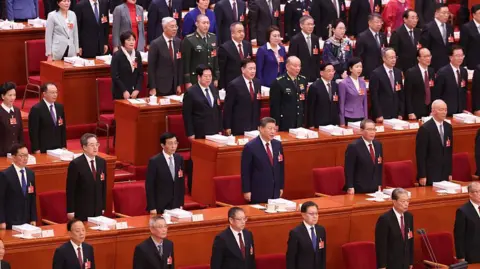
The details were released during China's biggest political gathering, known as the "two sessions", alongside the release of some details of the 15th Five Year Plan for the world's second largest economy.
Beijing aims to reshape its economy as it faces issues like weak consumption, a shrinking population, an ongoing property crisis, global trade tensions and an energy crunch due to the Iran war.
The event, which began on Wednesday and usually runs for at least a week, brings the country's leaders together for back-to-back meetings.
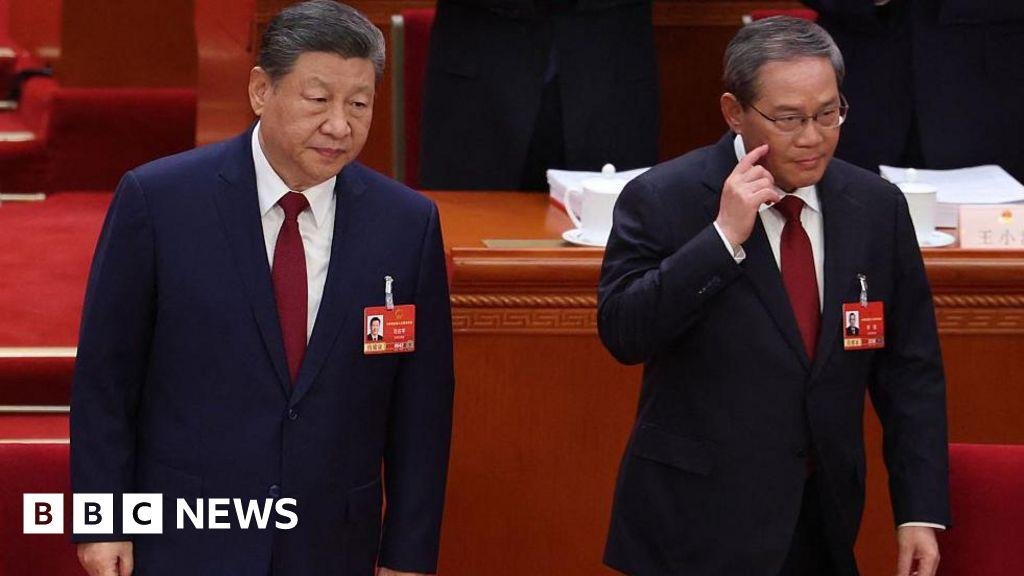
Details of China's gross domestic growth (GDP) target and its objectives under its latest Five Year Plan were included in a 46-page report published by Premier Li Qiang, seen by the BBC.
Li told delegates that the Five Year Plan will include investments in innovation, high-tech industries, scientific research and more efforts to boost household consumption.
His comments underline Beijing's concerns that weak domestic consumption makes the country too reliant on exports for growth, as well as highlighting its ambitions to upgrade the country's manufacturing industries.
The report outlines plans for more than 100 major projects over the next five years to expand China's industrial capacity, with a focus on science and technology, transportation and energy.
China aims to lead a green energy push, reducing carbon emissions and improving environmental protection, Li wrote.
The country will also build a "childbirth-friendly society" and address concerns over employment, education and healthcare, the report said.
China faces an ageing population and falling birth rates, complicating Beijing's plans to boost its economy.
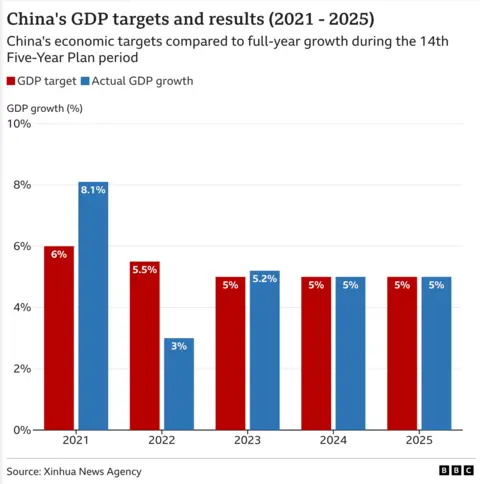
In January, official figures showed that China hit its 5% economic growth target for 2025 as a whole. But Beijing also said economic expansion had slowed to 4.5% in the last three months of the year, weighed down by weak domestic spending and a long-running property crisis.
More than two-thirds of China's provinces have scaled back their growth ambitions, either lowering the target figure or shifting language from aiming higher than a certain rate to targeting "around" that level.
While China hit its growth target last year, it should be taken with "a grain of salt", as other data suggests a weaker economic picture, said Georgetown University policy researcher Ning Leng.
Its people have been cautious about spending, while China's persistent real estate crisis have continued to weigh on its growth.
But China has become especially reliant on selling overseas to plug the gaps, which is a weakness the US can sense, Ning said.
 Getty Images
US President Donald Trump's tariffs have put further pressure on China's export-reliant economy.
China has responded by pouring huge resources to redirect trade with other countries to ensure its products can be sold, sustaining its manufacturing sector, said Ning.
The US-Israel war with Iran means Beijing has now lost two key sources of cheap oil this year.
It also can no longer access Venezuelan oil after the US seized President Nicolás Maduro in January.
But Beijing has highlighted that it is far less dependent on fossil fuels as it has for several years been transitioning to renewable energy.