How men with female surnames are standing up to ridicule in Kenya
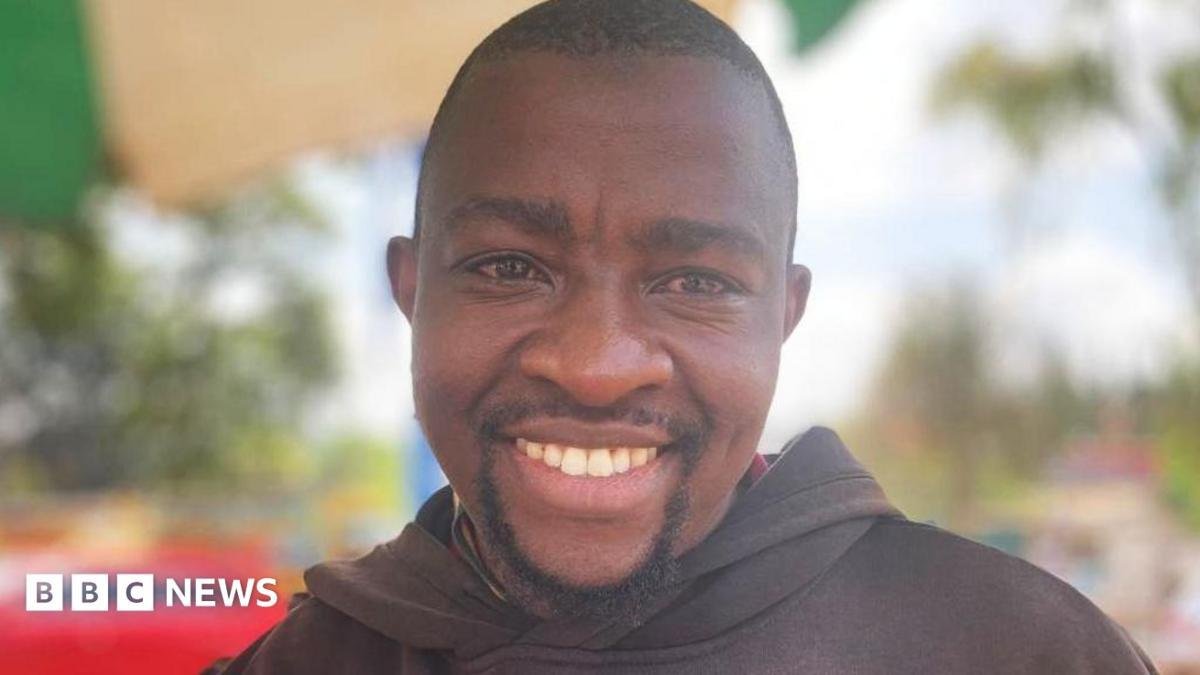
Female surnames in Kenya - the Kikuyu men standing up to ridicule
Many children in Kenya traditionally inherit their father's first name as their surname, but there are an increasing number of people who are taking their mother's instead.
This is particularly the case amongst the country's largest ethnic group, the Kikuyu - and has become a subject of debate and in some cases ridicule for the men with female surnames.
Girls and women who have their mother's names do not face the same censure - and often when they marry may opt to take their husband's first name as their surname.
Some say the growing trend of men having female surnames reflects changing attitudes to women and their influence in what is a patriarchal society; others are critical of those who have been given - or in some cases opt to take - their mother's name.
It used to be rare to see men in prominent positions with a female surname, but now there are even several politicians who have them - like MP John Njũgũna Wanjikũ.
Brought up by a single mother, he was first elected in 2021 and goes by the nickname "Ka-Wanjikũ", meaning child of Wanjikũ.
Some like Wanjikũ were given their female surname at birth, but others have chosen theirs to honour their mothers.
One of the earlier personalities to break the norm over male surnames was Peter Kĩgia, a Kenyan musician who chose his mother's name as his stage name.
Kĩgia wa Esther (son of Esther), now in his 60s, is known for playing benga - fast, rhythmic guitar folk music with lyrics in Kikuyu.
"When you take your mother's name, it means you love and respect her," he told the BBC, saying he had even registered his record company as Wa Esther Productions.
It now comes with a certain cachet in the music industry, with other younger male musicians following in his footsteps. Posters advertising performers with their mother's surname, such as Waithaka wa Jane and 90K Ka Msoh, are often plastered to hoardings in the capital, Nairobi.
Though in these cases the formal names of these artistes remain male.
Journalist Simon Macharia Wangũi told the BBC he decided to deliberately choose his mother's name as his official surname.
"Why give somebody credit where it does not exist?" he says of his father, who was absent for most of his life and about whom he has "only heard rumours of his existence".
Mostly raised by his grandmother, he was 12 when his mother died in 2003. He had no surname until his final year of high school, when he applied for a birth certificate.
Some Kenyans still think that a child raised by a single parent "lacks certain morals", explains Evans Kibe Waceke, a broadcaster who bears a female surname.
"People perceive you as undisciplined, especially when you are raised by a single mother," he tells the BBC.
A heated debate over the pros and cons of having a female surname began two years ago when prominent motivational speaker Robert Burale said it undermined men's masculinity.
This prompted TV personality Fred Mũitĩrĩri to go public about the difficulties of having a female surname - and how he ended up dropping his mother's name, deciding to use his English and Kikuyu first names only.
"Do you know how embarrassing it is for a boy to be called out, in a room full of kids, [with] a girl's name?" he wrote on Facebook - talking about his low self-esteem.
"From some of those experiences, I developed depression at the age of 23," he said.
Wairimũ Mũkũrũ, a young Kikuyu cultural expert with a large social media following, says the rise of female surnames is largely down to the fact that single-mother families have become much more common.
Still, she adds, it is a cultural anomaly as even sons of unmarried women are usually given male surnames.
"In the event that your mother doesn't tell you who your dad is or he rejects you, your mother's eldest brother takes up that role," she tells the BBC.
However, Mũkũrũ explains that there may sometimes be reluctance to do this as it gives a child the right to inherit property.
Mũgwe wa Njũhĩ, an official of the Kikuyu cultural group Kiama Kĩa Ma, agrees male relatives of single mothers may deny the use of their name to avoid inheritance disputes.
But he also argues that there should not be such disdain for female surnames given that, according to legend, the Kikuyu trace their lineage from the 10 daughters of the community's first couple - Gikũyũ and Mũmbi.
"I am Mũmbũi by clan [derived from Wambũi, one of the daughters]. We have always aligned ourselves with women, from the very beginning," he tells the BBC.
In fact, the Kikuyu are often referred to as the House of Mũmbi, after their mythological founding mother.
Wa Esther, the veteran musician, agrees that people from other communities who criticise the use of female names by Kikuyu men do not understand "our way of life".
Academic George Gathigi explains that while Kikuyu men may have traditionally identified themselves through their mothers, that was always informal, with formal adoption of female names being a new phenomenon.
When polygamy was more commonly practised, for example, children were identified by their mother's names in large groups to avoid confusion - as culturally too there is only a small pool of first names in each family.
Late Kenyan author Ngũgĩ wa Thiong'o, whose father Thiong'o wa Ndūcũ had four wives, wrote in his memoir Dreams in a Time of War that while growing up he was generally known as Ngũgĩ wa Wanjikũ – his mother's first name.
Gathigi, who lectures at the University of Nairobi and commentates on Kikuyu social issues, believes the adoption of female surnames reflects the "strength of women" in modern society, particularly in situations where men have been abandoning their responsibilities.
"Culture changes and you now have to deal with the modern realities in division of labour," he tells the BBC, noting that women have increasingly been taking up roles that had been seen as male.
He says that in such cases, when the children "don't get that advantage of being brought up by their father… the mother becomes both the mother and the father".
He sees this as a "bad thing that it is being normalised".
Such attitudes may explain the continuing backlash - one blog has described the practice of using female surnames as "a yoke around men's necks" while another says it is an effort to "womanise the Kikuyu man and make him weak".
While journalist Wangũi acknowledges it may not always be easy to have a female surname and it brings with it a certain "identity crisis", he is proud of his decision.
And he says that if you end up being successful, despite the name, "people will see you as having beaten the odds to get to where you are".
Sponsor
Sponsor
Sponsor
Sponsor
Zoekertjes
Categorieën
Read More
Today's Wordle Hints, Answer and Help for April 26, #1772Looking for the most recent Wordle answer? Click here for today's Wordle hints, as well as our daily answers and hints for The New York Times Mini Crossword, Connections, Connections: Sports Edition and Strands puzzles. Today's Wordle puzzle is a tricky one, with an unusual first letter, and then a double letter later on....

South Sudan attack in Ruweng kills at least 169 peopleAt least 169 people killed in South Sudan 'surprise' attackNichola Mandil,Juba, South Sudan ,Alfred LasteckandJean OtalorAFP via Getty ImagesThe Ruweng authorities say the attackers came before dawn on Sunday (file photo)The authorities in South Sudan have said at least 169 people, including senior officials, were killed on Sunday when a...
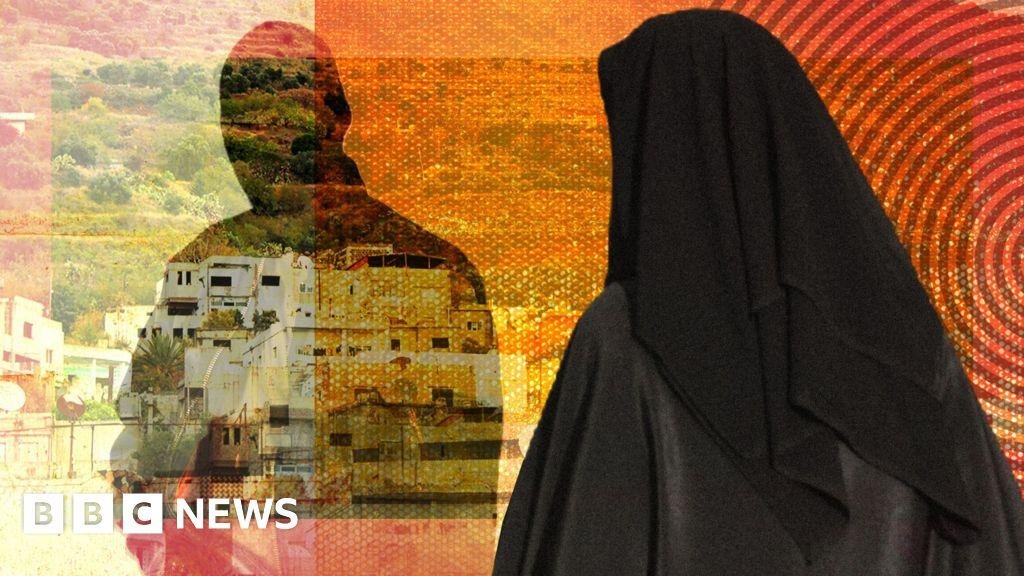
Women from Syria's Alawite minority tell of kidnap and rapeI would scream in my sleep: Women from Syria's Alawite minority tell of kidnap and rapeBBCWarning: This report contains accounts of sexual assault and violence that some readers may find distressing.Ramia was preparing for a family picnic, on a warm summer day in her village in Latakia province in western Syria, when a white car drove...
Today's NYT Mini Crossword Answers for Monday, June 29Looking for the most recent Mini Crossword answer? Click here for today's Mini Crossword hints, as well as our daily answers and hints for The New York Times Wordle, Strands, Connections and Connections: Sports Edition puzzles. Need some help with today's Mini Crossword? Read on for all the answers. And if you could use some...
War in Ukraine spills into Hungarian electionNick ThorpeBudapest correspondentReutersThe two leaders have not spared barbs for each-other recentlyWar-torn Ukraine "will stop at nothing" to prevent Prime Minister Viktor Orbán and his Fidesz party winning the upcoming Hungarian elections, the Hungarian government claims. Physical violence against the prime minister and his family, and attacks or...